
 1 month ago
56
1 month ago
56
- Long-dormant Ethereum wallets sold more than 33,000 ETH after holding their coins for nearly eight years.
- While some veteran holders took profits, other whales accumulated aggressively, highlighting a divided market.
- Ethereum remains near a critical support zone as weakening whale profitability adds pressure to the broader trend.
Ethereum is facing another wave of uncertainty after several long-dormant wallets suddenly sprang back to life. Coins that had not moved since 2017 were finally transferred and sold into an already fragile market, adding fresh supply just as ETH continues struggling near the $1,500 level.
At first glance, the move looked bearish. But the bigger picture is a little more complicated.
While some early investors chose to cash out after nearly eight years of holding, other large wallets were doing the exact opposite, rotating millions of dollars into Ethereum. That split among whales has left traders watching one question above everything else: can buyers defend support before selling pressure takes over again?
Dormant Ethereum Wallets Finally Cashed Out
Blockchain tracker Lookonchain reported that four wallets holding Ethereum since 2017 recently moved a combined 37,806 ETH after years of complete inactivity.
Those wallets originally accumulated their coins at an average cost of roughly $830 and held through multiple bull markets before selling approximately 33,623 ETH near the $1,560 level. The transactions generated an estimated $52.5 million in proceeds and roughly $27.4 million in realized profits.
The timing caught many traders’ attention.
These investors had previously watched Ethereum trade much higher without selling. Choosing to exit now, after such a significant correction, suggests that even long-term holders are reassessing their positions in the current market environment.
Other Whales Continue Buying the Dip
Not every large investor is heading for the exit.
Lookonchain also identified another whale that exchanged 464 Bitcoin, worth roughly $27.6 million, for 17,750 ETH. Instead of reducing exposure to crypto, the investor shifted capital directly from Bitcoin into Ethereum.
At the same time, investor Chun Wang continued adding to existing positions. Wang recently purchased another 9,937 ETH along with 147 wrapped Bitcoin. Over the past month alone, nearly 87,000 ETH has reportedly been withdrawn from Binance at an average purchase price around $1,749.
Large withdrawals from exchanges are often viewed as accumulation because the assets are typically being moved into long-term custody rather than prepared for immediate sale.
Meanwhile, BlackRock transferred almost 42,000 ETH and more than 4,500 Bitcoin to Coinbase Prime. Although some traders interpreted the move cautiously, transfers involving Coinbase Prime frequently relate to custody management or operational purposes and do not necessarily indicate an intention to sell.
Whale Profitability Has Turned Negative
One of the more concerning developments comes from on-chain analytics.
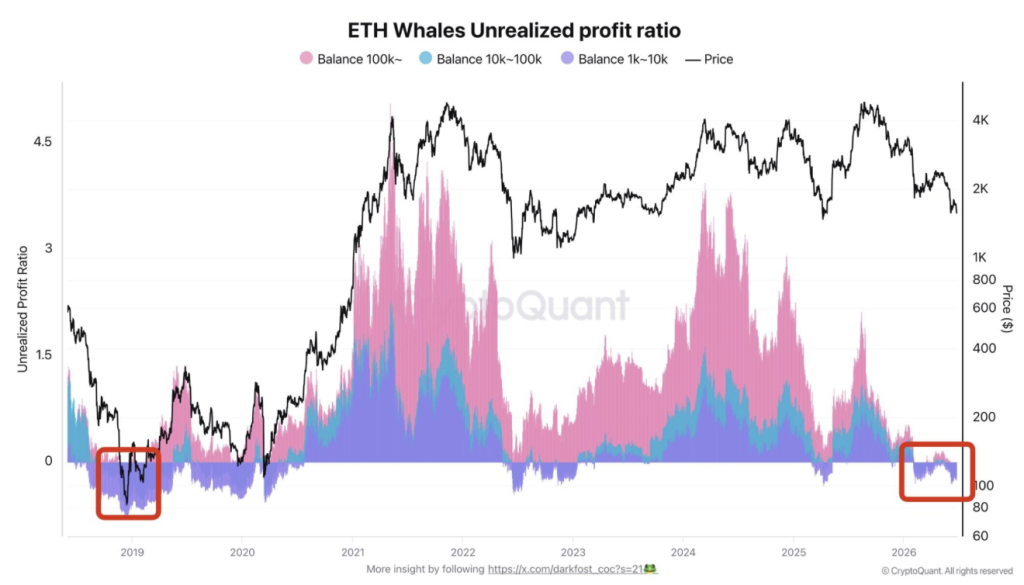
Crypto analyst Darkfost noted that major Ethereum whale groups are now sitting with negative unrealized profits for the first time since 2019. The analysis covered wallets holding anywhere from 1,000 ETH to more than 100,000 ETH.
In simple terms, many of Ethereum’s largest holders are now underwater on their positions.
That changes market psychology.
When large investors lose their profit cushion, the likelihood of defensive selling can increase, particularly if prices continue falling. It also means fresh exchange inflows deserve closer attention because more holders may be willing to reduce exposure during periods of weakness.
Ethereum Reaches a Critical Technical Level
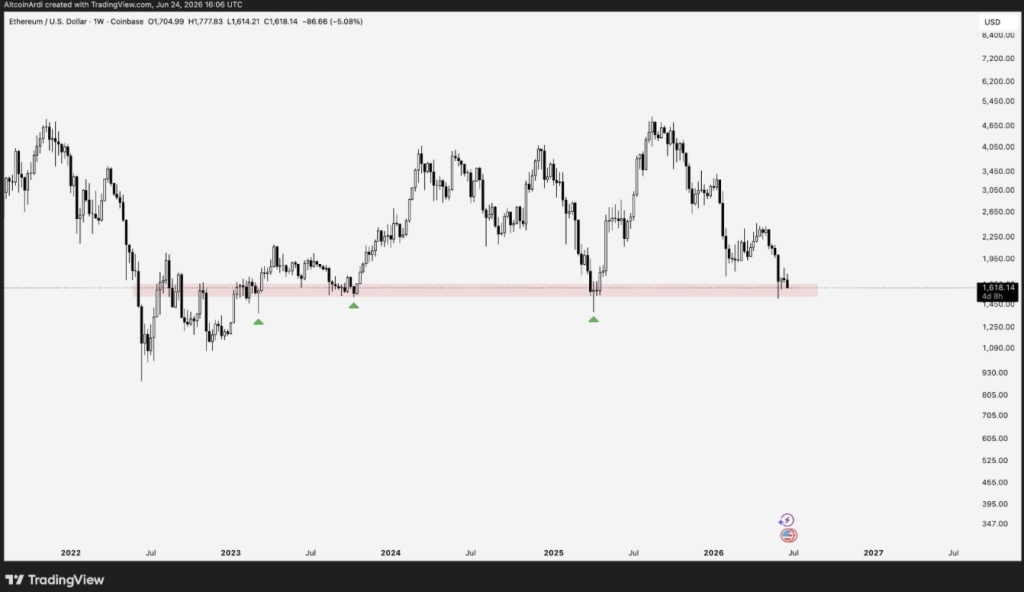
Despite the selling pressure, Ethereum has so far managed to avoid making a fresh yearly low.
ETH briefly dropped toward $1,510 during Thursday’s decline before stabilizing, while Bitcoin slipped to new lows for 2026. That relative strength has given Ethereum a small advantage, although the broader technical trend still favors sellers.
Several analysts now describe the current support zone as one of the most important areas on the chart.
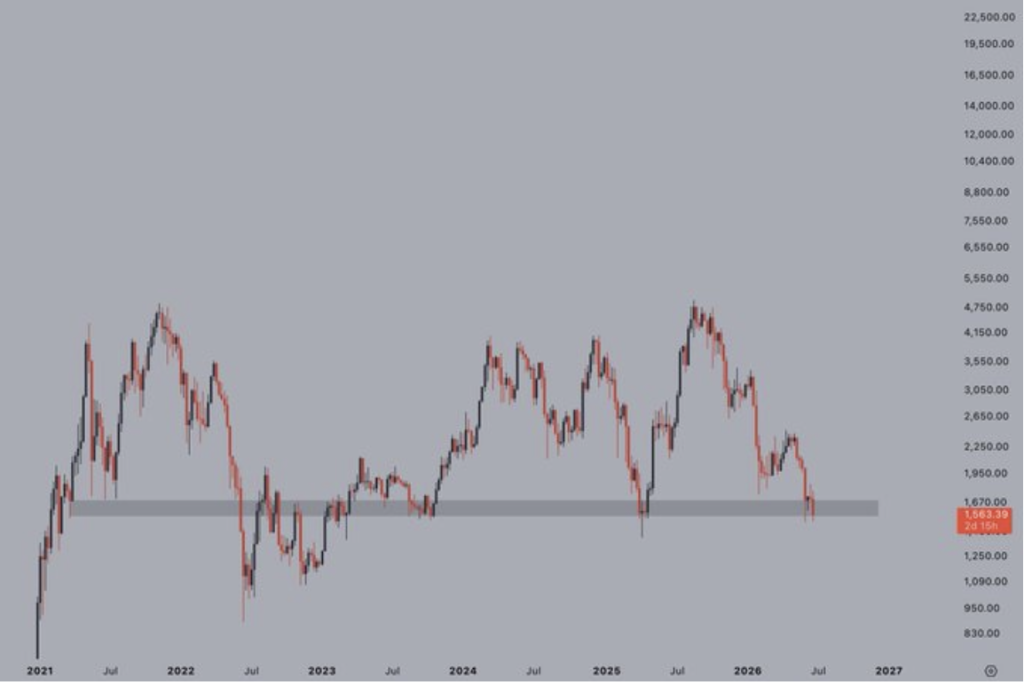
Trader Ardi believes daily closes below current levels would significantly weaken the bullish market structure that has been developing since the 2022 recovery. Another analyst, Jelle, reached a similar conclusion, warning that losing support could send Ethereum back into an older trading range that previously acted as the market’s base.
Bulls Still Have Work to Do
Not everyone believes the current support will hold.
Trader Cyclops identified the $1,070 to $1,370 region as a possible long-term accumulation zone if Ethereum continues lower. Reaching that area would also break the multi-year ascending trendline and extend the broader bearish structure.
For now, however, buyers continue absorbing much of the selling coming from dormant wallets and profit-taking whales.
The market remains finely balanced. Early investors are taking profits after nearly a decade of holding, while newer whales continue building positions. That combination has created active liquidity, but it has not removed the downside risks.
Ethereum’s next daily close may provide the clearest signal yet. Holding above long-term support would strengthen the case that accumulation is quietly taking place. Losing that level, however, could quickly shift attention toward much lower demand zones.
Disclaimer: BlockNews provides independent reporting on crypto, blockchain, and digital finance. All content is for informational purposes only and does not constitute financial advice. Readers should do their own research before making investment decisions. Some articles may use AI tools to assist in drafting, but every piece is reviewed and edited by our editorial team of experienced crypto writers and analysts before publication.








 English (US) ·