
 1 month ago
67
1 month ago
67
Key Takeaways
- Natural gas prices across Europe reached four-month peaks Friday, with TTF benchmark rising 0.4%
- Markets are experiencing their fourth consecutive weekly rally — the longest upward trend since May 2025
- Equinor cautioned that Europe will likely miss its 80% storage target ahead of winter
- Current storage capacity stands at approximately 54%, marking the second-weakest level in a decade and a half
- Military operations in Iran and Houthi disruptions are constraining LNG deliveries via the Strait of Hormuz
Wholesale natural gas prices in Europe remained elevated near four-month peaks on Friday, extending their rally into a fourth successive week.
The TTF front-month contract traded on the Dutch exchange, serving as Europe’s primary benchmark, advanced 0.4%, while Britain’s comparable futures contract climbed 0.3%. This week alone has witnessed an approximately 8% increase in gas values, with July’s cumulative surge exceeding 42%.
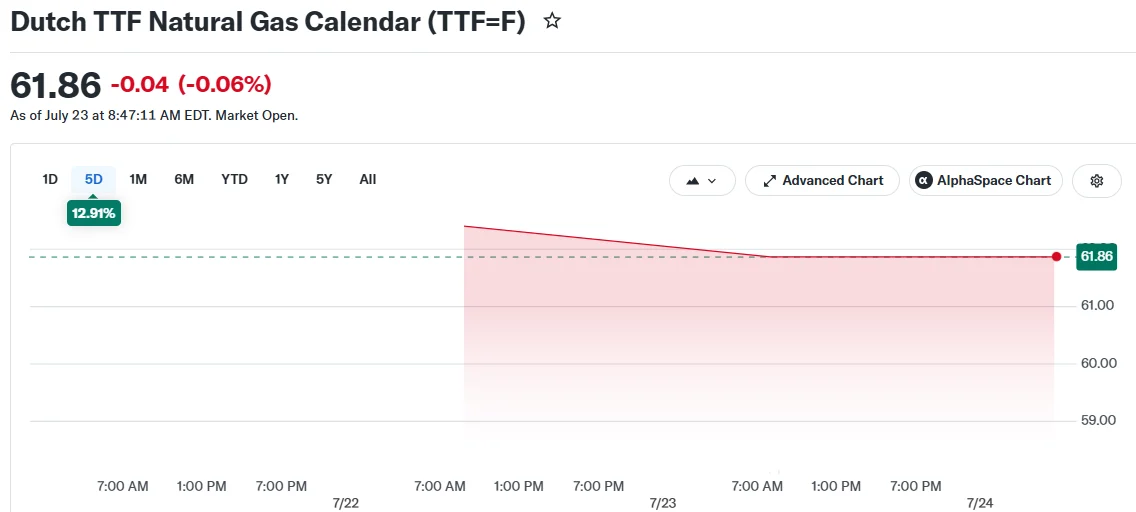
This represents the longest sustained upward momentum European gas markets have experienced since May of the previous year.
Underground Reserves Near 15-Year Bottom
Earlier this week, Equinor, the continent’s leading domestic natural gas provider, announced that storage facilities throughout Europe are currently filled to just 54% of total capacity. This figure falls short of the five-year seasonal norm and represents the second-weakest position recorded over the past fifteen years.
The energy giant’s chief executive stated that the continent is improbable to achieve its objective of replenishing underground reserves to 80% capacity prior to the commencement of the winter heating period. This benchmark exists as a buffer against potential supply disruptions during colder months.
Entering winter with depleted reserves increases market vulnerability to significant price volatility should weather conditions deteriorate.
Regional Instability Constraining International Supply
This week marked the thirteenth straight evening of American military operations targeting Iran. President Donald Trump issued warnings to Tehran and its Houthi proxies in Yemen regarding additional military responses should assaults on Red Sea maritime traffic persist.
 Insurance costs for shipping through the southern Red Sea doubled in a single day.
The jump came after Houthi forces hit at least one tanker overnight, with some companies now paying twice what they paid yesterday.
War risk premiums are the fastest signal in this whole… pic.twitter.com/w7OG07YfWT
— Mario Nawfal (@MarioNawfal) July 23, 2026
The ongoing hostilities have disrupted shipping lanes through the Strait of Hormuz, severing a segment of international LNG transportation from Persian Gulf facilities.
With reduced availability from Persian Gulf sources, Asian purchasers have been successfully outcompeting European utilities in securing available LNG shipments. This competitive dynamic is redirecting cargoes away from European regasification facilities during a critically vulnerable period.
Elevated temperatures throughout Europe have simultaneously increased electricity consumption for air conditioning, compounding the strain on natural gas availability.
Monetary Policy Expectations Under Pressure
Escalating energy expenses are contributing to intensifying inflationary pressures throughout the European region.
Financial markets are progressively incorporating scenarios where elevated utility costs could postpone anticipated interest rate reductions. Central banking authorities may need to maintain restrictive monetary policies for extended periods if energy-influenced inflation remains persistent.
The convergence of supply interruptions, insufficient storage capacity, and robust demand provides market participants with minimal indication that prices will moderate in the near term.
The TTF futures contract continues trading close to its strongest position since March, and without an imminent resolution to Middle Eastern tensions, the prospect facing European consumers approaching autumn remains precarious.
The post European Natural Gas Surges to Four-Month Peak Amid Geopolitical Tensions appeared first on Blockonomi.



 English (US) ·