
 4 months ago
77
4 months ago
77
- Quantum risk targets exposed public keys, not the Bitcoin network itself
- Most modern wallets already reduce exposure with newer address formats
- If crypto breaks, traditional finance and global systems break first
The conversation around quantum computing and Bitcoin is getting louder, and honestly, a bit messy. There’s a growing narrative that quantum machines could “break Bitcoin,” but that framing misses some important nuance. As DarkFrost points out, the real risk isn’t the network collapsing overnight, it’s far more specific than that.
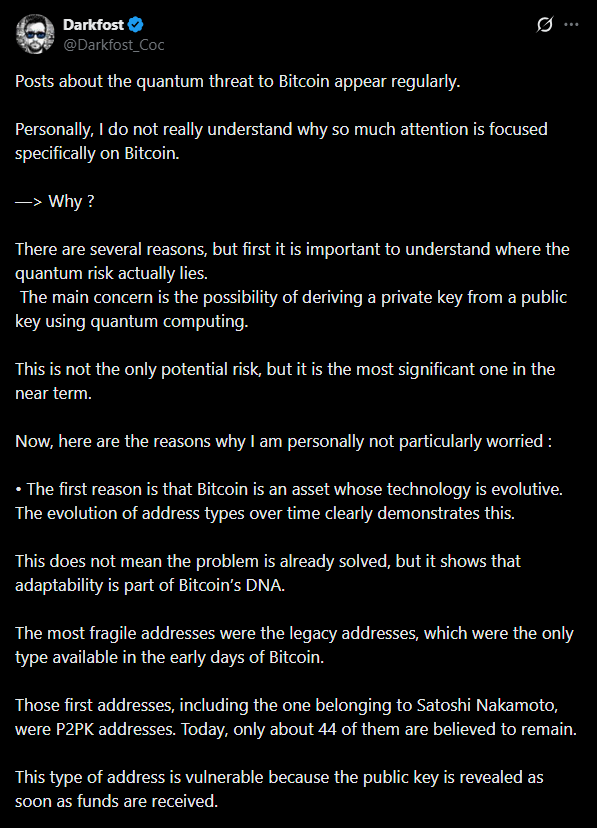
The vulnerability lies in deriving private keys from public keys. And that only becomes possible when those public keys are actually exposed. Not every wallet is equally at risk, and not every user is sitting in the same position, even if headlines make it sound that way.
The Real Risk Is Narrower Than It Sounds
The idea of Bitcoin being instantly compromised is… overstated. Quantum attacks, if they become viable, would target specific wallets where public keys are already visible on-chain. That’s a much smaller subset than people assume.
Older address formats, particularly early Bitcoin wallets, revealed public keys more openly. Those are more exposed. But that doesn’t apply evenly across the entire network.
Bitcoin Has Already Been Evolving
One thing that gets overlooked is how Bitcoin has quietly adapted over time. Newer address formats changed how public keys are handled, keeping them hidden until a transaction is made. That alone reduces the attack surface significantly.
Roughly 78% of addresses now benefit from this added layer of protection. It’s not a perfect shield, and newer upgrades like Taproot introduce different tradeoffs, but the bigger point is clear, Bitcoin isn’t frozen in time. It evolves, even if slowly.
Attacks Would Be Targeted, Not Global
Even in a future where quantum capabilities reach that level, attackers wouldn’t gain instant control over the entire network. They would need to target individual wallets, one by one.
That’s expensive, time-consuming, and likely focused only on high-value addresses. It’s not a “flip a switch and everything breaks” scenario. More likely, it would look like selective breaches rather than systemic collapse.
The Bigger Systemic Risk
There’s also a broader reality people tend to overlook. If quantum computing can break Bitcoin’s cryptography, it can break a lot more than that. Banking systems, government databases, secure communications, all rely on similar cryptographic foundations.

So Bitcoin wouldn’t be uniquely vulnerable. It would be part of a much larger problem affecting nearly every secure system in existence. And in that context, crypto isn’t necessarily the weakest link.
A Race to Adapt, Not a Sudden Collapse
This isn’t about dismissing the risk. Quantum computing is a real challenge, but it’s also a gradual one. The key variable is timing, and more importantly, adaptation.
Bitcoin has shown an ability to upgrade when needed, even if it takes time. The question isn’t whether quantum creates pressure, it’s who responds fastest when that pressure becomes real.
Perspective Matters More Than Panic
Right now, the narrative is leaning heavily toward fear. But the reality is more measured. The threat is specific, not universal. The timeline is tightening, but not immediate.
And if anything, this moment highlights something else entirely, crypto isn’t operating in isolation. It’s part of a much larger system that will need to evolve together when quantum computing finally crosses that threshold.
Disclaimer: BlockNews provides independent reporting on crypto, blockchain, and digital finance. All content is for informational purposes only and does not constitute financial advice. Readers should do their own research before making investment decisions. Some articles may use AI tools to assist in drafting, but every piece is reviewed and edited by our editorial team of experienced crypto writers and analysts before publication.








 English (US) ·