
 4 months ago
61
4 months ago
61
Within 48 hours, the United Arab Emirates (UAE) is expected to walk out on OPEC. The move ends more than half a century of cartel discipline, while at the same time detonating a power shift across global energy and crypto markets at the worst possible moment.
The decision was confirmed exclusively to BeInCrypto by senior figures inside the BRICS+ Consortium, who described it as both a strategic gamble and a quiet declaration of independence.
A Quiet Decision With Loud Consequences
Inside Abu Dhabi, the math is cold. The UAE believes it can pump more, sell more, and grow faster outside the cartel than inside it.
“The UAE has decided to leave OPEC and OPEC+ in two days. This means that the UAE will be able to independently produce more oil and control the oil market ahead of a new round of conflicts in the Middle East.”
That was Dr. Ebrahim D. Mello, Member of the Business Council at the BRICS+ Consortium (Iran-Russia Business Hub), speaking to BeInCrypto.
If the timeline holds, the move ends 50 years of coordinated Middle Eastern oil policy in less time than most cabinets take to draft a press release.
The Hidden Fight Inside the Cartel
The break did not come out of nowhere. For months, two of OPEC’s most influential producers have quietly tested the cartel’s outer limits.
“The UAE and Saudi Arabia are starting to increase production above OPEC’s annually approved quotas and are crashing oil prices,” Mello said.
He argued the cartel’s founding logic, that the United States and Saudi Arabia would jointly steer Middle Eastern oil policy, has been fraying for years.
Why the UAE Is Walking Away
According to Igbal Guliyev, Dean of the Faculty of Financial Economics at MGIMO and author of the IG Energy Telegram channel, the motive is strategic, not symbolic.
“The main motive is to avoid being bound by quotas at a time when the country believes it can produce and export more,” Guliyev told BeInCrypto.
The UAE is expanding aggressively across oil, gas, petrochemicals, and low-carbon energy. Quotas become a brake. Walking away buys speed.
Markets Brace for Sharp, Unpredictable Swings
Guliyev warned that the immediate aftermath will not be smooth.
“The market is becoming less predictable. When a large and flexible player drops out of the quota system, the balance is determined less by collective agreements than by a combination of situational factors, from geopolitics to logistics.”
The risk is amplified by rising tensions around the Strait of Hormuz, where any supply disruption can move global prices within minutes.
Indeed, President Donald Trump’s latest move, preparing to extend the US blockade against Iran in the Strait of Hormuz, has sent Brent crude oul prices past $115, levels last seen in 2022.
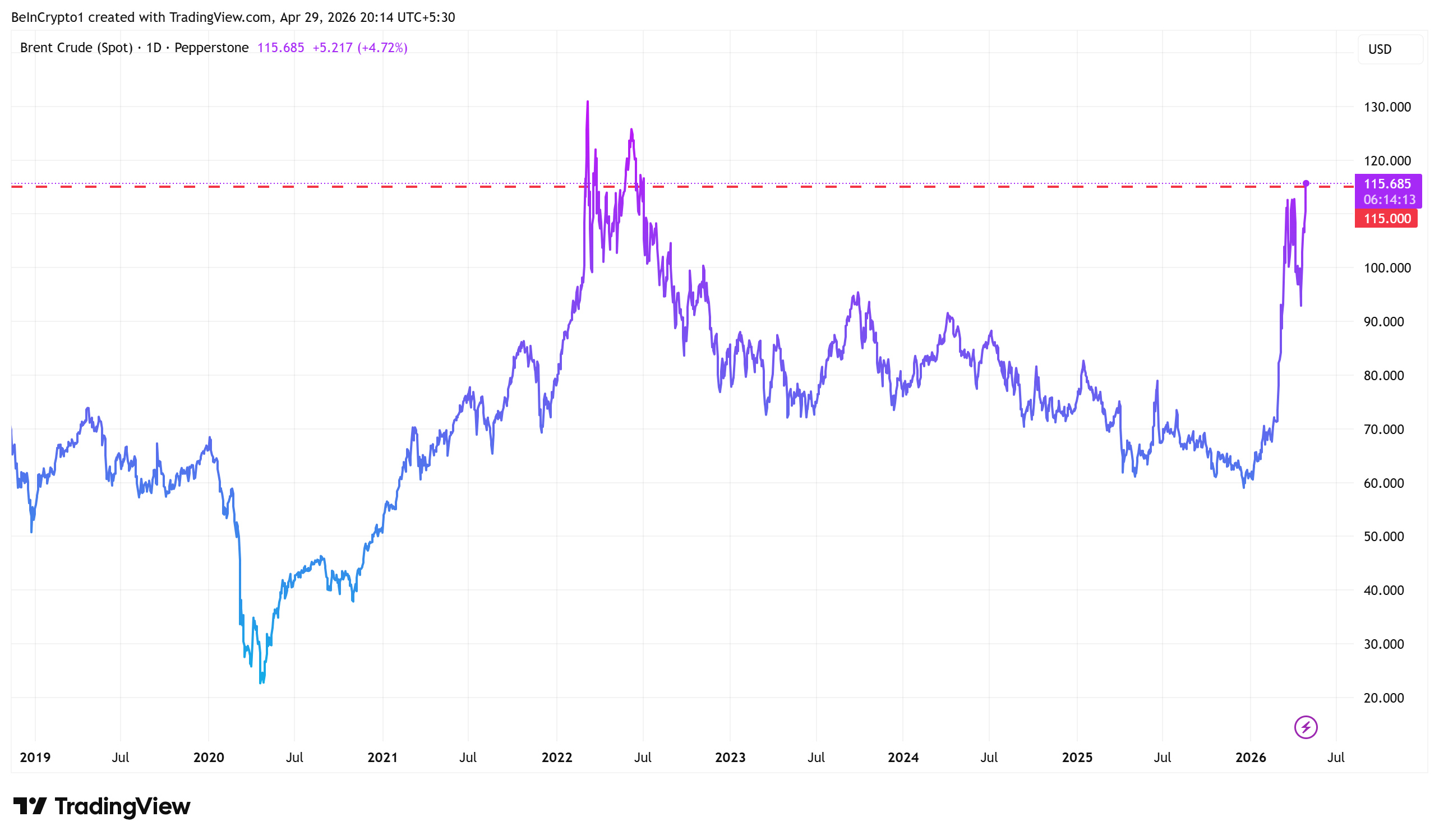 Brent Crude Oil Spot Prices. Source: TradingView
 “Trump wants a prolonged Iran embargo to squeeze out nuclear concessions. Oil’s already moving: WTI above $103, Brent at $115, as traders price in a Strait of Hormuz shutdown. Iran’s response: threats of “extraordinary military measures” if the U.S. keeps seizing their ships,” Milk Road analysts stated.
History adds a strange twist. When Saddam Hussein invaded Kuwait, Mello noted, oil prices “didn’t go up by a single dollar. It dropped by $10.”
In other words, geopolitics rarely rewards the obvious trade, as markets now bear the brunt of a $30 price hike in two weeks.
What Does This Mean For Your Crypto Portfolio?
Oil volatility does not stay in oil. It feeds directly into inflation expectations, central bank policy, and the risk appetite that drives Bitcoin (BTC) and broader crypto markets.
A controlled drop in oil prices could ease inflation pressure, indirectly supporting risk assets. Disorderly swings would inject fresh uncertainty into a market still reading Federal Reserve signals.
Lower oil eases stagflation fears. Volatile oil revives them.
May 1, the reported effective date for the UAE’s departure, is barely 48 hours away, and three questions will define the fallout.
- Will Saudi Arabia respond by tightening output or matching the move?
- Will smaller producers hold the line without OPEC’s most flexible engine? And
- Will the cartel still command pricing power once its second-largest producer is gone?
The era of predictable oil diplomacy is ending. What replaces it will be faster, less coordinated, and considerably harder to price for everyone holding risk.
Subscribe to our YouTube channel to watch leaders and journalists provide expert insights
The post Experts Dissect UAE’s Imminent Walkout That Could End 50 Years of OPEC Discipline appeared first on BeInCrypto.






 English (US) ·