
 1 hour ago
27
1 hour ago
27
Prediction markets and interest rate futures now point to a growing likelihood that the Federal Reserve will raise rates in September, reversing expectations from just weeks ago after officials struck a more hawkish tone.
Key Takeaways
- The Fed held rates at 3.50% to 3.75% on July 29 in a 9-3 vote with three dissents.
- CME Fedwatch odds for a September 16 hike rose to 61.4%, up from 50.6% a month ago.
- Kalshi and Polymarket traders price a hike near 52% to 53% ahead of the Fed’s next meeting.
The Federal Open Market Committee voted 9 to 3 to keep the target range unchanged. Fed Chair Kevin Warsh addressed the disagreement during his post-meeting press conference, making it clear the Committee wanted to reinforce its commitment to price stability rather than soften its stance.
“There is no soft inflation target, there is no soft implicit target, not on this Committee’s watch,” Warsh told reporters. The Fed Chairman added:
“There is only a target, and it is 2 percent.”
Markets Price In a September Hike
Rate expectations shifted almost immediately after the meeting, with traders across three major platforms now leaning toward a September increase. That reaction follows a familiar pattern. When the Fed delivers a hawkish hold instead of a dovish pause, markets often spend more time repricing the next meeting than reacting to the current one.
The CME Fedwatch Tool now assigns a 61.4% probability to a 25-basis-point increase, lifting the target range to 3.75% to 4.00% on Sept. 16, up from 50.6% one month ago. Expectations for a larger 50-basis-point hike disappeared entirely, falling from 25% a week earlier to 0.0%, while a rate cut carries no probability.
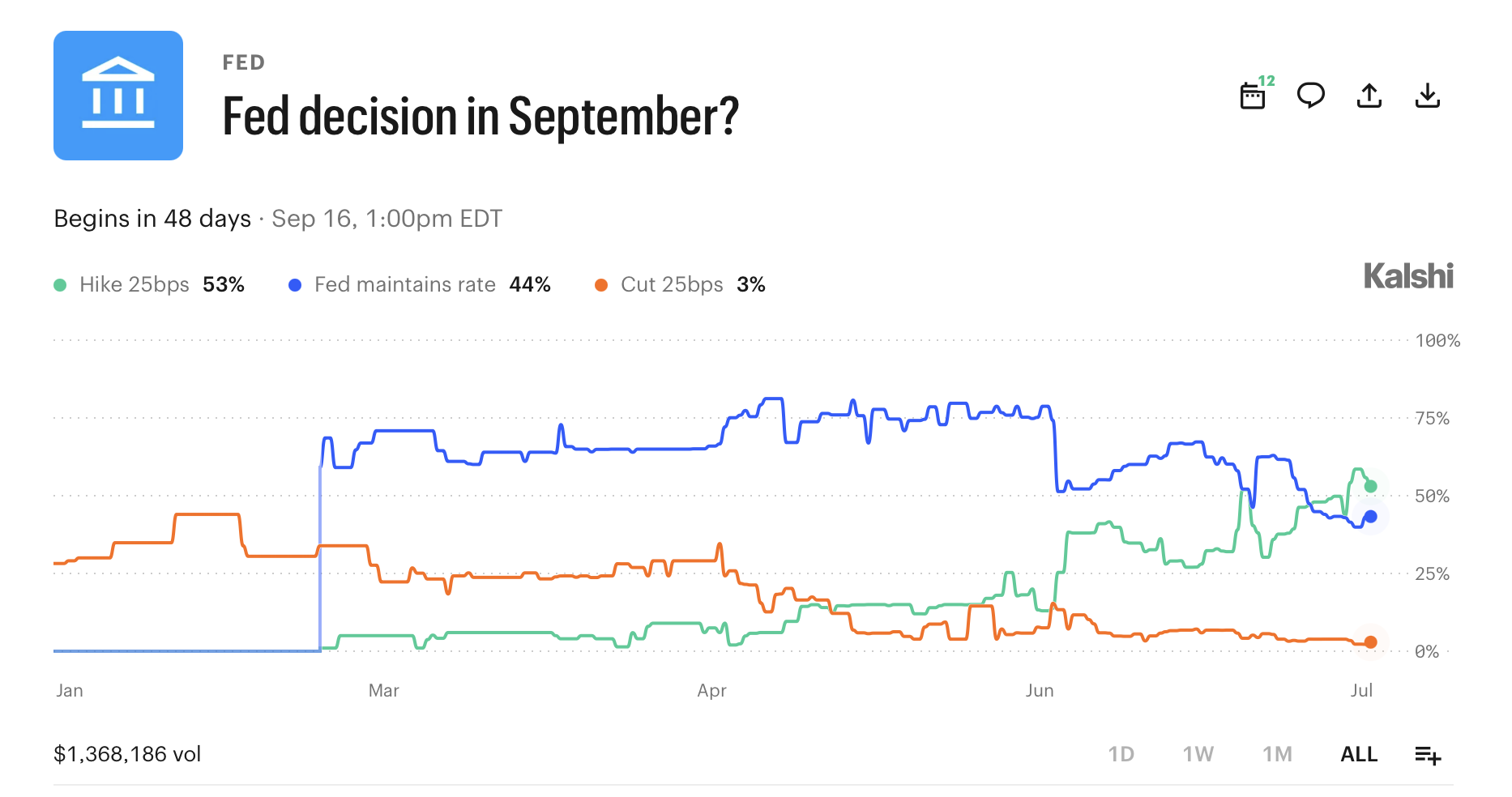 Kalshi market on the Fed interest rate decision for September recorded on July 30, 2026.
Prediction markets paint a similar picture. Kalshi traders give a 25-basis-point hike a 53% chance versus 44% for no change, with more than $1.36 million traded. On Polymarket, where more than $8 million has changed hands, betting participants price a hike at 52% compared with 46% for another hold.
Although each platform arrives there differently, all three are responding to the same signals: inflation has not cooled enough to satisfy policymakers, and Warsh’s comments left little doubt that the Committee remains focused on restoring credibility instead of preparing markets for easier policy.
Warsh Points to Treasury Yields and AI Spending
Warsh opened his remarks by highlighting two developments that stood out over the 42 days since the Committee last met.
The first was the move in Treasury yields. Sharp increases in both nominal and real yields tend to tighten financial conditions before the Fed changes rates, making them an important signal policymakers watch closely. The U.S. central bank’s Chairman described the rise as “among the most significant in the last two decades” and credited part of the move to the Fed stepping back from detailed forward guidance, telling reporters markets are “learning to play the ball, not the referee.”
The second centered on business investment. Artificial intelligence (AI)-related spending has become increasingly difficult to separate from broader capital expenditure trends because large-scale infrastructure projects ripple through manufacturing, semiconductors, energy demand, and construction simultaneously. Warsh noted investment in AI equipment and software grew nearly 20% over the past four quarters, supporting factory output while also complicating inflation because the same spending pushes up demand for high-value hardware and infrastructure.
Warsh said the Committee devoted much of the meeting to four practical questions: how five years of above-target inflation should influence today’s policy decisions, how different economic shocks affect employment and growth, whether AI-driven capital spending represents a temporary price pressure or a broader inflation risk, and how much monetary accommodation still comes from the Fed’s balance sheet beyond interest rate policy.
Stocks Rebound, Bitcoin Steadies
Markets spent Wednesday digesting the Fed’s message before reversing course the following day. That sequence is common after major policy announcements, particularly when investors initially react to the headline before reassessing the broader tone of the press conference.
Wednesday’s selloff marked the Dow’s worst single-day decline in roughly 15 months, with the index dropping about 2.2%. The S&P 500 fell around 1.5%, while the Nasdaq Composite lost roughly 1.7%. The U.S. equities market lost $1.2 trillion during Wednesday’s session.
By midday Thursday, buyers had returned. The Dow recovered about 0.6% to trade near 51,900. The S&P 500 gained roughly 1% to 1.2%, while the Nasdaq climbed between 1.5% and 2.4%, helped by Microsoft’s stronger-than-expected Azure cloud results. Meta shares lagged after weaker guidance, and elevated long-term Treasury yields, with the 30-year near multi-year highs, continued to limit broader enthusiasm.
Bitcoin traded in a comparatively narrow range throughout the session, holding above $64,000 with a slight upward bias. Price action remained orderly despite more than $20 billion in 24-hour trading volume, suggesting participants were willing to wait for additional macroeconomic data instead of aggressively positioning after the Fed meeting. That type of consolidation often follows a sharp move, especially after bitcoin pulled back from highs near $66,000 earlier in July.
What Comes Next
The Fed’s next policy decision arrives Sept. 16, giving officials roughly seven weeks of additional inflation, employment, and spending data before another vote. Historically, a divided Committee places even greater weight on incoming economic reports because they can quickly shift internal consensus.
Warsh closed by emphasizing that the Committee is moving away from predictable policy signaling and toward decisions driven more directly by incoming data and internal debate over inflation, supply-side pressures, and AI-led investment.
For investors, the gap between the Fed’s official vote and market expectations will remain the central story heading into September. If inflation remains stubborn and long-term yields stay elevated, a quarter-point increase would no longer qualify as a surprise. It would instead represent the next step in a policy path markets have already begun pricing.





 English (US) ·