
 4 months ago
46
4 months ago
46
- Samson Mow warns against rushing Bitcoin’s quantum upgrade
- Post-quantum signatures could massively reduce network throughput
- Quantum threat may still be 10–20 years away, easing urgency
There’s a growing push inside crypto to prepare Bitcoin for a quantum future, but not everyone agrees on how fast that should happen. Coinbase executives recently called for more urgent action, warning that quantum computing could eventually threaten current encryption. Samson Mow, though, is pushing back, not against the idea itself, but against the timing.
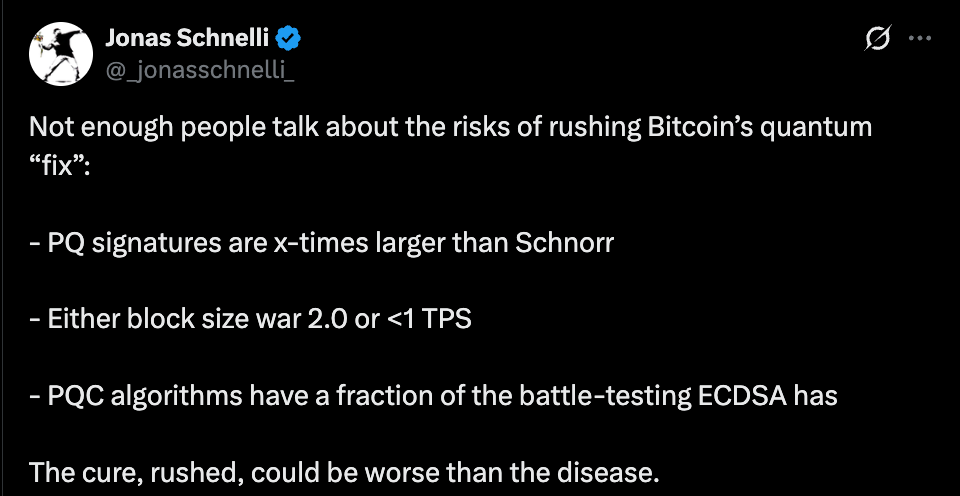
His argument is simple, and a bit uncomfortable. Moving too quickly could introduce new problems before solving the original one. In trying to protect Bitcoin from a future threat, the network might end up weakening its performance in the present.
Bigger Signatures Could Slow Bitcoin Down
The technical issue sits at the core of this debate. Post-quantum cryptographic signatures, which would replace Bitcoin’s current system, could be anywhere from 10 to 125 times larger. That’s not a small change, it’s a structural one.
Larger signatures mean fewer transactions fit into each block. And fewer transactions per block means reduced throughput, slower processing, and potentially higher fees. It’s the kind of trade-off that doesn’t just affect developers, it affects every user on the network.
A Possible Return of Bitcoin’s Old Scaling War
Mow has already compared this scenario to a potential “Blocksize Wars 2.0,” and that’s not a casual reference. The original blocksize debate from 2015 to 2017 nearly split the Bitcoin community, with disagreements over scaling turning into a prolonged and messy conflict.
Introducing larger signatures could reopen similar tensions. It wouldn’t just be a technical upgrade, it would be a philosophical one, forcing the network to choose between security, scalability, and efficiency all over again.
The Quantum Threat Might Not Be Immediate
Another key part of Mow’s stance is timing. He argues that quantum computers capable of breaking Bitcoin’s current cryptography likely don’t exist yet, and may still be 10 to 20 years away. That gives the network time to research and implement solutions carefully, rather than rushing into them.

The concern is that acting too early could leave Bitcoin exposed in a different way. A premature transition might weaken current security or performance without actually solving the long-term problem.
Crypto Faces a Trade-Off Between Present and Future
This debate highlights a deeper tension within crypto. How do you prepare for future risks without damaging what already works today? It’s not an easy balance, and Bitcoin, given its size and importance, feels those trade-offs more than most.
Mow’s position doesn’t dismiss quantum risk, it reframes it. The real danger might not be ignoring the problem, but trying to solve it too quickly.
Bitcoin’s Next Big Debate May Already Be Starting
Whether the industry leans toward urgency or caution, one thing is clear. The conversation around quantum security is no longer theoretical, it’s starting to shape real decisions.
And if history is any guide, when Bitcoin faces decisions like this, they rarely stay quiet for long.
Disclaimer: BlockNews provides independent reporting on crypto, blockchain, and digital finance. All content is for informational purposes only and does not constitute financial advice. Readers should do their own research before making investment decisions. Some articles may use AI tools to assist in drafting, but every piece is reviewed and edited by our editorial team of experienced crypto writers and analysts before publication.







 English (US) ·