
 2 months ago
73
2 months ago
73
TLDR
- Bullion is experiencing its steepest weekly decline in over a month, dropping more than 3%
- Escalating military confrontations between Washington and Tehran are driving crude oil prices significantly higher
- Federal Reserve policymakers maintain that borrowing costs will remain elevated, pressuring non-yielding assets
- Brent crude is poised for approximately 12% weekly gains amid Strait of Hormuz shipping disruptions
- Chart analysts identify support near $4,000 with possible rally toward $4,500 during the third quarter
Bullion prices experienced a modest uptick Friday morning despite being positioned for a challenging week. Spot gold advanced 0.5% to approximately $3,997 per ounce, with futures contracts rising just above the $4,000 threshold. However, this minor Friday recovery cannot offset the precious metal’s weekly decline exceeding 3%.
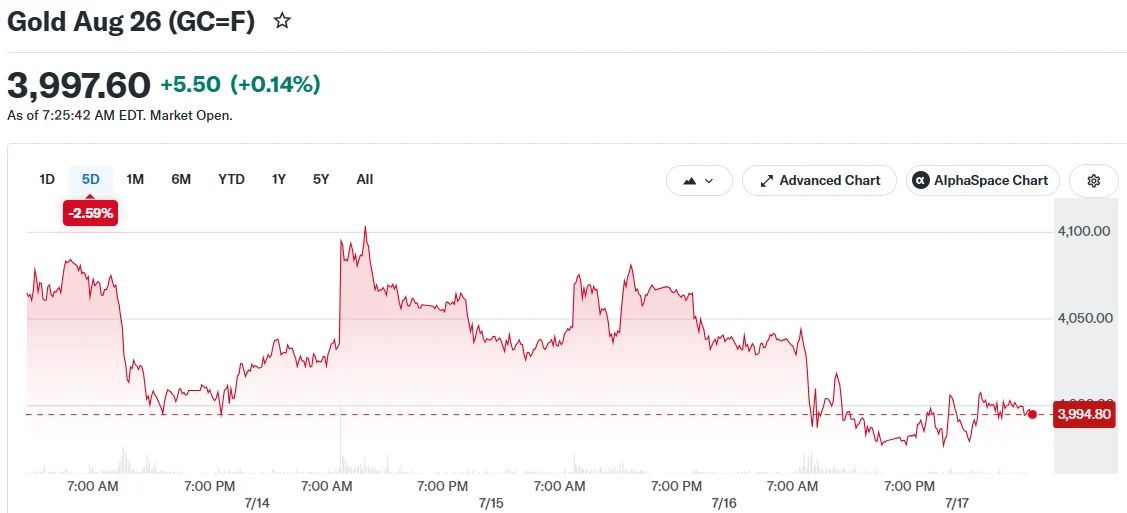 Gold Aug 26 (GC=F)
The weakness arrives amid dramatically intensifying hostilities across the Middle East. U.S. armed forces executed their sixth straight evening of military operations targeting Iranian installations. Tehran retaliated with renewed aerial assaults against American positions throughout the region.
Iranian state media outlets claimed that recent American military operations struck non-military targets, including five bridge structures and one railway facility.
Crude Oil Rallies as Hormuz Shipping Grinds to a Halt
The military confrontation has plunged the Strait of Hormuz back into instability. Vessel movement through this critical maritime corridor has been interrupted once more, dashing expectations of normalized shipping operations following a temporary cessation of hostilities.
Brent crude futures are tracking toward weekly increases exceeding 12% because of these developments. Elevated energy costs amplify inflation worries, which subsequently influences investor expectations regarding monetary policy.
Central bank officials have explicitly stated their reluctance to reduce interest rates. Chair Kevin Warsh, Governor Christopher Waller, and New York Fed President John Williams all cited persistent inflationary pressures as justification for maintaining current borrowing costs.
Central Bank Maintains Hawkish Position, Greenback Gains Ground
Neil Welsh, Head of Metals at Britannia Global Markets, observed that despite June’s inflation figures arriving below forecasts, hawkish Federal Reserve rhetoric indicates borrowing costs will remain elevated to combat ongoing price pressures.
A firmer U.S. dollar has simultaneously pressured the yellow metal. Dollar strength makes gold more costly for international buyers using alternative currencies, potentially dampening global demand.
Gold generates no yield or interest payments. During periods of sustained elevated rates, market participants frequently gravitate toward income-producing investments.
Notwithstanding recent weakness, certain market observers identify encouraging signals. Technical analysis reveals the precious metal has established support around the $4,000 threshold, potentially forming a double bottom formation.
Positive momentum readings suggest selling intensity may be diminishing. The RSI indicator registered a higher low during June and July even while prices established lower lows, indicating weakening bearish momentum.
One technical strategist projects $4,500 gold by third quarter conclusion, representing roughly 11% appreciation from present levels.
The precious metal has retreated approximately 30% from its January peak of $5,626.80. However, strategists emphasize the extended-term upward trajectory remains undisturbed, characterizing the secular bull market as experiencing a constructive consolidation rather than a trend reversal.
Trading volume throughout the selloff has stayed comparatively subdued, implying institutional participants have not been aggressively liquidating positions.
The post Gold Faces Steepest Weekly Decline in Six Weeks Amid Middle East Turmoil appeared first on Blockonomi.






 English (US) ·