
 3 months ago
85
3 months ago
85
Key Takeaways
- Gold climbed 0.2% Friday to approximately $4,220 per ounce yet remains poised for its second consecutive weekly decline
- Diplomatic sources indicate a potential U.S.-Iran agreement could unlock the Strait of Hormuz and remove petroleum sanctions
- Brent crude tumbled more than 4% following Trump’s announcement of imminent peace terms
- The European Central Bank implemented its first rate increase in almost three years, responding to conflict-fueled inflation
- UBS revised its Federal Reserve rate cut timeline to 2027, dampening gold investment appeal
Precious metals markets saw gold stabilize Friday, though the yellow metal remains on course for another weekly downturn as market participants monitor developments surrounding potential diplomatic resolutions between Washington and Tehran.
Spot gold advanced 0.3% to approximately $4,224 per ounce during London market hours. While Friday’s session brought modest gains, the precious metal has shed over 2% this week and is tracking toward its second consecutive weekly decline.
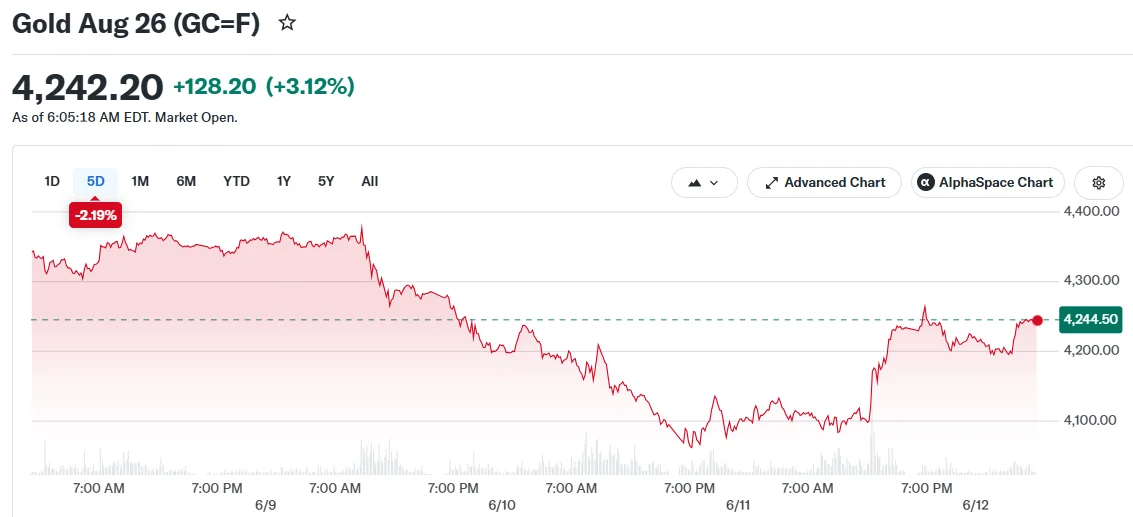 Gold Aug 26 (GC=F)
According to statements from Iran’s semi-official Mehr news agency, Washington and Tehran are working through a comprehensive 14-point framework. The proposed terms allegedly encompass reopening maritime routes through the Strait of Hormuz, unfreezing $24 billion in Iranian financial holdings, and establishing a 60-day period to advance nuclear negotiations.
During Thursday remarks, President Trump indicated that Iran’s supreme leader had consented to peace terms potentially ready for weekend signing. He characterized the framework as “a very strong memorandum of understanding that is a little bit conceptual.”
Iranian foreign ministry officials countered these claims, stating the nation “has not yet reached a conclusion on this matter.” The proposed agreement requires additional examination and authorization from Tehran’s leadership.
Crude Prices Retreat on Diplomatic Progress
Brent crude plunged over 4% to $86.47 per barrel. Prices fell beneath $90 per barrel Thursday after the president’s diplomatic remarks. Earlier this year, petroleum markets surged when the ongoing conflict, now entering its fourth month, disrupted shipping lanes through the Strait of Hormuz.
The military confrontation has intensified worldwide inflation concerns. Declining petroleum costs could alleviate some economic strain, although Brent continues trading substantially above pre-conflict benchmarks.
The European Central Bank executed a rate increase this week, marking its first such move in nearly three years. ECB President Christine Lagarde cautioned that conflict-related inflation pressures are expanding beyond energy sectors.
Precious Metals Face Headwinds
Financial markets have grown skeptical regarding diplomatic breakthrough announcements. Ole Hansen, head of commodity strategy at Saxo Bank, noted that investors have witnessed over 30 comparable statements in recent months.
“Forget what Trump says and focus instead on what the Iranians do,” Hansen said.
Gold currently trades approximately 20% beneath pre-war levels from late February. The metal recently breached its 200-day moving average, a significant technical benchmark, triggering additional selling momentum earlier this week.
Julius Baer reduced its 3-to-12-month gold price projection from $4,500 to $4,250 per ounce. UBS analysts now anticipate Federal Reserve rate reductions will be postponed until 2027, diminishing projected gold ETF demand throughout 2026.
The Chicago Mercantile Exchange revealed plans to introduce continuous 24-hour, seven-day trading for its 1-ounce gold futures contract beginning July 26, addressing increasing demand for non-stop market participation.
Silver declined 0.5% to $66.97 per ounce, while platinum and palladium registered gains.
The post Gold Posts Second Weekly Drop Amid U.S.-Iran Diplomatic Breakthrough Rumors appeared first on Blockonomi.




 English (US) ·