
 5 months ago
693
5 months ago
693
Key Takeaways
- Goldman Sachs reaffirms its year-end 2026 gold price target of $5,400 per troy ounce
- Gold experienced a 13–15% decline this month, marking its worst monthly performance since 2009
- Middle East tensions and inflationary pressures have driven rate cut expectations out of the market
- Goldman expects central bank gold purchases to accelerate and provide price support
- A bear case scenario places gold at $3,800 under worsening geopolitical conditions
Goldman Sachs continues to stand behind its bold prediction that gold will climb to $5,400 per troy ounce before 2026 ends. This projection was reaffirmed in a research note released Monday, March 31, 2026.
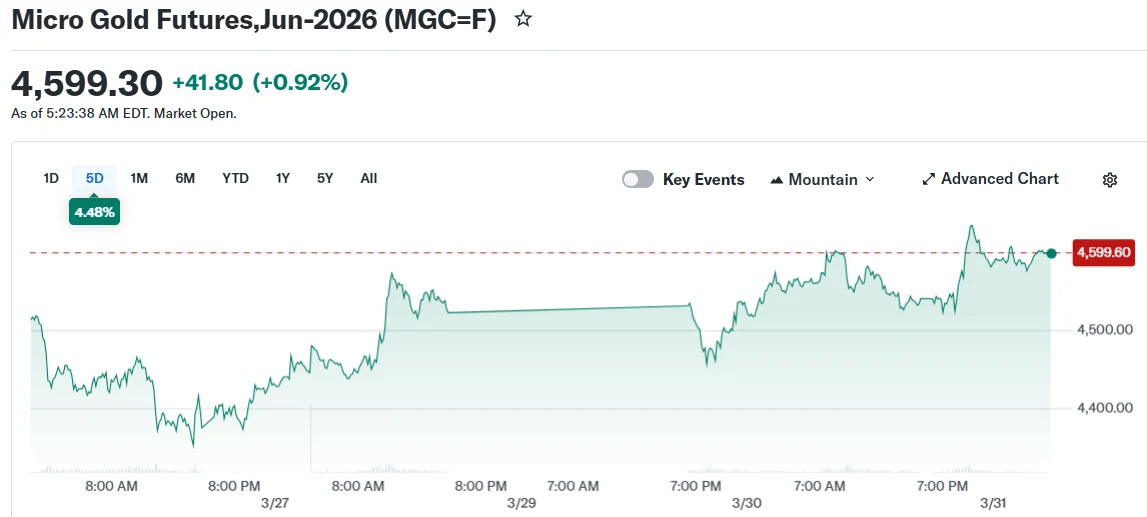 Micro Gold Futures,Jun-2026 (MGC=F)
March has proven catastrophic for gold investors. The precious metal has tumbled approximately 13% during the month, hovering around $4,500 on Tuesday. This represents gold’s most severe monthly decline in nearly two decades. The metal reached an all-time peak near $5,500 on January 29 before entering its current downward spiral.
Escalating hostilities in the Middle East have triggered the sharp selloff. The ongoing conflict has created significant disruptions to global energy markets and sparked concerns about persistent inflation, prompting traders to abandon expectations for Federal Reserve interest rate reductions in 2026.
According to Goldman strategists Lina Thomas and Daan Struyven, gold’s fundamental fair value currently stands at approximately $4,550, reflecting today’s macroeconomic landscape and assuming existing policy hedges stay intact.
The research team pushes back against claims that gold has lost its safe-haven appeal. They note that gold’s performance varies significantly based on inflation’s underlying causes. Supply-shock-driven inflation, such as the current scenario, typically benefits broader commodity markets. Gold tends to shine brightest when inflation anxieties stem from questions about central bank commitment and credibility.
“Similar to 2022, gold generally lags during the initial phase of supply shock events,” the strategists explained. Rising bond yields increase the carrying cost of non-yielding assets like gold, while equity market turmoil can trigger forced selling due to margin requirements.
The Foundation Behind Goldman’s Bullish Outlook
Goldman’s ambitious $5,400 projection relies on three core pillars. The first involves a normalization of speculative trader positions in Comex gold futures, which the firm values at roughly $195 per troy ounce.
The second pillar centers on Goldman’s economic team still forecasting two Federal Reserve rate reductions during 2026, which would theoretically contribute approximately $120 per ounce to gold prices.
The third and most substantial factor is an anticipated resurgence in official sector gold acquisitions, returning to approximately 60 tonnes monthly. Goldman calculates this variable alone could deliver $535 per troy ounce in upward price momentum.
Speculative net positioning on Comex has dropped to the 39th percentile. Goldman characterizes the current market setup as “cleaner” and representing a “more compelling entry opportunity.”
Potential Downside Scenarios
Goldman acknowledges meaningful downside possibilities. An extended closure of the Strait of Hormuz, coupled with additional equity market deterioration, could drive gold down to $3,800 in a worst-case projection.
The investment bank discounted speculation about Persian Gulf central banks liquidating gold holdings. These nations maintain smaller gold allocations relative to their reserves compared to Turkey, which recently offloaded roughly 52 tonnes. Given their dollar-pegged currency frameworks, these countries would more likely sell U.S. Treasuries than gold to manage monetary policy.
Looking beyond the baseline scenario, Goldman identifies upside potential exceeding $5,400. Geopolitical disruptions and mounting concerns regarding Western government debt sustainability could propel gold to $5,700, or potentially $6,100 if institutional hedging demand intensifies.
The conflict involving Iran has now entered its second month without signs of de-escalation. President Trump has issued warnings that the United States would strike Iranian energy facilities if the critical Strait of Hormuz shipping channel remains obstructed.
The post Goldman Sachs Doubles Down on Gold Despite Historic 17-Year Monthly Crash appeared first on Blockonomi.




 English (US) ·