
 1 hour ago
19
1 hour ago
19
Grayscale Investments said several leading revenue-generating crypto protocols are trading at relatively low valuation multiples. The firm added that a potential CLARITY Act vote in the coming weeks could support growth in on-chain finance and tokenized assets.
Key Takeaways
- Grayscale said many revenue-producing crypto protocols are trading at low multiples relative to their trailing revenue.
- Financial applications dominate the highest-revenue protocols.
- The crypto asset manager said the CLARITY Act could support tokenized assets and on-chain finance.
Revenue Rankings Highlight Low Valuation Multiples Ahead of CLARITY Act
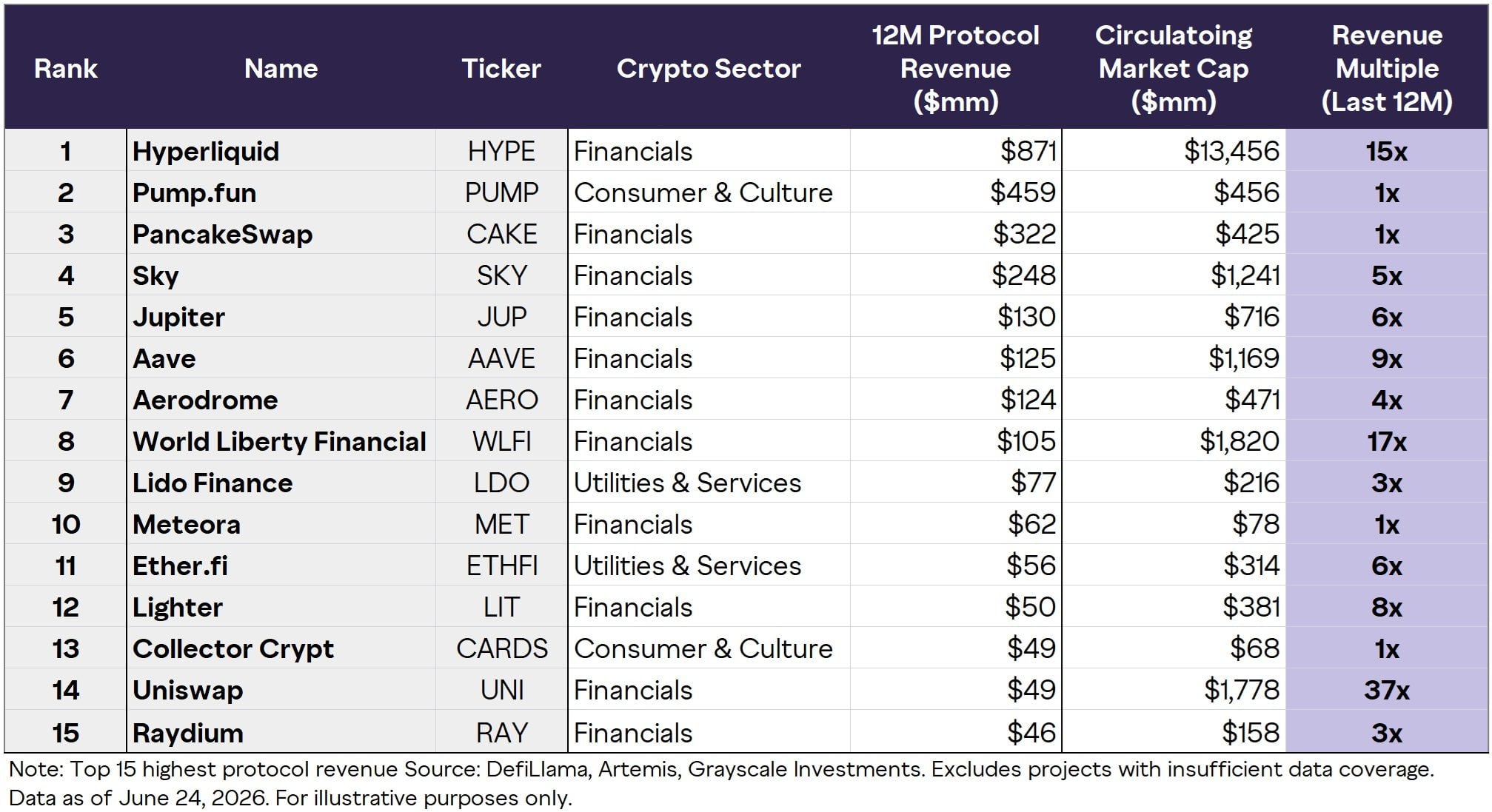
Grayscale Investments said many revenue-generating crypto protocols are trading at low valuation multiples as the CLARITY Act awaits possible Senate floor action. In a June 24 research note, the firm analyzed the 15 largest onchain applications by protocol revenue using data from DeFiLlama, Artemis, and Grayscale Investments research.
The firm’s head of research, Zach Pandl, wrote:
“We believe they stand to benefit substantially from the expected growth in on-chain transaction activity that is expected to follow the passage of the CLARITY Act.”
Hyperliquid led with $871 million in trailing 12-month revenue, a $13.46 billion market cap, and a 15x multiple. Pump.fun followed with $459 million in revenue and a $456 million market cap, near 1x, while PancakeSwap generated $322 million and also traded around 1x.
Sky reported $248 million in revenue at a 5x multiple, Jupiter $130 million at 6x, Aave $125 million at 9x, and Aerodrome $124 million at 4x. World Liberty Financial posted $105 million at a 17x multiple. Lido Finance generated $77 million at 3x, and Meteora $62 million at roughly 1x.
Financial Applications Account for Most of the Highest-Revenue Protocols
Grayscale linked these valuations to the potential passage of the CLARITY Act, which could introduce a regulatory framework similar to traditional finance and support growth in tokenized assets and onchain activity.
Financial applications accounted for 11 of the 15 protocols listed, including Hyperliquid, PancakeSwap, Sky, Jupiter, Aave, Aerodrome, World Liberty Financial, Meteora, Lighter, Uniswap, and Raydium. The remaining entries included consumer platforms and infrastructure providers.
Grayscale stated:
“Many revenue-producing crypto assets are trading at low multiples ahead of potential passage of the CLARITY Act, creating an attractive entry point for fundamental investors, in our view.”
Uniswap had the highest multiple at 37x with $49 million in revenue and a $1.78 billion market cap. Raydium generated $46 million at a 3x multiple, while Collector Crypt traded at 1x with $49 million in revenue. Chainlink was excluded due to mixed onchain and offchain revenue. All figures reflect June 24, 2026.
CLARITY Act Could Reshape Crypto Market Structure
The CLARITY Act has advanced to the Senate after passing the House and was moved toward Senate floor consideration. Its path to a vote remains uncertain due to limited legislative time and unresolved policy differences.
The Senate Banking Committee approved its version on May 14 with a 15–9 vote, adding provisions such as SEC disclosure certification for ancillary digital assets and regulatory requirements for crypto ATMs.
Grayscale’s head of research stated:
“We believe that the potential passage of the CLARITY Act—which could happen as soon as next month—may help unlock this value.”
“Why? Because the law, if passed, could be a boon for many of these applications by bringing a traditional finance rulebook to crypto assets,” he added.
Lawmakers must reconcile differences between the Senate Banking Committee version, the Senate Agriculture Committee’s framework, and the House bill passed in July 2025. Lobbying from financial institutions, law enforcement groups, and industry advocates continues as the bill moves forward.







 English (US) ·