
 4 months ago
52
4 months ago
52
- Hedera is being labeled “quantum resistant” based on documented cryptographic standards
- Its DAG architecture and hashgraph consensus improve scalability and resilience
- The network’s ability to upgrade cryptography without hard forks strengthens its long-term security outlook
Crypto researcher SMQKE recently stirred up discussion on X, suggesting that Hedera could be considered “quantum resistant.” Now, that’s a big statement — the kind that usually gets picked apart quickly — but in this case, the claim leans heavily on Hedera’s own published documentation rather than speculation.
The post didn’t just throw out buzzwords either. It pointed directly to technical materials outlining how the network is built, particularly its cryptographic approach and ability to adapt over time. That detail matters, because in crypto, claims without documentation tend to fall apart pretty fast.
A Different Kind of Architecture Under the Hood
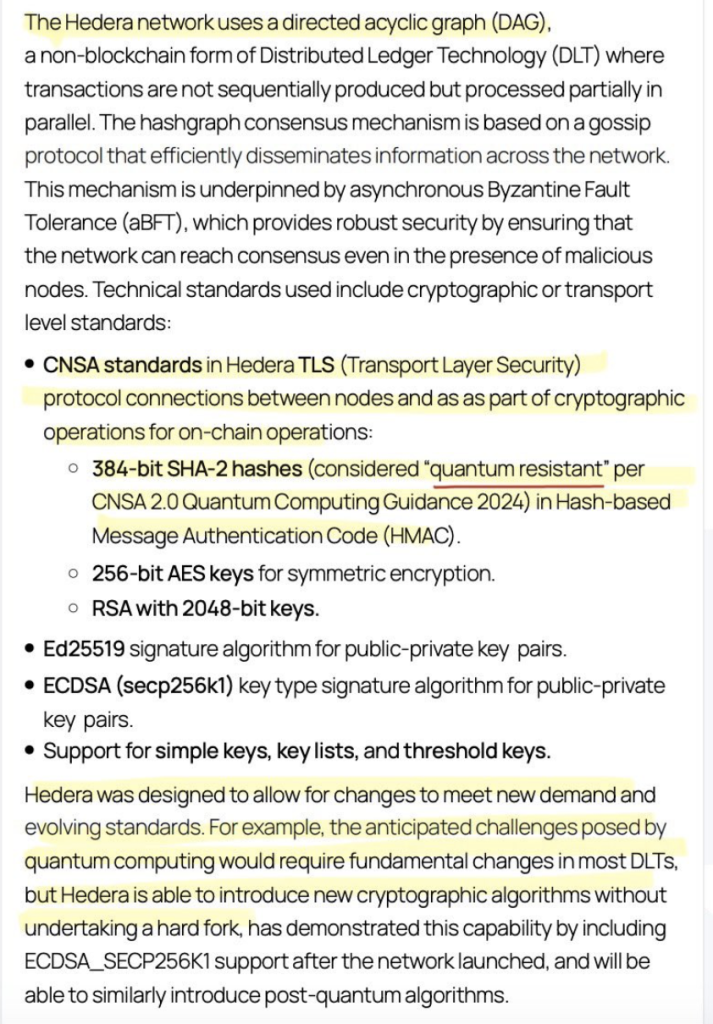
One of the more interesting pieces here is Hedera’s structure itself. Instead of using a traditional blockchain, it runs on a directed acyclic graph, or DAG. That means transactions aren’t processed one after another in a strict sequence — they can happen in parallel, which changes how the system scales and behaves under load.
On top of that, Hedera uses something called hashgraph consensus, powered by a gossip protocol. It’s a bit of an odd name, sure, but the idea is simple enough — information spreads quickly across nodes, helping the network reach agreement efficiently. Combined with asynchronous Byzantine Fault Tolerance, the system can still function even if some participants act maliciously, which adds another layer of resilience.

Cryptography and the Quantum Angle
Where things get more technical, and arguably more important, is in the cryptographic layer. The materials referenced in SMQKE’s post highlight Hedera’s use of CNSA-aligned standards, particularly in how nodes communicate and secure data.
For example, the network uses 384-bit SHA-2 hashing in HMAC constructions, which, under current CNSA 2.0 guidance, is considered resistant to quantum-level threats — at least for now. It also incorporates 256-bit AES encryption and RSA keys with 2048-bit strength, alongside modern signature schemes like Ed25519 and ECDSA.
Individually, these aren’t groundbreaking, but together, they form a fairly robust framework. It’s less about one single feature and more about how all these pieces stack up to create a system that’s, well, harder to break.
Built to Adapt, Not Just Survive
Another point that stands out — and maybe gets overlooked — is Hedera’s flexibility. According to the documentation, the network was designed to evolve without requiring disruptive upgrades like hard forks. That’s a big deal, especially when talking about something as unpredictable as quantum computing.
The system can integrate new cryptographic standards as they emerge, which means it doesn’t have to rely solely on today’s defenses. There’s even precedent for this — Hedera added ECDSA support after launch, showing that upgrades can happen without breaking the network.
So while calling it “quantum resistant” might still feel a bit early to some, the argument isn’t coming out of nowhere. It’s grounded in how the network is built, and maybe more importantly, how it can change when it needs to.
Disclaimer: BlockNews provides independent reporting on crypto, blockchain, and digital finance. All content is for informational purposes only and does not constitute financial advice. Readers should do their own research before making investment decisions. Some articles may use AI tools to assist in drafting, but every piece is reviewed and edited by our editorial team of experienced crypto writers and analysts before publication.








 English (US) ·