
 1 month ago
50
1 month ago
50
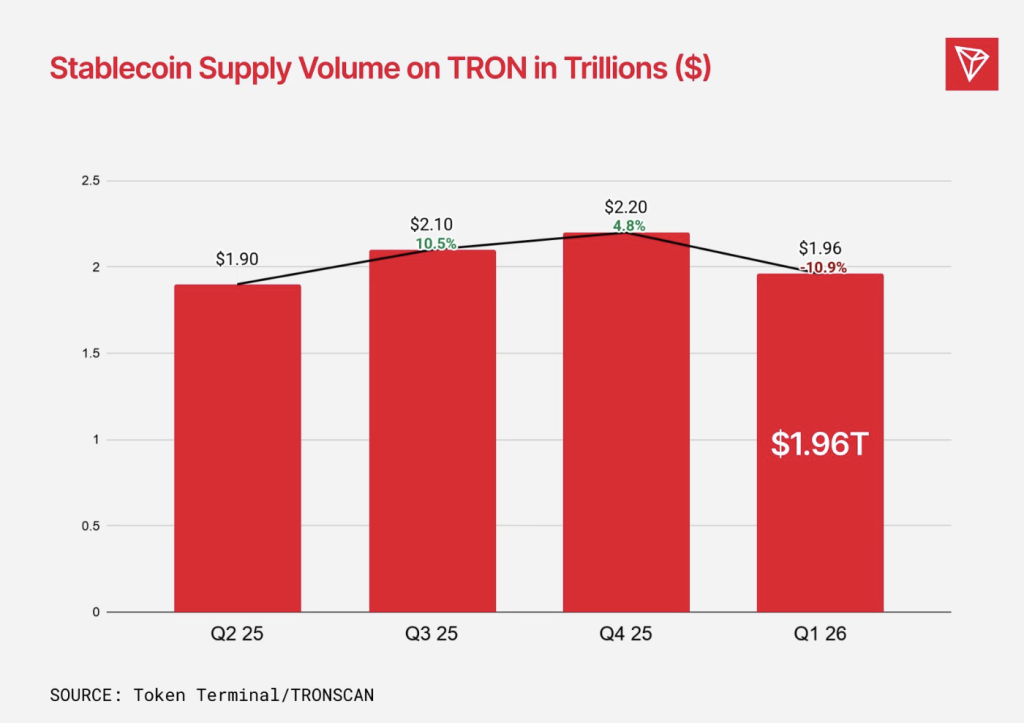
- TRON processed $1.96 trillion in stablecoin settlements during Q1 2026, reinforcing its position as one of the world’s largest blockchain payment networks.
- The network now holds roughly $85-86 billion in USDT, driven by growing demand for fast, low-cost cross-border payments.
- While payment activity continues to surge, slower new-user growth and limited DeFi adoption remain key challenges for long-term expansion.
TRON’s recent growth tells a bigger story than just rising transaction numbers. The network is quietly becoming one of the most important blockchains for moving digital dollars across the globe, fueled by low fees, near-instant settlement, and massive Tether (USDT) liquidity.
Instead of competing primarily through complex decentralized finance applications, TRON has carved out a niche as the go-to network for remittances, peer-to-peer transfers, and cross-border payments. For many users, affordability and speed matter far more than advanced DeFi features.
According to TRONSCAN, that strategy is paying off. The blockchain processed an impressive $1.96 trillion in stablecoin settlements during the first quarter of 2026 while hosting approximately $85 billion to $86 billion worth of USDT. Much of this activity comes from recurring payments and everyday transfers rather than speculative trading.
If payment flows continue growing and USDT issuance expands further, TRON could strengthen its position as the leading blockchain for stablecoin settlements. Still, growing competition from newer, faster networks means maintaining that advantage won’t be automatic.
User Activity Continues to Grow
The surge in stablecoin usage has translated into stronger network activity.
Daily active users climbed roughly 16% over the past 30 days to around 4.4 million, comfortably above the first-quarter average of 3.2 million. That increase suggests existing users are becoming increasingly active as payment volumes continue rising.
However, not every metric is moving higher.
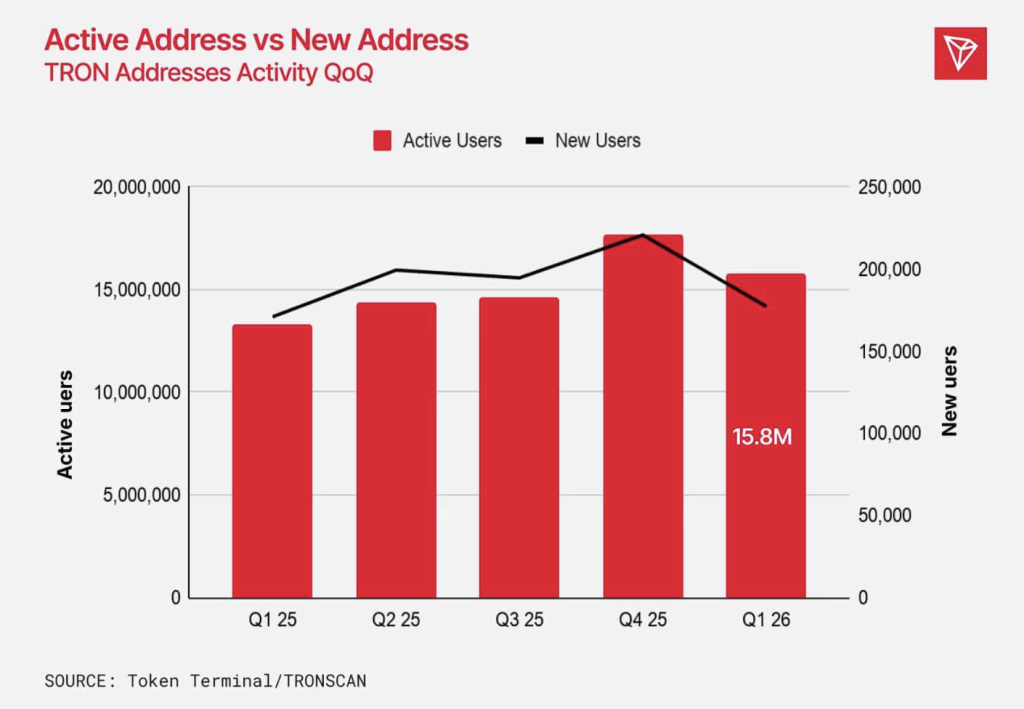
Quarterly data shows active addresses slipped to 15.8 million from their Q4 2025 peak, while new wallet creation also slowed. In other words, TRON is seeing fewer new users joining the ecosystem, even as existing users generate more transactions through stablecoin payments.
That dynamic can support strong network activity in the short term, but sustained long-term growth will likely require a healthier pace of new-user adoption alongside continued payment demand.
Stablecoin Liquidity Continues Supporting the Network
TRON’s payment-focused model is also helping retain capital on-chain.
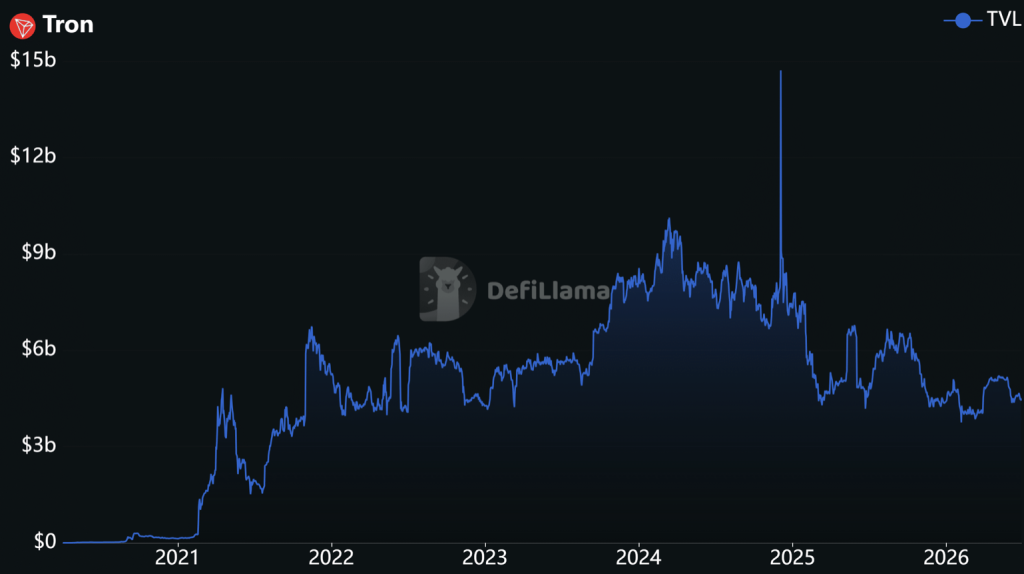
According to DeFiLlama, the network’s total value locked (TVL) has climbed to roughly $4.4 billion, with stablecoins making up a significant share of that liquidity. Rather than leaving the blockchain immediately after settlement, much of the capital continues circulating through additional transfers, helping support transaction volume and network revenue.
This efficiency also contributes to recurring TRX token burns and validator rewards without significantly increasing costs for users, creating a sustainable cycle that benefits the network.
Even so, TRON’s strength in payments has not yet translated into broader DeFi adoption. Lending protocols, decentralized exchanges, and smart contract activity remain relatively small contributors compared to stablecoin transfers.
If more of the liquidity already on TRON gradually expands into those sectors, the blockchain could develop a more balanced ecosystem. Otherwise, it may continue dominating stablecoin payments while relying less on growth from decentralized finance.
Disclaimer: BlockNews provides independent reporting on crypto, blockchain, and digital finance. All content is for informational purposes only and does not constitute financial advice. Readers should do their own research before making investment decisions. Some articles may use AI tools to assist in drafting, but every piece is reviewed and edited by our editorial team of experienced crypto writers and analysts before publication.







 English (US) ·