
 5 months ago
81
5 months ago
81
TLDR:
- Brent crude consolidating at $100.66 places 30% of global oil supply under critical logistical risk at the Strait of Hormuz.
- Institutions moved $11.574 billion in Bitcoin through OTC desks, locking supply as a strategic reserve amid cost-push inflation fears.
- Bitcoin’s $65K–$70K structural support zone holds a 65% survival probability, contingent on no global credit market capitulation.
- A systemic stress scenario tied to April 6th liquidity risk could push Bitcoin toward a corrective low of $54,000 per coin.
The ghost of 1973 is back, and oil at $100 is forcing a reckoning across global markets. Brent crude has consolidated at $100.66 per barrel as the Strait of Hormuz faces active geopolitical tension.
Roughly 30% of the world’s oil supply now sits under critical logistical risk. Bitcoin, priced at $66,339.88 after a 3.45% weekly decline, is caught in the crossfire.
On-chain data tracked by GugaOnChain reveals $12.3351 billion in institutional movement reshaping how the market absorbs this pressure.
Oil’s 1973 Echo Puts Bitcoin’s Neutral Infrastructure Under the Spotlight
The 1973 oil crisis repriced nearly every asset class as supply disruptions spread across global economies. Today’s energy shock carries a structurally similar fingerprint, with physical logistics facing blockade-level risk at a critical shipping corridor. Unlike oil, Bitcoin moves without ships, pipelines, or territorial dependencies.
GugaOnChain described Bitcoin as a liquidity rail that operates outside physical blockades entirely. This framing positions the asset differently from commodities that rely on geographic infrastructure to settle and clear. When oil freezes at a chokepoint, Bitcoin settlement continues at the same pace.
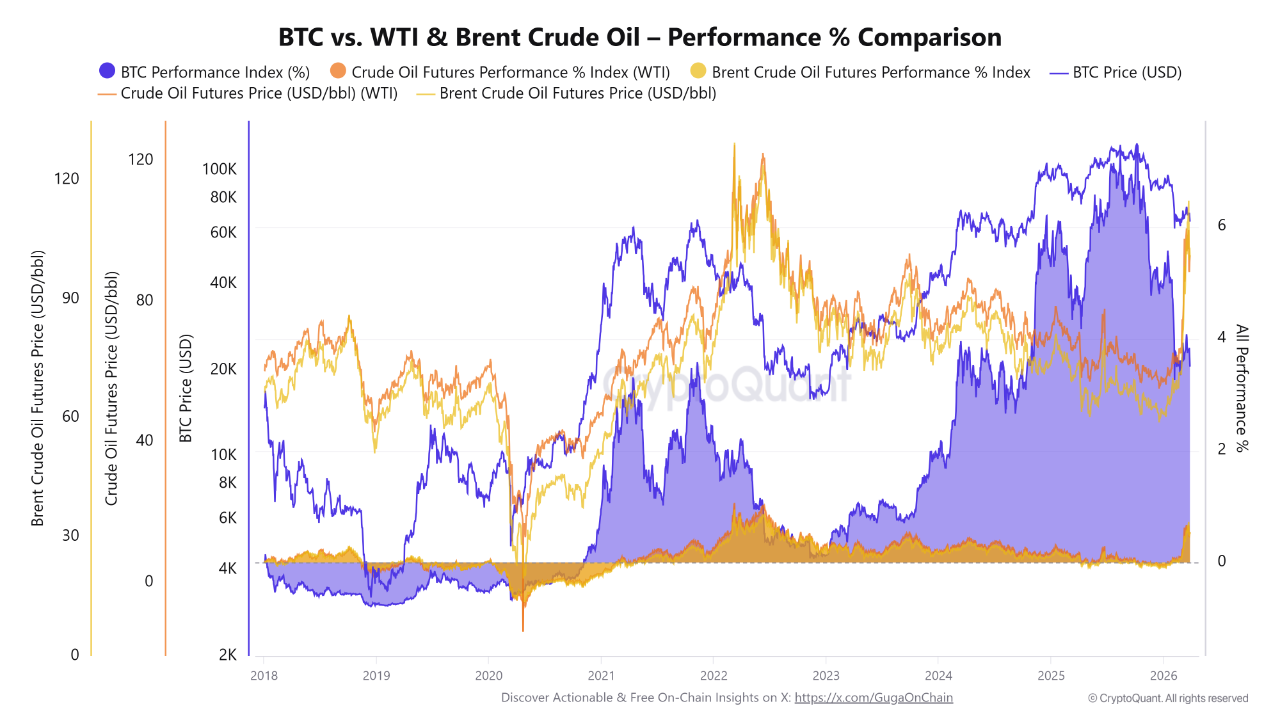
Source: Crptoquant
That distinction becomes relevant as cost-push inflation pressures mount from rising energy prices. Institutions appear to be responding to this dynamic through heavy over-the-counter accumulation.
Of the $12.3351 billion tracked on-chain, 93.83%—approximately $11.574 billion—flowed through OTC desks away from public exchanges.
This volume signals a deliberate strategy to lock Bitcoin as a strategic reserve during the current macro disruption. Smart money is absorbing mobile supply during the panic rather than exiting.
The 1973 parallel holds here too — those who held hard assets through the energy crisis largely preserved purchasing power.
Bitcoin’s $65K–$70K Support Zone Faces a Systemic Stress Test
The $65,000–$70,000 range now serves as a structural support zone anchored by Bitcoin’s realized price. GugaOnChain estimates a 65% probability that this zone holds through the current volatility cycle. That probability, however, depends on global credit markets avoiding a full capitulation event.
The probability of a broader liquidity crunch in traditional markets currently sits between 45% and 50%. Such an event would trigger margin calls across leveraged positions, forcing temporary liquidations even where demand remains fundamentally strong. The shallow exchange order book raises the risk of moves exceeding 8% to above 70% on any geopolitical trigger.
GugaOnChain flagged April 6th as a concentrated risk window, calling it a global liquidity solvency test. A systemic stress scenario during this period could drive a corrective move toward $54,000. Derivative hedges are recommended as active protection around this specific date for exposed portfolios.
The overall asymmetry remains neutral-to-positive given the supply lock-up through OTC channels. Forced scarcity from institutional accumulation creates a structural floor even as downside scenarios remain on the table.
Bitcoin’s trial by fire, much like 1973, will ultimately determine whether the asset earns its place as a credible reserve in an energy-disrupted world.
The post How a $100 Oil Shock Is Putting Bitcoin’s Digital Gold Status to the Test appeared first on Blockonomi.






 English (US) ·