
 1 month ago
83
1 month ago
83
- Analysts believe Bitcoin could remain under pressure until late 2026 before a broader recovery begins.
- ETF outflows, institutional selling, and macroeconomic uncertainty have extended the current downturn.
- While some experts still see Bitcoin reaching $100,000, others warn another drop below $50,000 remains possible.
Bitcoin investors continue asking the same question: How long will the current downturn last? While no one can predict the market with certainty, many analysts believe Bitcoin may remain in a consolidation or bearish phase through much of 2026 before a more sustained recovery begins.
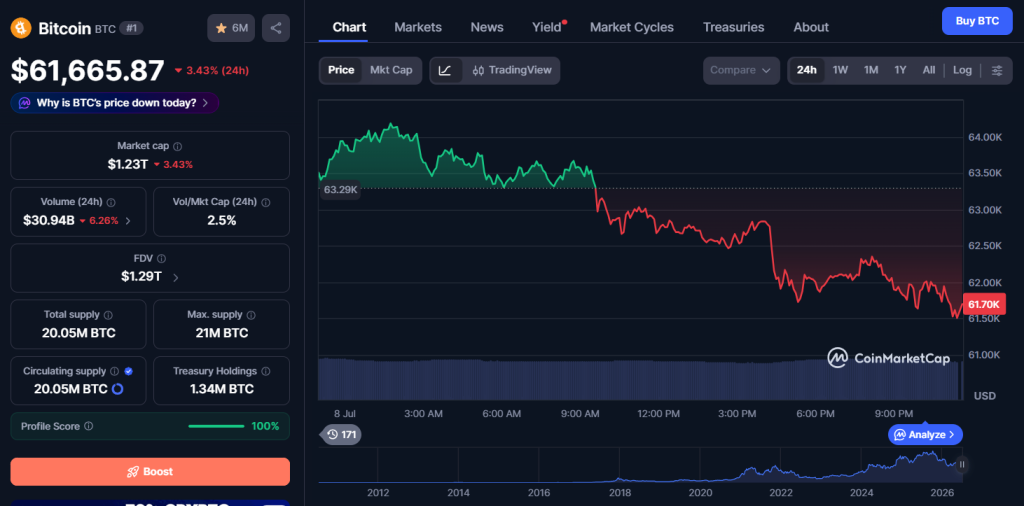
At the time of writing, Bitcoin is trading roughly 53% below its all-time high of $126,272 reached in October 2025. The current crypto winter has lasted longer than many investors expected, forcing traders to reassess when the next major bull market could finally begin.
What Triggered Bitcoin’s Decline?
Bitcoin’s correction was driven by several factors rather than a single event. A broad selloff in AI and semiconductor stocks during late June reduced investor appetite for risk assets, and Bitcoin was among the first markets to experience heavy selling.
Another blow came when Strategy disclosed one of its first Bitcoin sales in years. Although the transaction represented only a small portion of the company’s holdings, the announcement weighed heavily on market sentiment. Standard Chartered’s Geoffrey Kendrick described the timing of the sale as unfortunate, noting that it added pressure during an already fragile market environment.
Institutional flows also turned sharply negative. U.S. spot Bitcoin ETFs recorded approximately $4.5 billion in net outflows during June, marking the largest monthly withdrawal on record. Those redemptions created additional selling pressure that extended Bitcoin’s decline.
What the Technical Indicators Suggest
Several on-chain and technical indicators suggest Bitcoin may be approaching historically attractive valuation levels. Analysts continue monitoring the MVRV Z-Score, which has moved into a range that has previously coincided with long-term market bottoms.
Bitcoin has also repeatedly tested its 200-week moving average, a support level that has played an important role during previous bear markets.
Some cycle analysts, including Benjamin Cowen, believe the current four-year market cycle points to a potential bottom around October 2026. If that scenario plays out, Bitcoin’s next sustained recovery could begin during late 2026 or early 2027.
What Needs to Happen for Bitcoin to Recover?
Analysts generally agree that Bitcoin’s next major rally will require several catalysts rather than one isolated event.
Steady inflows into spot Bitcoin ETFs, stronger spot market demand, reduced liquidation activity, and continued price stability above key technical support levels would all help rebuild investor confidence. Market participants are also closely watching the Federal Reserve, as any shift toward lower interest rates could improve conditions for risk assets, including cryptocurrencies.

Forecasts remain divided. Standard Chartered continues projecting Bitcoin could reach $100,000 by the end of the year, while Citi recently lowered its 12-month target to $82,000, citing weaker institutional flows and slower-than-expected regulatory progress in the United States.
Downside Risks Still Remain
Despite growing optimism among some analysts, others believe Bitcoin could face another wave of selling before establishing a long-term bottom.
Prediction markets continue assigning meaningful odds to Bitcoin falling below $50,000 if current support levels fail. Long-time Bitcoin critic Peter Schiff has also warned that a deeper correction toward $20,000 remains possible under a more bearish scenario.
A stronger U.S. dollar, elevated interest rates, and continued macroeconomic uncertainty have reduced Bitcoin’s appeal as an inflation hedge, making the recovery path more difficult than many investors had anticipated.
For now, Bitcoin’s outlook remains highly dependent on institutional demand, macroeconomic conditions, and investor sentiment. While many analysts expect the current crypto winter to eventually end, the exact timing of the next sustained bull market remains one of the biggest unanswered questions facing the digital asset market.
Disclaimer: BlockNews provides independent reporting on crypto, blockchain, and digital finance. All content is for informational purposes only and does not constitute financial advice. Readers should do their own research before making investment decisions. Some articles may use AI tools to assist in drafting, but every piece is reviewed and edited by our editorial team of experienced crypto writers and analysts before publication.








 English (US) ·