
 4 months ago
79
4 months ago
79
Credit spreads are among the most popular strategies for generating consistent income with defined risk. The challenge is rarely understanding how they work. It is finding good candidates in a market with thousands of tickers and constantly shifting volatility. An option scanner built for multi-leg strategies changes this process entirely, replacing hours of manual searching with structured, repeatable workflows.
This guide explains how traders can use an options screener to identify credit spread opportunities that align with their outlook, risk tolerance, and income goals.
Why Credit Spreads Deserve a Screening Workflow
A credit spread involves selling one option and buying another at a different strike price, both on the same underlying and with the same expiration. The seller collects a net premium upfront and profits when the underlying stays within a defined range. The two most common types are the bull put spread, used when the outlook is neutral to bullish, and the bear call spread, used when the outlook is neutral to bearish.
The concept is straightforward, but execution depends heavily on the quality of the underlying stock, the pricing of the options, and how volatility is behaving at the time. A good-looking spread on a weak company or during a period of compressed volatility can quickly become a losing trade, even if the direction is right.
This is where using an easy to use options scanner adds value. Rather than browsing individual tickers and checking each one manually, an options screener filters the entire market based on the conditions that matter most for credit spread success: probability of profit, annualized return, spread width, volatility levels, and company quality.
What to Look for When Screening Credit Spreads
Probability of profit is often the first filter traders apply. A high probability of profit means the short strike is positioned far enough from the current price to give the trade room to work. Most options screeners allow filtering by delta or probability, letting traders set a minimum threshold before any results appear.
Annualized return matters because it normalizes the income across different expirations. A spread that returns 2% in 10 days looks different from one that returns 3% in 45 days when both are annualized. Filtering by annualized return helps compare setups on a level playing field.
Implied volatility context is equally important. Credit spreads are premium-selling strategies, and selling premium works best when implied volatility is elevated relative to its own history. Using IV Rank or IV Percentile as a filter ensures the premiums being collected are above average, not near the bottom of their range.
Liquidity and spread width round out the picture. Tight bid-ask spreads reduce slippage, and wider strike distances increase the credit received but also raise the maximum loss. An option scanner that includes these filters gives traders the ability to balance income against risk before placing any trade.
How Option Samurai Screens for Credit Spreads
Option Samurai includes predefined scans specifically designed for credit spread strategies. These scans are pre-built with filters that target high-probability setups on quality companies, making it easy to get started without configuring dozens of parameters manually.
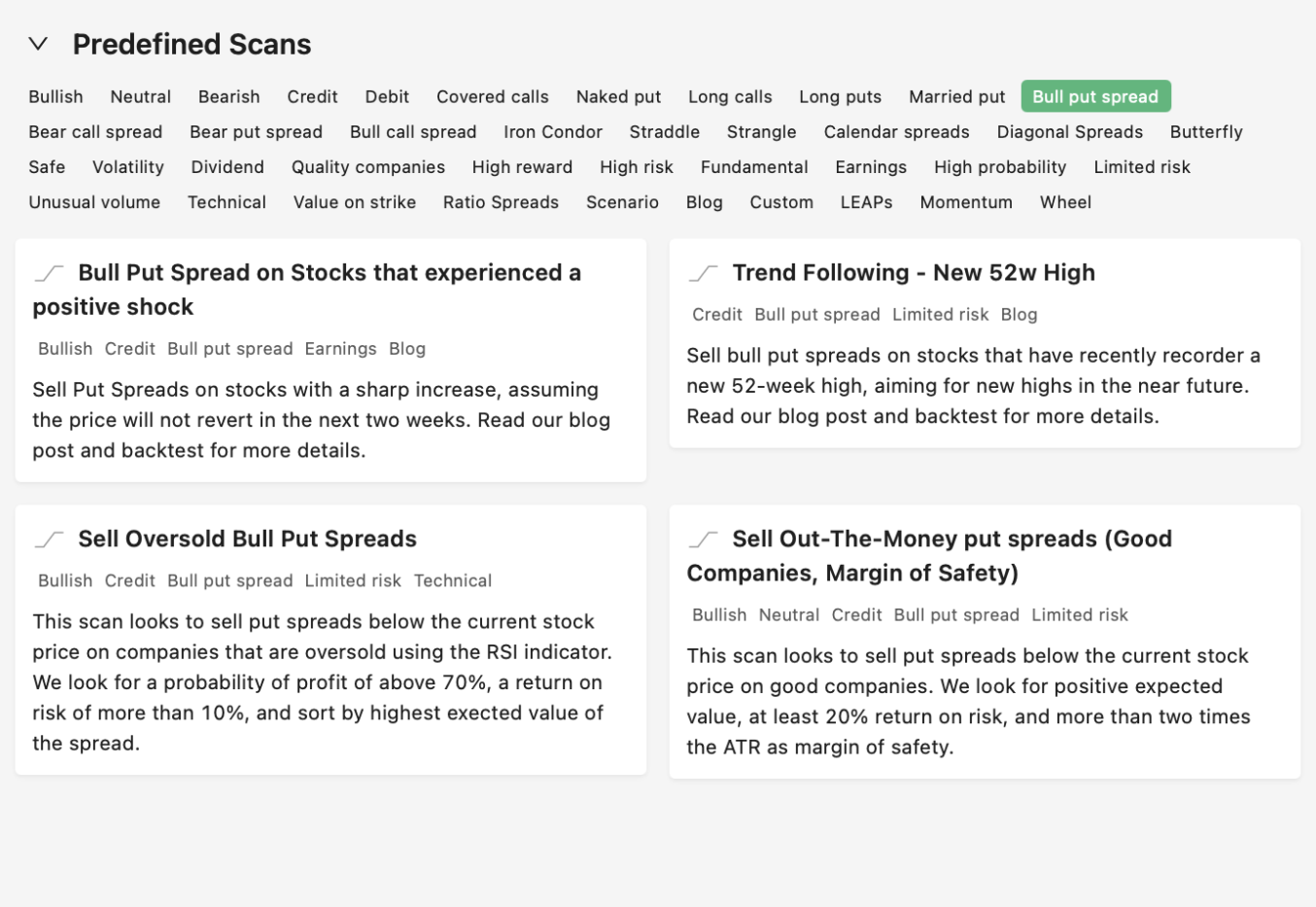
The Bull Put Spread scans focus on neutral to bullish setups. They filter for companies with stable fundamentals, elevated implied volatility, and puts that offer attractive premiums relative to the risk. Results are sorted by probability of profit and annualized return, giving traders a clear view of the best available opportunities.
Here are some of the available bull put spread scans on Option Samurai:
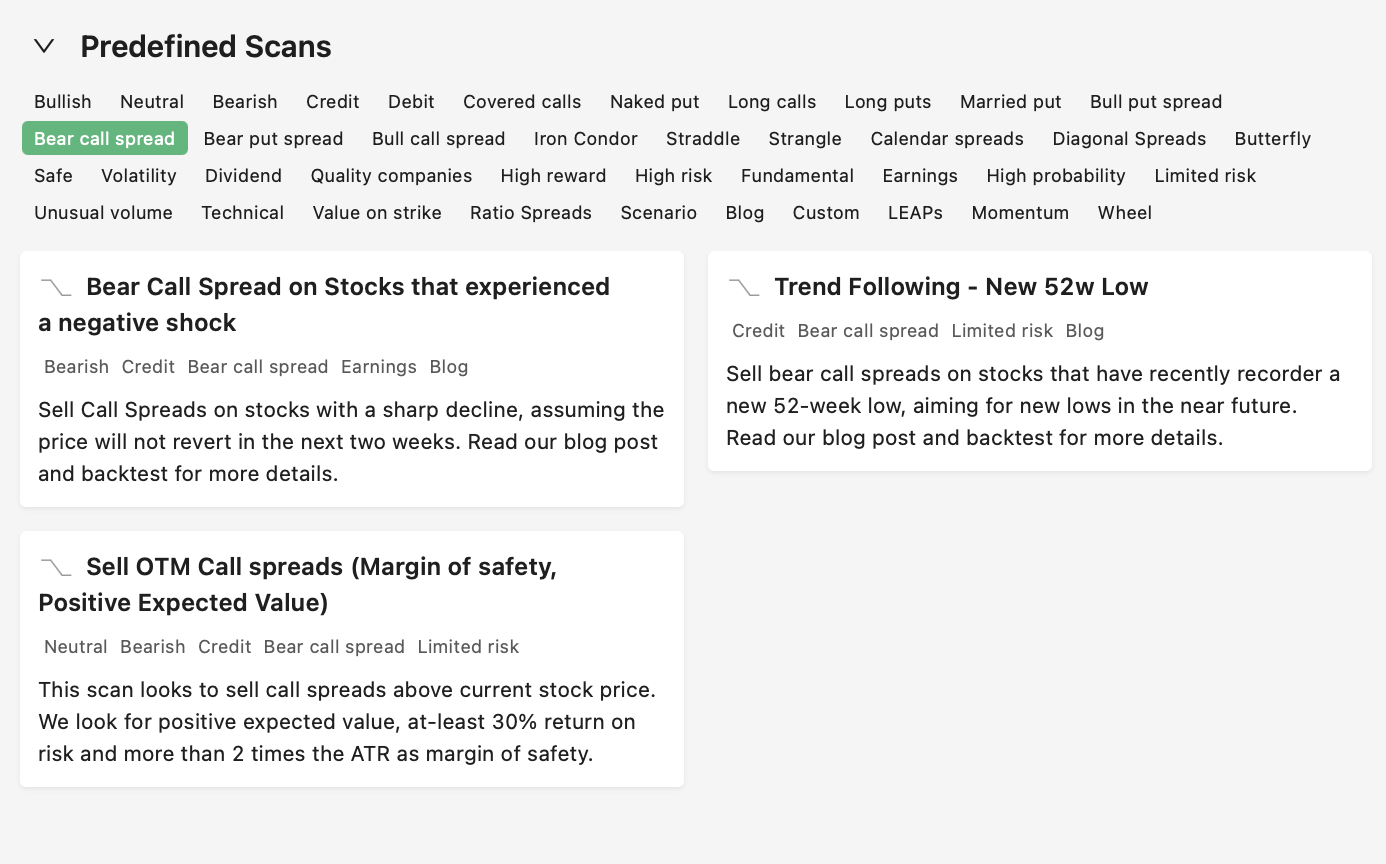
The Bear Call Spread scans apply the same logic in reverse, targeting stocks where the outlook is neutral to bearish and call premiums are rich enough to justify the trade. These scans are useful during periods of market strength when certain sectors or names appear overextended.
Again, this is a quick view of the scans users will find in Option Samurai:
Both scan types benefit from the underlying quality filters built into Samurai’s options screener. Rather than surfacing credit spreads on low-quality or thinly traded stocks, the results are limited to names with sufficient liquidity, reasonable fundamentals, and option chains that support clean execution.
Refining Results with Volatility and Fundamentals
Once a set of credit spread candidates appears, traders can refine further by layering on volatility and fundamental filters. IV Rank is particularly useful here. A credit spread on a stock with an IV Rank above 50 means the options are priced above their median level for the past year, which generally favors premium sellers.
Comparing implied volatility to realized volatility adds another layer of insight. When IV is significantly higher than what the stock has actually been delivering in terms of movement, the market may be overpricing the risk. This creates a natural edge for credit spread sellers who are collecting premiums inflated by fear rather than by actual volatility.
Fundamental filters help avoid names that might look attractive on a volatility basis but carry hidden risks. A stock with elevated IV because of deteriorating earnings or a looming debt issue is not the same as a strong company experiencing a temporary spike in uncertainty. Filtering for quality, whether through predefined tags or custom criteria, keeps the focus on setups where assignment or adverse moves are manageable.
Managing Credit Spreads After Entry
Screening is only the first step. Once a credit spread is placed, ongoing monitoring determines whether the trade reaches its full potential or needs adjustment. The options screener can help here as well, since the same volatility and probability data used to find the trade can be used to evaluate whether conditions have changed.
If implied volatility drops after entry, the spread may reach its profit target faster than expected. If the underlying moves toward the short strike, the probability of profit decreases and a decision about rolling or closing becomes necessary. Tracking these metrics inside a structured platform avoids the common trap of holding spreads too long or exiting too early based on emotion rather than data.
Final Thoughts
Credit spreads are a core income strategy, but their effectiveness depends on finding the right setups at the right time. Screening the entire options market with structured filters removes the guesswork and ensures that each trade is backed by favorable probabilities, appropriate volatility conditions, and quality underlying companies.
An option scanner built for multi-leg strategies brings this process together in a single workflow, making it easier to identify, compare, and execute credit spreads with consistency and discipline.
Start your free trial today (no credit card required) and see how Option Samurai helps traders screen for credit spreads with greater clarity, structure, and confidence.
The post How to Scan the Market for Credit Spreads Using an Options Screener appeared first on Blockonomi.





 English (US) ·