
 2 months ago
52
2 months ago
52
- Hyperliquid ETFs have attracted nearly $172 million in inflows since launching in May.
- During the same period, Bitcoin ETFs recorded approximately $5.6 billion in net outflows.
- Investors are increasingly drawn to Hyperliquid’s fee-generating model, token buybacks, and expanding revenue streams.
Hyperliquid continues to separate itself from the broader crypto market as institutional demand for its ecosystem grows. While many digital assets struggled through a challenging second quarter marked by macroeconomic uncertainty and cooling investor sentiment, Hyperliquid’s native token HYPE has surged to fresh all-time highs.
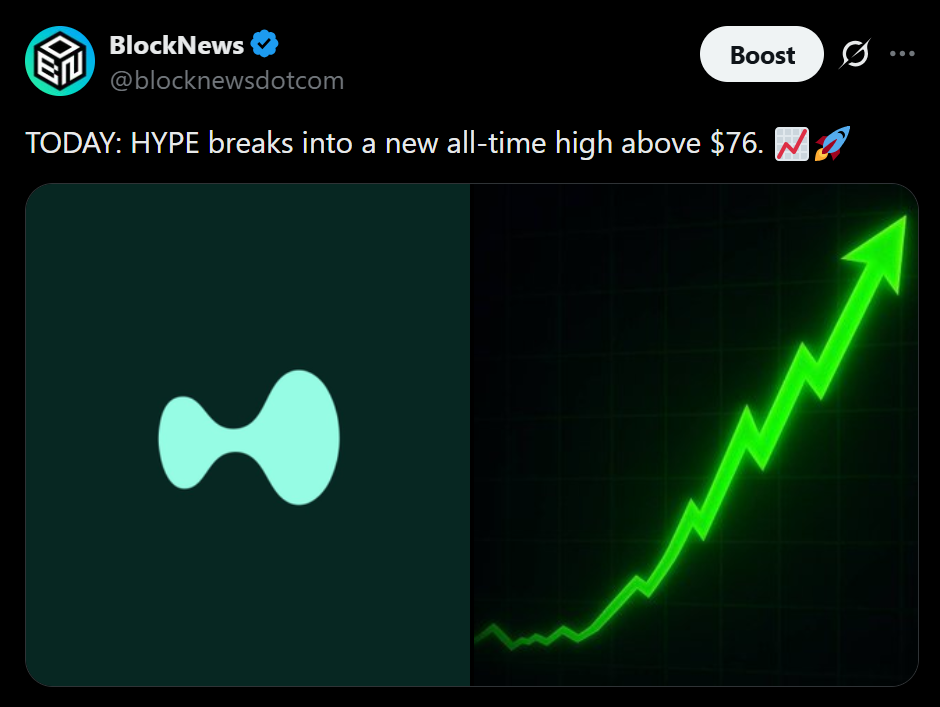
The token climbed to $76 on Tuesday, extending its gains to more than 73% over the past month and nearly 196% since the beginning of 2026. The rally has been supported not only by retail enthusiasm but also by significant institutional capital flowing into newly launched Hyperliquid exchange-traded funds.
Hyperliquid ETFs Defy the Broader Trend
Since debuting in May, three Hyperliquid-focused ETFs have collectively attracted nearly $172 million in net inflows. The strongest performer has been Bitwise’s BHYP fund, which has accumulated approximately $107 million in inflows and manages roughly $122.8 million in assets.
21Shares’ THYP fund follows with around $60 million in inflows, while Grayscale’s HYPG has attracted roughly $8.6 million. Combined trading volume across the three products is approaching $900 million, highlighting growing institutional interest in the ecosystem.
The trend stands in sharp contrast to Bitcoin ETFs, which have lost approximately $5.6 billion during the same period. As rising Treasury yields and geopolitical uncertainty pressured broader markets, investors appeared willing to reduce exposure to Bitcoin while increasing allocations to Hyperliquid-related products.
Investors Are Focusing on Fundamentals
According to market participants, Hyperliquid’s appeal comes from something many crypto projects struggle to offer: measurable revenue generation. Rather than relying solely on speculative narratives, the protocol has built a reputation for producing substantial fees and returning value directly to the ecosystem.
Industry observers point to Hyperliquid’s Assistance Fund, which automatically directs between 97% and 99% of trading fees toward token buybacks. This creates a direct connection between platform activity and demand for the HYPE token, a mechanism many investors view as fundamentally different from traditional crypto assets.
The platform has also benefited from its growing role within the derivatives market. Analysts argue that investors can clearly see Hyperliquid gaining market share, attracting traders, and generating significant protocol revenue, helping strengthen confidence in the long-term value proposition.
Revenue Streams Continue to Expand
One reason institutions are increasingly interested in Hyperliquid is the platform’s expanding business model. While crypto perpetual futures remain a major revenue source, Hyperliquid has successfully broadened its offerings into commodities, equities, prediction markets, and pre-IPO trading.

The protocol gained significant attention through its handling of high-profile markets, including pre-market pricing activity surrounding Coinbase and SpaceX-related trading products. One SpaceX perpetual contract launched through Hyperliquid’s permissionless HIP-3 framework reportedly generated approximately $1.4 billion in trading volume within a single session.
This diversification helps reduce reliance on any single market segment and creates multiple sources of fee generation, an important factor for long-term institutional investors evaluating protocol sustainability.
Coinbase Partnership Strengthens the Bull Case
Another key catalyst is Hyperliquid’s evolving stablecoin infrastructure. Through its partnership with Coinbase, the protocol’s USDC reserves can now participate in the AQAv2 program, allowing approximately $5 billion in stablecoins to generate a 4% yield.
Notably, 90% of that yield is directed back into the Assistance Fund, further strengthening the protocol’s token buyback mechanism. The result is a reinforcing cycle where liquidity generates yield, yield supports buybacks, and buybacks potentially support long-term token demand.
Market observers believe this structure gives Hyperliquid a unique advantage compared to many other blockchain ecosystems that remain heavily dependent on speculative trading activity.
What Comes Next for HYPE?
Despite HYPE’s explosive rally, analysts suggest the most important metrics remain user growth, liquidity, and trading volume rather than token price alone. If Hyperliquid continues capturing market share in crypto derivatives while expanding into new asset categories, institutional participation could continue rising.
Options market data currently suggests a 10% to 15% probability that HYPE reaches the $100 level before the end of July. Whether that target is reached remains uncertain, but one thing is becoming increasingly clear: while billions continue flowing out of Bitcoin ETFs, institutional investors are finding compelling reasons to allocate capital to Hyperliquid.
Disclaimer: BlockNews provides independent reporting on crypto, blockchain, and digital finance. All content is for informational purposes only and does not constitute financial advice. Readers should do their own research before making investment decisions. Some articles may use AI tools to assist in drafting, but every piece is reviewed and edited by our editorial team of experienced crypto writers and analysts before publication.







 English (US) ·