
 1 hour ago
15
1 hour ago
15
Iran’s national soccer team played to a 2-2 draw against New Zealand on June 15 at SoFi Stadium in Inglewood, California. The scoreline was almost an afterthought compared to the scene surrounding it.
Protests by Iranian Americans erupted both inside and outside the stadium, with some fans waving pre-revolutionary Iranian flags. The match became a lightning rod for the deep divisions within the Iranian diaspora, a community so concentrated in greater Los Angeles that the area has long carried the nickname “Tehrangeles.”
A match defined by what happened off the pitch
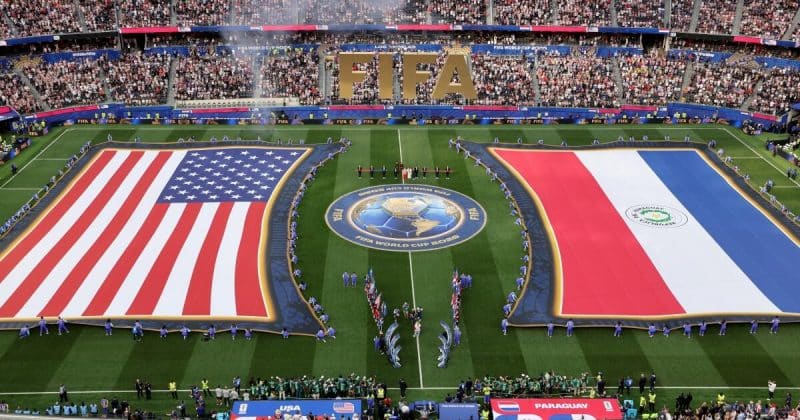
The 2026 FIFA World Cup, co-hosted by the United States, Canada, and Mexico, was always going to produce politically charged moments. Placing Iran’s opening group stage match in a city home to the largest population of Iranians outside Iran itself guaranteed this one would be especially volatile.
Fans inside SoFi Stadium were visibly split. Some cheered for Team Melli as a matter of national pride. Others used the global stage to protest against the Iranian regime, treating the match less as a sporting event and more as a megaphone.
The dynamic is not new. Iranian soccer has been tangled in politics for years, with the national team caught in an impossible position: representing a country whose government many of its own supporters oppose. But the Los Angeles setting amplified every tension to a degree rarely seen at a World Cup.
Iran’s coach described the squad as “the most oppressed team in the whole World Cup,” a comment that landed with the subtlety of a sledgehammer but was rooted in legitimate grievances. The team was required to leave the United States immediately after the match, relocating to a training camp in Tijuana, Mexico. Whatever the official reasoning, the optics of a team being effectively expelled from its host city right after playing told their own story.
On the pitch, resilience
For all the chaos swirling around SoFi Stadium, Iran actually put together a gutsy performance. Team Melli fell behind twice during the match and equalized twice, showing the kind of stubborn resilience that has defined Iranian soccer at its best.
New Zealand, making their own bid for relevance on the World Cup stage, will feel they let two leads slip away. Going ahead once against Iran is an achievement. Going ahead twice and still walking away with only a point is a different conversation entirely.
Iran’s ability to come back on two separate occasions, in front of what was effectively a hostile crowd in their own group stage venue, speaks to the mental fortitude within the squad. These are players who have spent their entire careers navigating the intersection of sport and politics, and it showed.
A draw is a draw, though. Neither side will look at the result with overwhelming satisfaction. For Iran, a point in their opening match keeps them alive but hardly comfortable. For New Zealand, the missed opportunity to take all three points against a distracted opponent will sting for a while.
The broader context
This is the first World Cup co-hosted across three nations, and the tournament’s geographic sprawl has created logistical headaches that go well beyond Iran’s situation. But few teams have faced the combination of political baggage, diaspora tension, and forced relocation that Team Melli dealt with in Inglewood.
The protests were not spontaneous. The Iranian American community in Los Angeles has been vocal about the Iranian government for decades, and the World Cup provided a platform with guaranteed global viewership. Pre-revolutionary flags, a symbol of opposition to the current regime, were visible throughout the stadium.
For players on the pitch, the question of how to respond to protests has never had a clean answer. At the 2022 World Cup in Qatar, Iranian players made headlines by refusing to sing the national anthem in their opening match against England, a gesture interpreted as solidarity with the Woman, Life, Freedom movement. The political pressure on this squad is a continuation of that chapter, not a new one.
The forced departure to Tijuana added an extra layer of difficulty. Training camps are supposed to provide stability and focus. Being uprooted from US soil immediately after your first match is neither of those things.
What this means going forward
Iran’s remaining group stage fixtures will be watched as closely for crowd dynamics as for tactics. If the team advances to knockout rounds played in US cities, the protest scenes from Inglewood could repeat at larger scale.
For the tournament itself, the Iran-New Zealand match is a preview of something organizers probably anticipated but hoped to contain: the World Cup as a venue for political expression that overshadows the sport. FIFA has historically tried to keep politics out of soccer. Soccer has historically ignored that request.
The draw leaves both teams in a precarious position in their group. Iran’s ability to equalize twice suggests they have enough quality to compete, but the off-field distractions are a tax that no other team in the tournament is paying. Whether Team Melli can sustain that level of focus over multiple matches, while navigating cross-border logistics and a divided fanbase, is the question that will define their campaign.
New Zealand, meanwhile, has to reckon with the math. Two leads surrendered means two points lost. In a World Cup group stage where goal difference can decide everything, those margins matter enormously.
Disclosure: This article was edited by Editorial Team. For more information on how we create and review content, see our Editorial Policy.


 English (US) ·