
 1 hour ago
17
1 hour ago
17
TLDR:
- Past Bitcoin cycle bottoms landed between 770 and 900 days after halvings in 2012, 2016, 2020.
- Bitcoin posted a new all-time high before this cycle’s halving, breaking the historical timing pattern.
- Spot ETF inflows now tie Bitcoin’s price more to macro liquidity than to halving supply shocks.
- A viral X post argues the four-year cycle is compressing, not disappearing, altering timelines.
Is the Bitcoin 4-year cycle broken? That question is gaining traction as this cycle unfolds differently from the last three. Previous cycle bottoms in 2012, 2016, and 2020 formed between day 770 and 900 after halvings, per CryptoQuant data.
This time, Bitcoin posted a fresh all-time high before the halving even occurred. That early move has left traders divided on whether the historical rhythm still holds or has finally given way.
Capital Structure Raises Doubts About the Old Pattern
Spot ETF approvals opened the door for large institutional inflows ahead of the halving. Institutional allocators typically base decisions on monetary policy, interest rates, and broader liquidity.
They do not track days elapsed since a halving event. This approach differs sharply from the retail-driven cycles seen in 2012, 2016, and 2020.
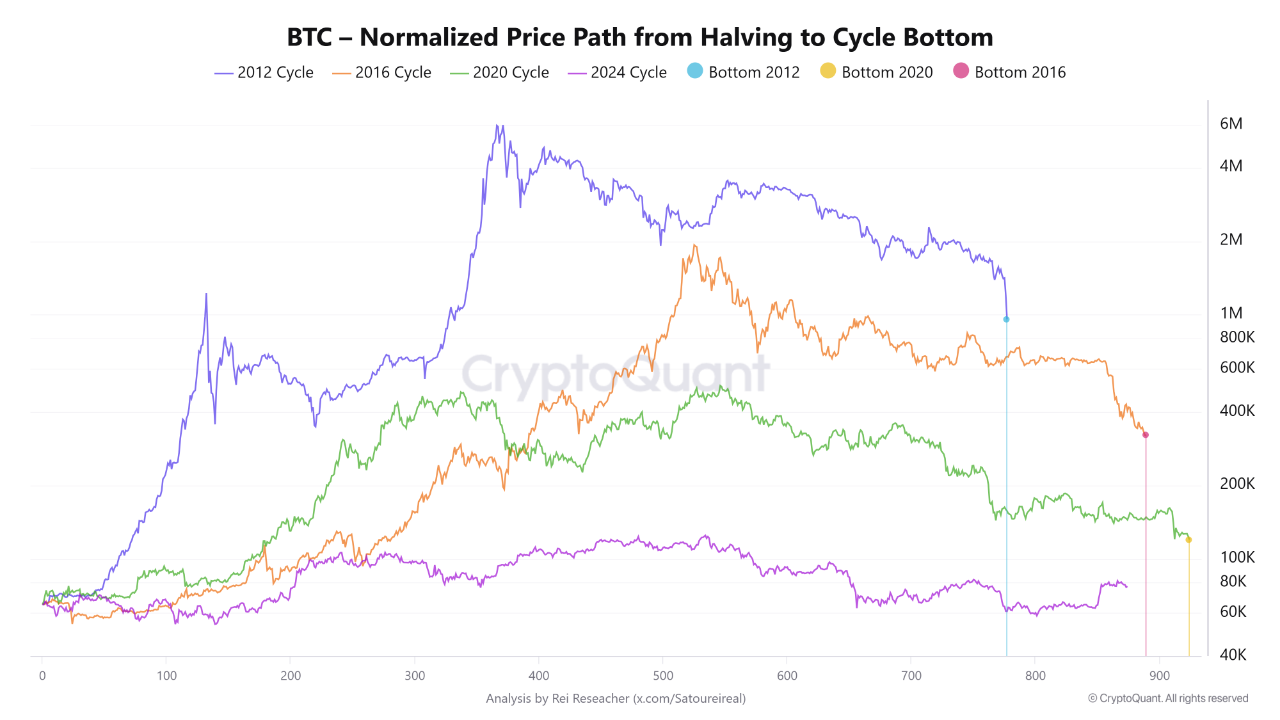
Source: Cryptoquant
The halving’s supply shock also carries less weight than it once did. Newly minted coins represent a small fraction of daily volume moving through derivatives and major funds.
In earlier cycles, reduced issuance visibly affected available supply. Today, that effect is diluted by the much larger pool of tradable Bitcoin in circulation.
Bitcoin’s market capitalization has grown into trillion-dollar territory, changing what it takes to move the asset. Shifting a market of this size now requires substantial liquidity across global markets.
Aggressive monetary easing, a factor behind past rallies, has not appeared recently. Without that liquidity push, price momentum may build more slowly than before.
These shifts raise a real question about whether counting days after a halving still applies. Some observers argue Bitcoin increasingly resembles a mature macro asset tied to broader financial conditions.
The four-year model may not be dead, but its timing looks disrupted. Many are now watching macro indicators instead of a historically timed bottom.
Social Media Debate Adds a Compression Theory
The question has extended beyond analysts into wider social media discussion. A post from the account Discover on X argued Bitcoin may have already broken its cycle. The post suggested the bottom formed roughly 650 days before the next scheduled halving.
 BITCOIN MAY HAVE JUST BROKEN THE 4 YEAR CYCLE
If the bottom is already in, something MASSIVE has changed$BTC isn’t just recovering early
The entire cycle could be speeding up
Think about what that means:
Bitcoin may have bottomed roughly 650 DAYS before the next halving… pic.twitter.com/phvPjrWnv3
— Discover (@0x_Discover) September 13, 2026
That timeline, if accurate, would open room for a new all-time high before the 2028 halving arrives. The post also floated the idea that the next cycle top could arrive only around 350 days after that halving. Such a timeline would differ sharply from the multi-year gaps seen in previous cycles.
Rather than treating the four-year cycle as finished, the post framed the pattern as compressing. Under that view, each stage of the cycle would happen closer together in time. This would depart from the roughly four-year spacing seen between past bottoms and tops.
Whether the cycle is broken or simply compressed remains an open question. Historically, major rallies have followed halvings rather than preceded them.
Market participants are watching whether coming months confirm a compressed timeline or the traditional four-year rhythm.
The post Is Bitcoin’s 4-Year Cycle Broken? Analysts Question the Old Halving Pattern appeared first on Blockonomi.




 English (US) ·