
 4 months ago
73
4 months ago
73
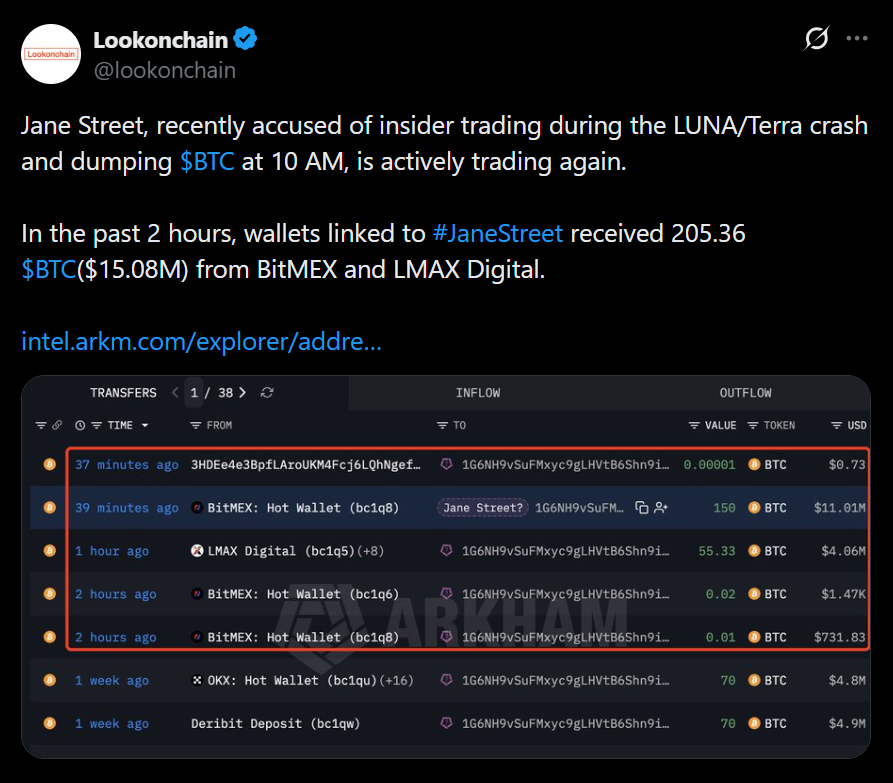
- Jane Street wallets received 205 BTC worth about $15 million from major exchanges
- The trading firm is facing scrutiny tied to the 2022 TerraUSD collapse
- Analysts say accusations of Bitcoin market manipulation misunderstand ETF mechanics
Jane Street, one of Wall Street’s most powerful quantitative trading firms and an authorized participant for several spot Bitcoin ETFs, appears to have resumed active crypto trading. On-chain data shows wallets linked to the firm receiving 205 BTC — roughly $15 million — from institutional trading venues BitMEX and LMAX Digital earlier this week.
The movement has drawn attention across the crypto market, largely because Jane Street plays a critical role in the functioning of Bitcoin ETFs. Authorized participants like the firm help maintain price alignment between ETF shares and the underlying Bitcoin market by creating and redeeming ETF shares when price discrepancies appear.
Legal Pressure From Terra Collapse Claims
The renewed trading activity comes at a sensitive time for the firm. Jane Street is currently facing legal accusations tied to the collapse of the TerraUSD (UST) and LUNA ecosystem in May 2022, an event that erased roughly $40 billion in market value.
Todd Snyder, the bankruptcy plan administrator for Terraform Labs, has filed a lawsuit accusing the trading giant of using non-public information to front-run trades during the collapse. The claim alleges that Jane Street may have exploited insider knowledge during critical market moments.

In the same legal process, Snyder also filed a separate $4 billion claim against Jump Trading, another major trading firm heavily involved in crypto markets during the Terra era.
Conspiracy Theories Around Bitcoin Price Movements
Alongside the legal case, social media discussions have fueled speculation about Jane Street’s potential influence over Bitcoin price movements. Some traders on X circulated a theory suggesting Bitcoin often dropped sharply around 10:00 a.m. Eastern Time — shortly after U.S. markets opened — during several months leading into early 2026.
According to the theory, the trading firm may have used its role as an authorized participant for BlackRock’s iShares Bitcoin Trust ETF to sell Bitcoin in the spot market, trigger cascading liquidations, and then accumulate ETF shares at lower prices.
Observers later pointed out that the daily sell-off pattern appeared to fade in late February 2026, shortly after the Terraform-related lawsuit became public.
Analysts Reject Manipulation Claims
Despite the speculation, many industry experts have pushed back strongly against the idea that Jane Street manipulated Bitcoin markets.
Rob Hadick, a partner at Dragonfly Capital, said the accusations reflect a misunderstanding of how derivatives markets and ETF creation mechanisms actually work. Authorized participants typically operate within strict arbitrage frameworks designed to keep ETF prices aligned with underlying assets, rather than attempting to move markets.
A person close to Jane Street also dismissed the claims in comments to Fortune earlier this year, describing the allegations as an “absolutely ridiculous” conspiracy theory.
Why Markets Are Still Paying Attention
Even though many analysts reject the manipulation narrative, Jane Street’s movements still attract attention because of the firm’s scale and influence. Large trading firms often provide liquidity across both traditional finance and crypto markets, meaning their activity can sometimes signal shifts in institutional positioning.
The latest Bitcoin inflow suggests that Jane Street remains active in the digital asset ecosystem despite ongoing legal scrutiny.
For crypto traders, the real takeaway may be simpler: when major institutional players move capital on-chain, markets tend to watch closely.
Disclaimer: BlockNews provides independent reporting on crypto, blockchain, and digital finance. All content is for informational purposes only and does not constitute financial advice. Readers should do their own research before making investment decisions. Some articles may use AI tools to assist in drafting, but every piece is reviewed and edited by our editorial team of experienced crypto writers and analysts before publication.







 English (US) ·