
 2 months ago
56
2 months ago
56
- Japan’s new EJPY stablecoin is targeting business payments, settlements, and remittances instead of retail speculation
- The token will launch on both Ethereum and Japan Open Chain under Japan’s strict trust-backed stablecoin laws
- Japan already requires full reserves, guaranteed redemption, and direct regulatory oversight for stablecoin issuers
Japan is preparing to launch another major stablecoin initiative, but unlike much of the crypto industry, EJPY is not chasing meme coin traders or speculative retail hype.
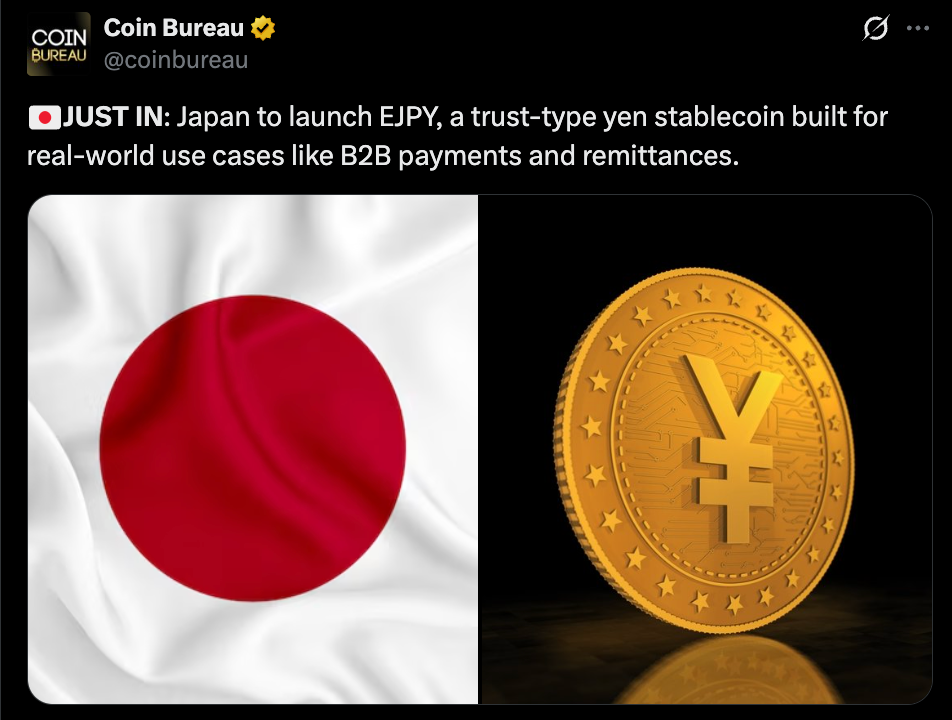
Instead, the trust-backed yen stablecoin is being built specifically for enterprise payments, settlements, and cross-border financial infrastructure — the kind of use case traditional finance institutions actually care about.
The Japan Blockchain Foundation confirmed EJPY will operate across both Ethereum and Japan Open Chain, combining global blockchain accessibility with tightly controlled domestic compliance standards.
Japan Built Stablecoin Rules Early
Part of what makes EJPY stand out is the legal framework behind it. Japan revised its Payment Services Act in 2023 following the collapse of Terra and Luna, creating one of the strictest stablecoin regulatory systems anywhere in the world.
Under current Japanese law, stablecoins must maintain full reserve backing, guarantee redemption at face value, and operate under direct Financial Services Agency oversight.
The structure is intentionally conservative. Every token issued must correspond directly to segregated reserves held in trust accounts managed by licensed entities.
It’s not flashy, but that’s also the point.
EJPY Targets Real Financial Infrastructure
EJPY’s primary focus is business-to-business financial activity rather than speculative crypto trading. The stablecoin is designed to improve international payments, settlements, and remittances — areas where traditional banking infrastructure still moves surprisingly slowly.
International wire transfers today often cost between 2% and 7% while taking several days to settle. Stablecoin-based transfers can reduce those costs dramatically while settling within minutes instead.

That efficiency gap is becoming increasingly difficult for traditional payment systems to ignore.
Japan Is Quietly Becoming A Stablecoin Leader
The broader ecosystem around regulated stablecoins in Japan is also expanding rapidly. Project Pax — backed by financial giants MUFG, SMBC, and Mizuho — is reportedly targeting roughly 1 trillion yen in B2B stablecoin issuance by 2028.
Rather than debating whether stablecoins should exist at all, Japan appears focused on building regulated infrastructure around them before many Western governments fully settle their own frameworks.
Ethereum’s inclusion also matters because it keeps EJPY interoperable with broader global blockchain liquidity and financial applications outside Japan itself.
Stability May Matter More Than Hype
The interesting part about EJPY is that its strongest feature may actually be how boring it sounds. There’s no algorithmic stabilization mechanism, no experimental tokenomics, and no promise of explosive returns.
Instead, the product is built around regulatory certainty, full backing, redemption guarantees, and operational reliability — basically the opposite of how much of crypto operated during previous market cycles.
And honestly, that may end up being exactly why institutional finance eventually trusts products like EJPY far more than many earlier stablecoin experiments.
Disclaimer: BlockNews provides independent reporting on crypto, blockchain, and digital finance. All content is for informational purposes only and does not constitute financial advice. Readers should do their own research before making investment decisions. Some articles may use AI tools to assist in drafting, but every piece is reviewed and edited by our editorial team of experienced crypto writers and analysts before publication.









 English (US) ·