
 6 months ago
78
6 months ago
78
TLDR
- Brent crude reached $104.76 per barrel amid U.S.-Israel operations against Iran, disrupting Strait of Hormuz shipments
- Nearly one-fifth of global oil supplies pass through the Strait, where vessel traffic has virtually ceased
- JPMorgan forecasts European energy companies could achieve ~14% free cash flow yields with sustained $100 oil pricing
- Shell, TotalEnergies, Eni, and Galp represent JPMorgan’s preferred investment targets
- Federal Reserve policy decisions may shift as oil price shocks threaten to postpone anticipated rate reductions
Wall Street analysts are turning their focus toward European energy companies as oil prices surge beyond $100 per barrel, fueled by supply disruption concerns stemming from the U.S.-Israel military operations targeting Iran.
On Wednesday, Brent crude futures advanced 1.3% to reach $104.76 per barrel, recovering from earlier session declines. The uptick occurred despite news that Iraq and Kurdish officials reached an agreement to restart crude shipments via Turkey’s Ceyhan terminal, providing modest market stability.
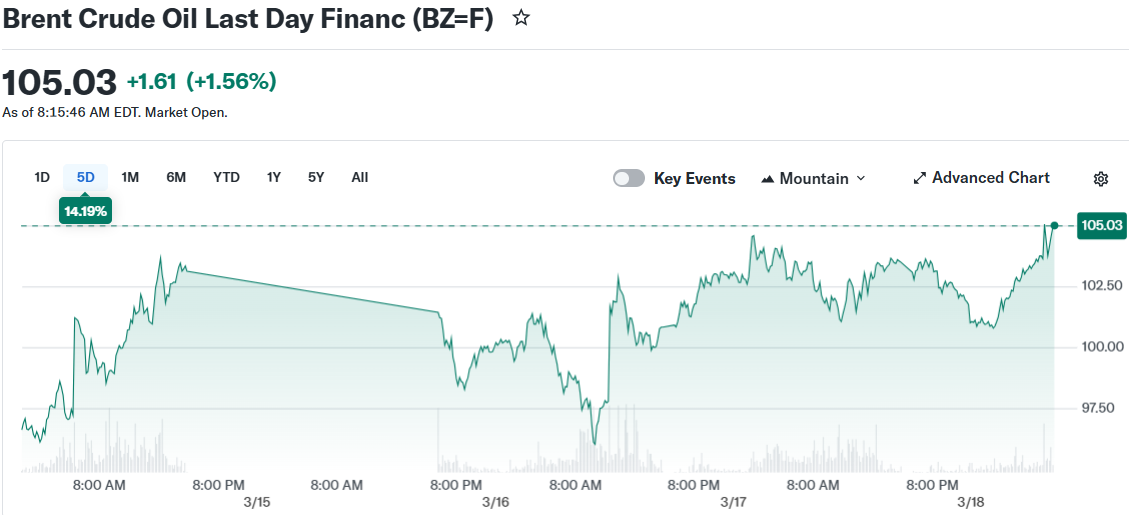 Brent Crude Oil Last Day Financ (BZ=F)
Meanwhile, West Texas Intermediate declined 0.6% to settle at $94.95 per barrel during the same trading period.
Entering its third week, the military conflict has effectively paralyzed maritime traffic through the Strait of Hormuz. American forces have conducted strikes against Iranian coastal installations housing cruise missile systems capable of threatening vessels navigating the critical waterway.
Approximately 20% of the world’s oil supply travels through the Strait of Hormuz, making any prolonged interruption significant for global energy markets.
JPMorgan equity analyst Matthew Lofting characterizes the financial implications for European energy producers as “clearly positive.” His analysis indicates that volume reductions resulting from Hormuz-related disruptions represent approximately $6 per barrel in lost cash generation—potentially reaching $10 for companies with maximum exposure.
This contrasts sharply with the roughly $30 price appreciation in crude markets since hostilities commenced, indicating that price benefits substantially exceed volume-related setbacks for most operators.
Free Cash Flow Yields Could Hit 14%
Lofting’s projections suggest free cash flow generation for European oil producers could climb from approximately 10% based on existing forward curves to around 14% assuming persistent $100 oil pricing. He characterizes current sector valuations as remaining “modestly cheap” relative to metrics observed during 2022’s energy market upheaval.
European energy sector equities have already appreciated more than 10% since the conflict’s inception.
JPMorgan identifies Shell, TotalEnergies, Eni, and Galp as preferred investment opportunities within the sector. The investment bank emphasizes robust price sensitivity, extended production horizons, and attractive valuation metrics as primary selection criteria.
Eni and Shell receive particular attention for their elevated oil price correlation. Galp’s price leverage appears underrepresented in immediate financial projections, according to the analysis.
TotalEnergies, Shell, and OMV maintain the most substantial Middle Eastern asset exposure. Conversely, Equinor, Repsol, and Galp possess minimal direct regional presence, potentially enhancing their responsiveness to immediate price movements.
JPMorgan anticipates exceptional trading results will contribute additional value, with models indicating approximately $4 billion in potential incremental gains for Shell specifically.
Lofting identifies potential windfall taxation as a downside risk, referencing 2022-2023 precedents. His framework incorporates an additional 5% levy on cash generation as a possible constraint.
Fed Meeting Adds Uncertainty
Investors maintained a cautious stance ahead of Wednesday’s Federal Reserve policy announcement. Market consensus anticipates the central bank will maintain its benchmark rate within the 3.5% to 3.75% range.
Fed Chair Jerome Powell, whose tenure concludes in May, is scheduled to address markets following the decision. Observers are particularly interested in commentary regarding how oil market disruptions might influence monetary policy trajectories.
Prior to the conflict, market expectations incorporated a rate reduction during 2025’s latter half. ING analysts suggest the Fed may now indicate postponement of such adjustments.
According to JPMorgan, below-average winter temperatures combined with recent market dynamics position energy trading operations for robust first-quarter performance.
The post JPMorgan Picks Shell, Eni, Galp, and TotalEnergies as Oil Prices Cross $100 Threshold appeared first on Blockonomi.





 English (US) ·