
 2 months ago
58
2 months ago
58
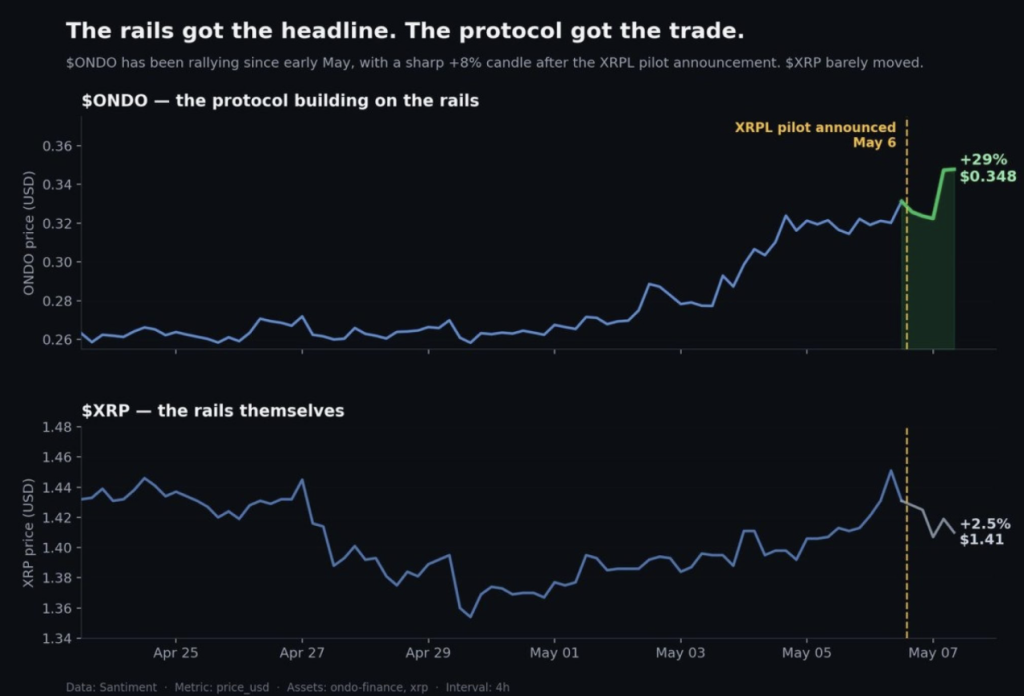
- ONDO surged sharply after the pilot, while XRP saw minimal movement despite powering the transaction.
- The market favored the token tied to the real-world asset product rather than the underlying infrastructure.
- This highlights a growing trend where application-layer tokens capture more short-term value than base networks.
Something kind of telling played out when JPMorgan, Mastercard, Ripple, and Ondo Finance wrapped up a real-world test on the XRP Ledger. They managed to settle a cross-border redemption of tokenized U.S. Treasuries in under five seconds… which, on paper, is impressive. Fast, clean, exactly the kind of thing crypto keeps promising. But the market’s reaction? Not what you’d expect.
The Market Chose the Product Over the Rails
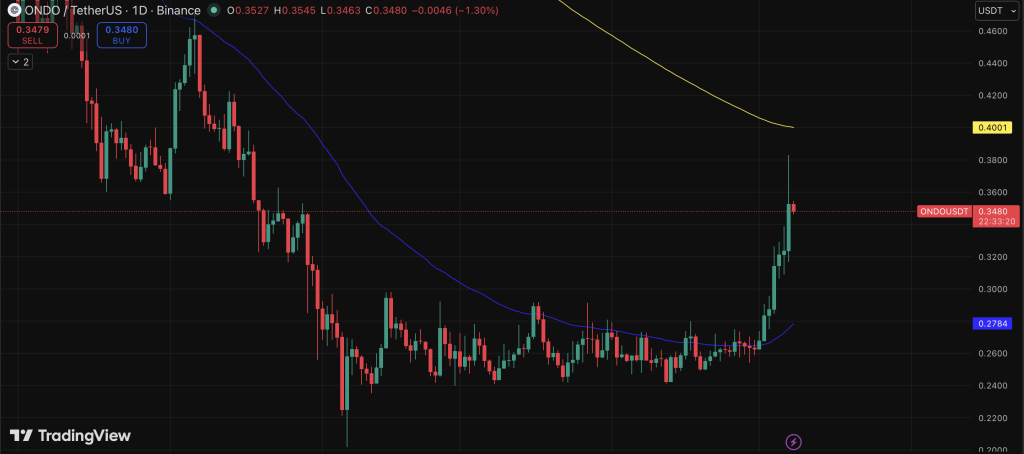
Instead of rewarding the network that powered the transaction, traders seemed to shift their attention elsewhere. ONDO, the token tied directly to tokenized Treasuries, saw a sharp move—jumping from around $0.27 to nearly $0.36 in a pretty short window. XRP, meanwhile, barely flinched, moving from roughly $1.38 to $1.41… and then, well, settling back down again.
That contrast wasn’t subtle. It highlighted something the market has been quietly leaning toward for a while now: infrastructure doesn’t always capture the excitement, even when it’s doing the heavy lifting. XRP handled the transaction, sure. But ONDO was closer to the actual product being tested, and that’s where attention went.
Timing and Narrative Did the Heavy Lifting
Looking closer, ONDO didn’t just spike out of nowhere. It had already been climbing steadily before the announcement, moving from the mid-$0.20 range into the low $0.30s. That kind of slow grind usually points to accumulation, not hype. So when the news hit, it didn’t start the move—it accelerated it.
XRP’s path was almost the opposite. It dipped earlier, recovered gradually, and then… didn’t really hold any momentum from the announcement. Even with big names like JPMorgan and Mastercard involved, the reaction felt muted. Almost like the market had already priced in the idea, or just didn’t see XRP as the main beneficiary.
A Clear Split Between Utility and Value
What stands out here is the separation. XRP provided the rails, the infrastructure, the environment where everything settled smoothly. But ONDO represented the asset being moved, the actual financial product tied to real-world value. And in this case, traders chose the product over the pipes.
It’s not the first time this kind of pattern has shown up either. In a lot of ecosystems, infrastructure gets validated quietly, while the application layer absorbs most of the attention—and, at least short term, the price action too.
That doesn’t mean XRP isn’t important in the bigger picture. It clearly is. But markets don’t always reward importance… they reward proximity to the narrative. And right now, that narrative seems to be centered on tokenized real-world assets, not just the networks enabling them.
Disclaimer: BlockNews provides independent reporting on crypto, blockchain, and digital finance. All content is for informational purposes only and does not constitute financial advice. Readers should do their own research before making investment decisions. Some articles may use AI tools to assist in drafting, but every piece is reviewed and edited by our editorial team of experienced crypto writers and analysts before publication.






 English (US) ·