
 2 hours ago
20
2 hours ago
20
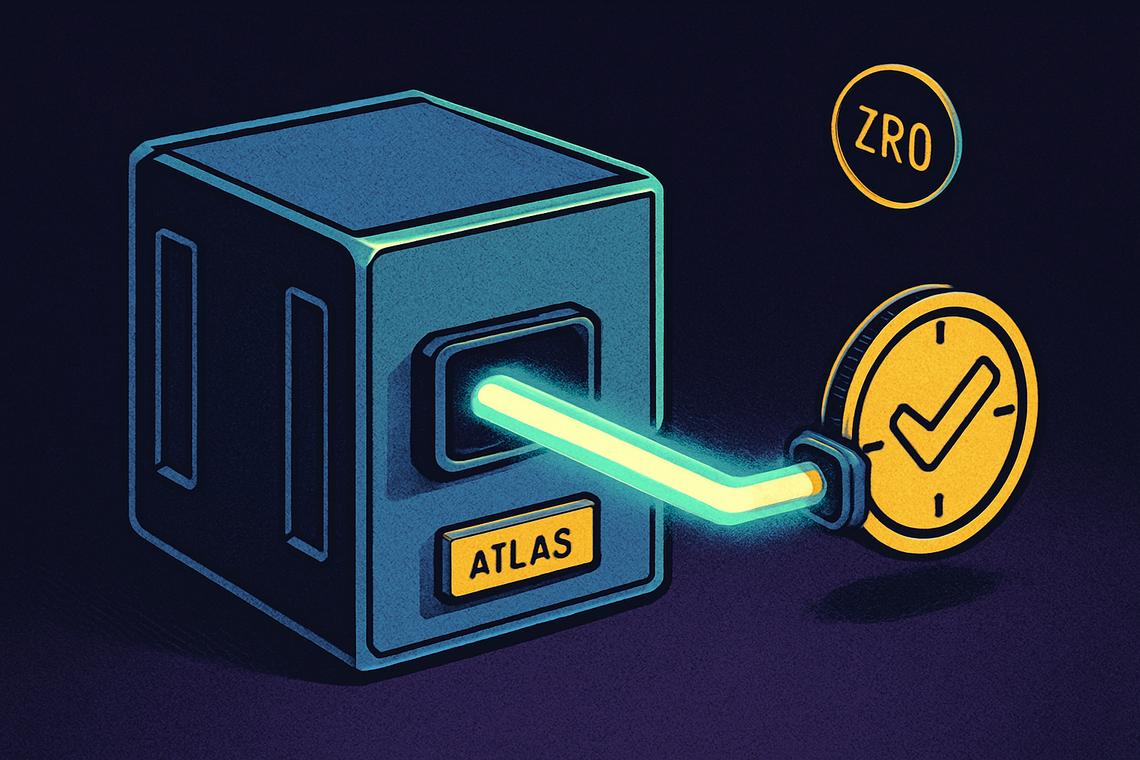
LayerZero has rolled out a new piece of financial infrastructure that could reshape how trading venues handle the plumbing behind their markets. The LayerZero ATLAS exchange system, unveiled on August 26, 2026, is built on the company’s Zero blockchain and designed to give crypto platforms, brokers and financial institutions a shared backend for matching, clearing, settling and managing risk on trades — all while letting those firms keep their own branding and customer relationships intact.
Key takeaways
- LayerZero launched ATLAS, an exchange infrastructure layer on its Zero blockchain, aimed at trading platforms and financial institutions.
- ATLAS runs as a “headless” backend, meaning trading venues control their own front-end apps while ATLAS handles matching, clearing, settlement and risk.
- The system comes in two flavors: Open ATLAS for public crypto markets and Institutional ATLAS for operators needing custom access rules.
- ZRO secures the Zero network through delegated proof-of-stake and can unlock trading fee rebates of up to 65% for venues that stake it.
- ZRO jumped more than 16% to trade near $1.26 after the announcement, even as LayerZero still works to rebuild trust following a $292 million bridge exploit in April.
LayerZero launches ATLAS to power exchange backends
ATLAS, short for Aggregated Trading, Liquidity and Settlement, is not another exchange app — it’s the machinery meant to sit underneath one. LayerZero designed it so trading venues, brokers and institutions can plug in without building their own matching engines or renting backend technology from a competitor.
That distinction matters because most financial firms still stitch together separate systems for trade matching, clearing, settlement and risk management. ATLAS folds all of that into a single stack running on Zero, the layer-1 network LayerZero introduced back in February. Trades get verified onchain using Zero’s zero-knowledge proof architecture, a setup meant to handle the kind of throughput financial markets actually need rather than the lighter workloads typical of most blockchains.
A single stack for matching, clearing and settlement
Because ATLAS operates as a headless exchange, the venues built on top of it decide how customers experience the product — LayerZero just supplies the engine underneath. Bryan Pellegrino, LayerZero’s co-founder and CEO, framed the pitch bluntly: “We built ATLAS to be the neutral, performant backend to power them all.” The company plans to launch ATLAS later this year, positioning it as an alternative to firms relying on backend infrastructure controlled by a rival exchange.
ATLAS configurations and market roles
ATLAS splits into two modes depending on who’s building on it. Open ATLAS is aimed at crypto applications, prediction markets and other public financial products, while Institutional ATLAS lets operators set their own access controls and trading rules for more restricted markets.
Both configurations share the same underlying engine, according to LayerZero, but institutional operators get to decide who can trade and under what conditions. The system is structured around three participants: trading venues run the customer-facing platforms, market creators decide what assets or products can be listed, and market makers supply the liquidity that keeps those markets functioning. Market creators will be able to list everything from spot crypto and perpetual futures to stocks, bonds, commodities, meme tokens and prediction contracts — a notably broad remit for a single backend system.
ZRO’s expanded role: staking, rebates and burns
The launch hands ZRO a bigger job than the one it’s had until now. Beyond its existing role in LayerZero’s interoperability network, ZRO will secure the Zero blockchain through delegated proof-of-stake while also functioning as the network’s gas and governance token.
Trading venues that stake ZRO on ATLAS can earn fee rebates ranging from 20% to 65%, with the size of the discount tied to how much ZRO a venue stakes, how much volume it processes, or a mix of both — though the top rebate tier reportedly requires staking an amount equal to as much as 1% of ZRO’s total supply. Once that venue rebate is subtracted, the remaining fee revenue splits again: 25% goes to the market creator, and the other 75% is used to buy ZRO on the open market and permanently burn it.
That buy-and-burn mechanism gives ZRO a second fee-linked demand driver, following LayerZero’s earlier move in August tying excess revenue from its new Stargate OFT transfer fees to token buybacks. Together, the two mechanisms mean ATLAS trading activity and existing cross-chain transfers can both put upward pressure on ZRO’s supply dynamics — a structural link between platform usage and token scarcity that investors will likely watch closely.
Speed targets and the shadow of the Kelp DAO exploit
LayerZero is promising serious speed out of the gate: sub-millisecond median latency in its current ATLAS test environment, with p95 and p99 latency at 1.418 milliseconds and 2.641 milliseconds respectively. The company says it plans to provision the system for 200,000 transactions per second at launch, with Zero itself designed to eventually scale to as many as 2 million transactions per second.
Zero was introduced with involvement from Citadel Securities, ARK Invest, Intercontinental Exchange and the Depository Trust & Clearing Corporation — a lineup that signals LayerZero is chasing institutional-grade trading infrastructure, not just another crypto-native product. Whether ATLAS can actually hit those throughput numbers under live trading conditions, rather than in controlled tests, remains to be seen.
What happened in April
This launch also arrives while LayerZero is still working to repair confidence after a costly security incident. On April 18, attackers drained 116,500 rsETH — worth roughly $292 million — from a LayerZero-enabled bridge tied to Kelp DAO, after compromising infrastructure used in the token’s cross-chain verification setup. LayerZero said the breach was limited to Kelp DAO’s configuration, which relied on a single decentralized verifier network, and maintained its core protocol was never compromised; the company’s incident report described attackers poisoning RPC infrastructure to pass a forged cross-chain message.
In response, LayerZero said it would stop signing messages for applications using single-verifier setups and push affected integrations toward multi-verifier security, tightening bridge protections around single-signer deployments. Kelp DAO disputed parts of that account and later said rsETH would migrate to Chainlink’s Cross-Chain Interoperability Protocol, a move Chainlink framed as a security upgrade. Pellegrino, for his part, rejected Kelp DAO’s version of how the original verifier configuration had been set up. Other projects followed the same path: by May, assets tied to migrations involving Kelp DAO, Lombard, Solv, Re.xyz and Kraken toward Chainlink CCIP had topped $4 billion.
Market impact and community response
Investors reacted almost immediately. ZRO climbed more than 16% within 24 hours of the ATLAS announcement, trading near $1.26 — a sign that markets see real upside in a token gaining utility beyond cross-chain messaging. The rally suggests traders are betting ATLAS could open a meaningfully larger revenue stream for LayerZero than its existing interoperability business, which has processed more than $290 billion in cross-chain volume across over 160 networks through its Omnichain Fungible Token standard.
LayerZero also brought in new leadership to push the product forward: Jack Melnick, who joined from Berachain to lead strategy for Zero and ATLAS, announced on X that ATLAS is the first product built on the Zero network.
Whether that bet pays off will depend on adoption LayerZero can’t fully control: how many trading venues actually choose ATLAS over building their own systems, how the ZRO rebate structure holds up once real trading volume flows through it, and whether the memory of the Kelp DAO exploit fades faster than the security upgrades LayerZero has put in place since.
FAQ
What is ATLAS and who can use it?
ATLAS is an exchange infrastructure layer built on LayerZero’s Zero blockchain, designed for crypto trading platforms and financial institutions. It supports both public market configurations through Open ATLAS and institutional setups through Institutional ATLAS.
How does the headless exchange model in ATLAS benefit trading venues?
The headless model lets trading venues run their own front-end user interfaces while ATLAS handles backend processing — trade matching, clearing, settlement and risk management — behind the scenes.
What role does the ZRO token play in the ATLAS ecosystem?
ZRO secures the Zero blockchain through delegated proof-of-stake and serves as the network’s gas and governance token. Staking ZRO on ATLAS also gives trading venues access to trading fee rebates.
What security issues has LayerZero faced recently?
In April, an exploit on Kelp DAO’s rsETH bridge drained 116,500 rsETH, worth about $292 million, after attackers compromised a single-verifier configuration. LayerZero responded by tightening security and pushing affected integrations toward multi-verifier setups.
Article produced with the assistance of artificial intelligence and reviewed by the editorial team.





 English (US) ·