
 6 months ago
84
6 months ago
84
- LINK remains a standout crypto infrastructure play despite weak market conditions
- CCIP and institutional tools position Chainlink for long-term adoption beyond retail hype
- A $5,000 LINK position depends heavily on cross-chain and tokenization growth over time
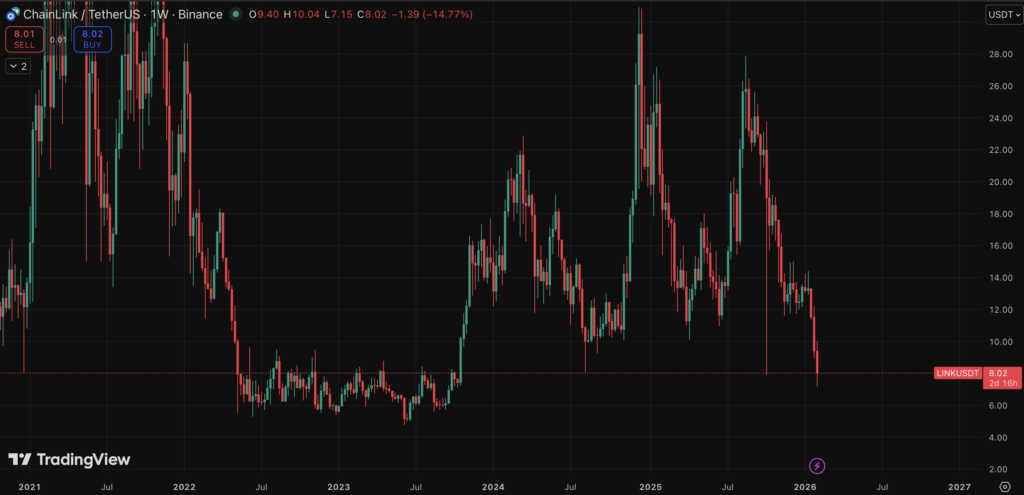
Chainlink has been one of the few projects still standing out even as the broader crypto market looks rough. LINK is trading around $8.99, and price-wise, it’s clearly not in a glamorous phase. But what’s interesting is that Chainlink keeps popping up in places where real infrastructure is being built, not where hype is being manufactured.
In just the past few days, CME has been exploring token-related plans, Bitget-backed Morph integrated Chainlink’s CCIP, and analysts have pointed out that LINK tends to hold up better than most retail-driven coins during downturns. That’s not because it’s “stronger” emotionally, it’s because Chainlink is positioned differently. Its story isn’t built around vibes.
Chainlink’s role is plumbing. And crypto still needs plumbing if it wants to grow into something that resembles real finance.
Why Chainlink still matters in 2026
Chainlink isn’t competing with meme coins, narratives, or fast trend cycles. It’s operating in a deeper layer of the stack, where the real work happens and where institutions actually pay attention. Most blockchains can’t function properly without high-quality data, secure connections, and reliable infrastructure. Chainlink sits right in the middle of that, supplying DeFi protocols, tokenized assets, and cross-chain systems with the tools they need to run.
That’s why institutions keep circling back to it. When traditional finance starts moving on-chain in a serious way, Chainlink is already part of the base layer, not an optional add-on. It’s basically infrastructure that was built early, survived multiple cycles, and keeps getting adopted anyway.
CCIP upgrades could turn Chainlink into a cross-chain rail
One of the biggest expansions for Chainlink is CCIP v1.5, which is positioned as a major upgrade for cross-chain transfers. The key value is that it makes it easier for tokens and apps to move across different blockchains without requiring custom bridging setups every time. That’s a huge deal because most cross-chain systems are still messy, fragmented, and honestly, too easy to exploit.
CCIP also adds support for zkRollups, meaning more networks can plug into the same system. If cross-chain transfers become standard across crypto, CCIP could become one of the main rails powering that movement. Not flashy, but essential.
And in crypto, the “boring” rails often end up being the biggest winners.
Chainlink is leaning directly into institutional tokenization
Chainlink is also building products aimed directly at banks and large financial firms. The Digital Assets Sandbox is designed to help institutions test tokenization faster, without spending months reinventing the wheel. Meanwhile, the Blockchain Abstraction Layer is meant to simplify blockchain usage so firms can interact with on-chain systems without needing to rebuild their entire infrastructure from scratch.
This is where long-term demand could come from. Not retail traders chasing candles, but finance moving slowly, deliberately, and at scale. It’s not as exciting, but it’s far more durable.
Another major expansion is Data Streams, Chainlink’s faster oracle product built for real-time markets. The goal is to support more assets like commodities, FX, and tokenized real-world markets. As tokenized finance grows, infrastructure like this becomes less of a “nice-to-have” and more like a requirement.
What a $5,000 LINK buy looks like right now
At $8.99, a $5,000 investment would buy roughly 556 LINK. Where that goes by 2027 depends on adoption and market cycles, and there’s no point pretending otherwise. If LINK stays stuck near current levels, that position stays close to $5,000 with limited upside.
If the market recovers and Chainlink continues expanding its role across tokenization and cross-chain rails, a return to the $20 to $30 zone would push that investment closer to roughly $11,000 to $16,000. And if institutional tokenization becomes a dominant theme, with CCIP becoming widely adopted, prices above $50 become realistic, which would put $5,000 closer to $27,000 and beyond.
Chainlink doesn’t need hype. It needs usage. And the key point is, it keeps placing itself right where usage is heading.
Disclaimer: BlockNews provides independent reporting on crypto, blockchain, and digital finance. All content is for informational purposes only and does not constitute financial advice. Readers should do their own research before making investment decisions. Some articles may use AI tools to assist in drafting, but every piece is reviewed and edited by our editorial team of experienced crypto writers and analysts before publication.





 English (US) ·