
 1 month ago
61
1 month ago
61
- Michael Saylor says Bitcoin’s network has successfully avoided a long-term “spam” transaction problem.
- The Strategy chairman argues free-market dynamics have naturally balanced block space demand over time.
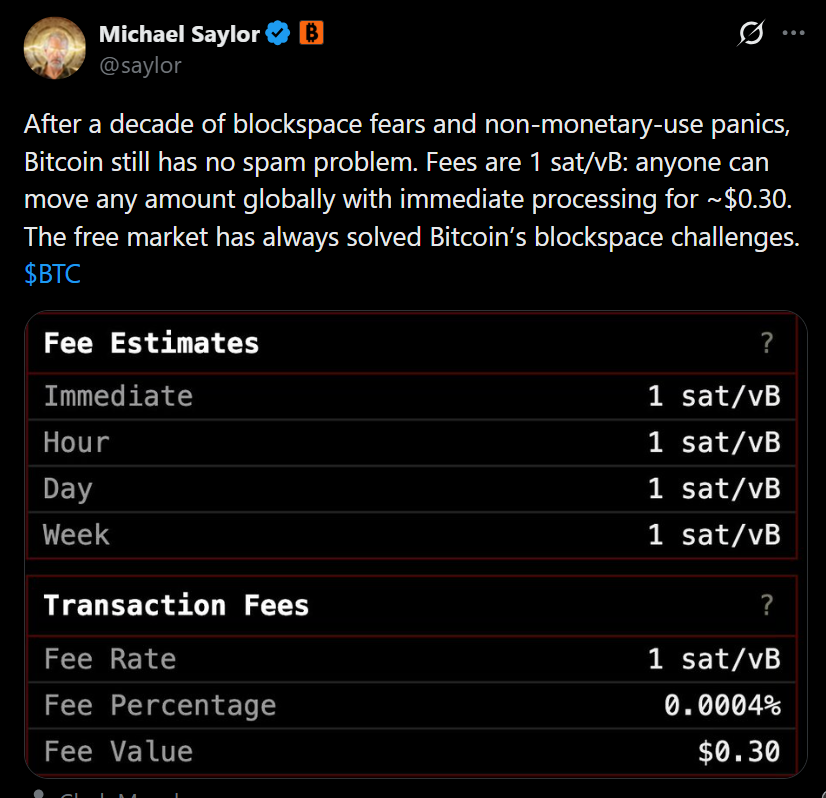
- Bitcoin transaction fees remain around 1 sat/vB, allowing users to transfer BTC globally at relatively low cost.
Michael Saylor believes Bitcoin’s network has successfully overcome concerns surrounding transaction congestion and so-called “spam” activity. Responding to renewed debate over how Bitcoin’s limited block space is being used, the Strategy executive argued that market forces have consistently solved capacity challenges without requiring major intervention.
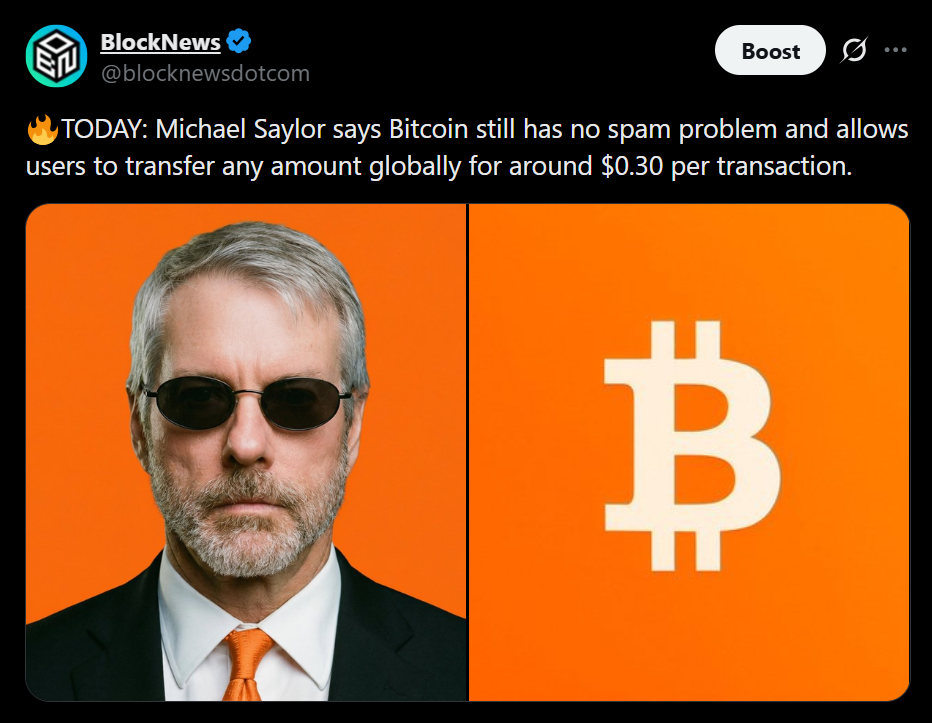
His comments arrive as Bitcoin transaction fees remain near multi-month lows, suggesting the network currently has sufficient capacity to handle demand while keeping transfer costs inexpensive.
Saylor Defends Bitcoin’s Fee Market
Posting on X, Saylor noted that Bitcoin network fees currently sit at roughly 1 satoshi per virtual byte (sat/vB), allowing users to transfer any amount of Bitcoin across the world at relatively low cost.
According to Saylor, this demonstrates that Bitcoin’s fee market is functioning as intended. Rather than viewing block space as a problem, he argued that supply and demand naturally determine how the available capacity is allocated.
Saylor added that Bitcoin has faced similar concerns for more than a decade, yet the network has continued operating without developing a persistent congestion issue.
Debate Over Ordinals Continues
Saylor’s remarks come after renewed discussions surrounding Ordinals, inscriptions, and other non-financial applications built on Bitcoin.
Critics argue these applications consume valuable block space and can drive transaction fees higher during periods of heavy network activity. Supporters, however, believe they represent legitimate uses of Bitcoin‘s blockchain while contributing additional fee revenue for miners.
Saylor sided with the latter view, suggesting the market ultimately determines which transactions are valuable enough to occupy block space.
Low Fees Reflect Healthy Network Conditions
According to Saylor, today’s low transaction fees indicate that Bitcoin has reached a healthy balance between available block space and current demand.
When network activity increases, users willing to pay higher fees naturally receive transaction priority. As activity slows, fees decline again, allowing more affordable transfers. He argued that this market-driven mechanism has repeatedly demonstrated its effectiveness throughout Bitcoin’s history.
Bitcoin’s Long-Term Design Remains Intact
Saylor has consistently described Bitcoin as a global store of value and settlement network rather than a platform optimized for every type of blockchain application.
His latest comments reinforce that position, emphasizing that Bitcoin’s economic incentives continue functioning as originally designed. While debates over block space usage are likely to continue as the network evolves, Saylor believes Bitcoin’s fee market has repeatedly proven capable of adapting without compromising the network’s long-term security or reliability.
Disclaimer: BlockNews provides independent reporting on crypto, blockchain, and digital finance. All content is for informational purposes only and does not constitute financial advice. Readers should do their own research before making investment decisions. Some articles may use AI tools to assist in drafting, but every piece is reviewed and edited by our editorial team of experienced crypto writers and analysts before publication.








 English (US) ·