
 3 months ago
67
3 months ago
67
The Wall Street titan has now launched crypto trading for a small portion of its customers under its E*Trade platform, as the company plans to offer more investment options linked to the cryptocurrency asset class. Morgan Stanley is also undercutting its rivals on fees.
Key Takeaways
- Morgan Stanley launched E*Trade crypto trading, expanding to 8.6M users later this year.
- Charging a low 50-basis-point fee, Morgan Stanley undercuts Coinbase to disrupt institutional crypto.
- Expanding beyond its MSBT Bitcoin ETF, Morgan Stanley next seeks a bank charter for crypto custody.
Morgan Stanley Rolls Out Crypto Trading Pilot on E*Trade
Giants of the financial world are now moving to include cryptocurrency as a portfolio option for their customers.
Morgan Stanley, a Wall Street behemoth with a valuation of almost $300 billion and holding over $1 trillion in assets under management (AUM), has reportedly launched crypto trading on its E*Trade platform for a small number of its customers, with access to this option extending to all 8.6 million E*Trade users later this year.
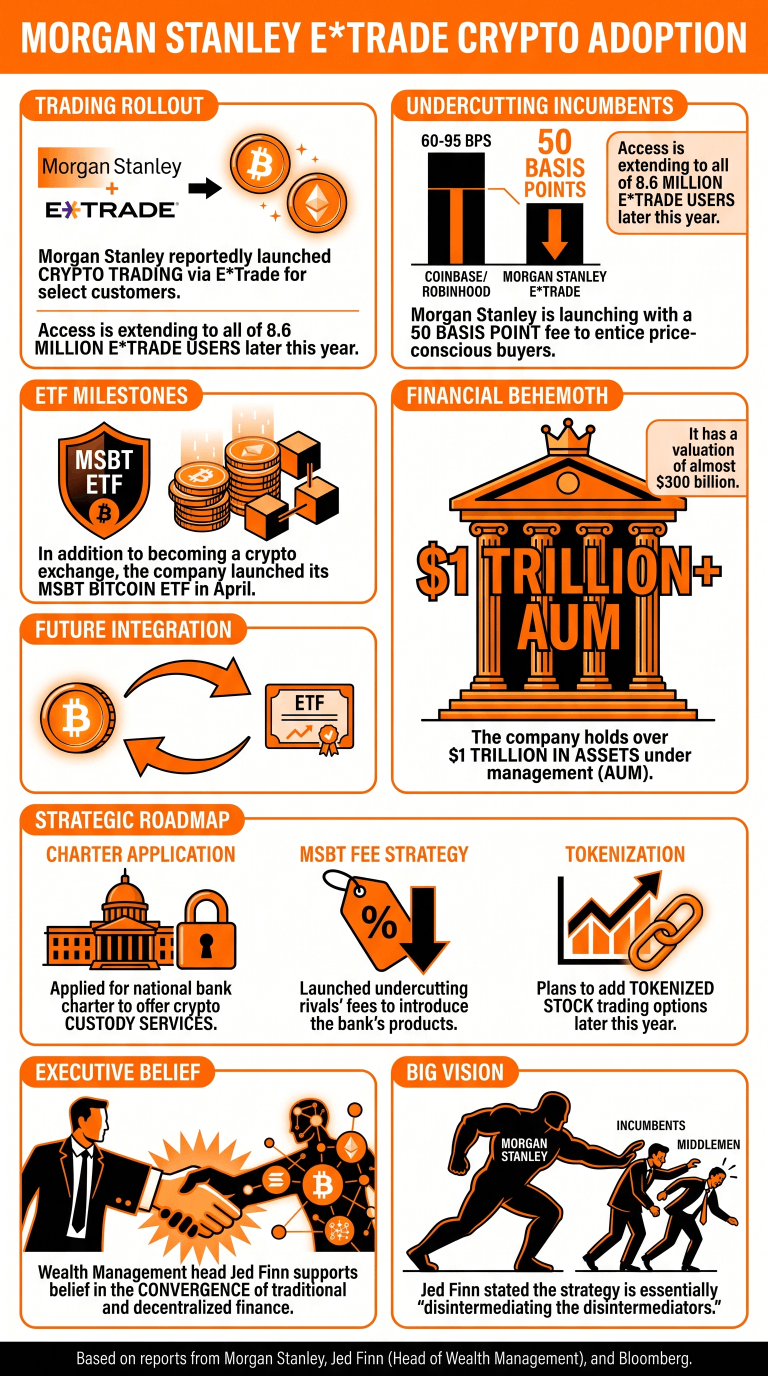
The move completes a crypto milestone for the company, which has not only become a crypto exchange but also an exchange-traded fund (ETF) operator, having launched its MSBT Bitcoin ETF in April.
Morgan Stanley’s debut in the crypto trading space aims to entice price-conscious buyers by offering cheaper fees. While incumbents like Coinbase and Robinhood charge up to 60 and 95 basis points on the dollar, Morgan Stanley is launching with a 50-basis-point fee to entice large customers.
MSBT also launched while undercutting rivals’ fees, which seems to be a strategy for introducing the bank’s products.
Morgan Stanley wants to facilitate the transition from decentralized to institutional crypto investment offerings, and is reportedly planning to add the option to convert crypto holdings into equivalent ETFs directly, according to Bloomberg.
For Morgan Stanley’s head of wealth management, Jed Finn, this is a move supporting the bank’s belief in the convergence of traditional and decentralized finance, driven by current regulatory efforts that are also pushing in that direction.
“This is much bigger than trading crypto at a cheaper rate. In a way, the strategy is disintermediating the disintermediators,” he stated.
The bank has also applied to receive a national bank charter to offer cryptocurrency custody services and plans to add tokenized stock trading options later this year.





 English (US) ·