
 2 months ago
57
2 months ago
57
- The Federal Reserve has proposed new identity verification requirements for certain stablecoin issuers.
- The rules would require some stablecoin companies to adopt customer identification programs similar to banks.
- The proposal is part of the implementation of the recently passed GENIUS Act framework.
U.S. regulators are taking another step toward formal stablecoin oversight after the Federal Reserve announced a proposal that would require certain stablecoin issuers to implement customer identification programs similar to those used by banks and credit unions.
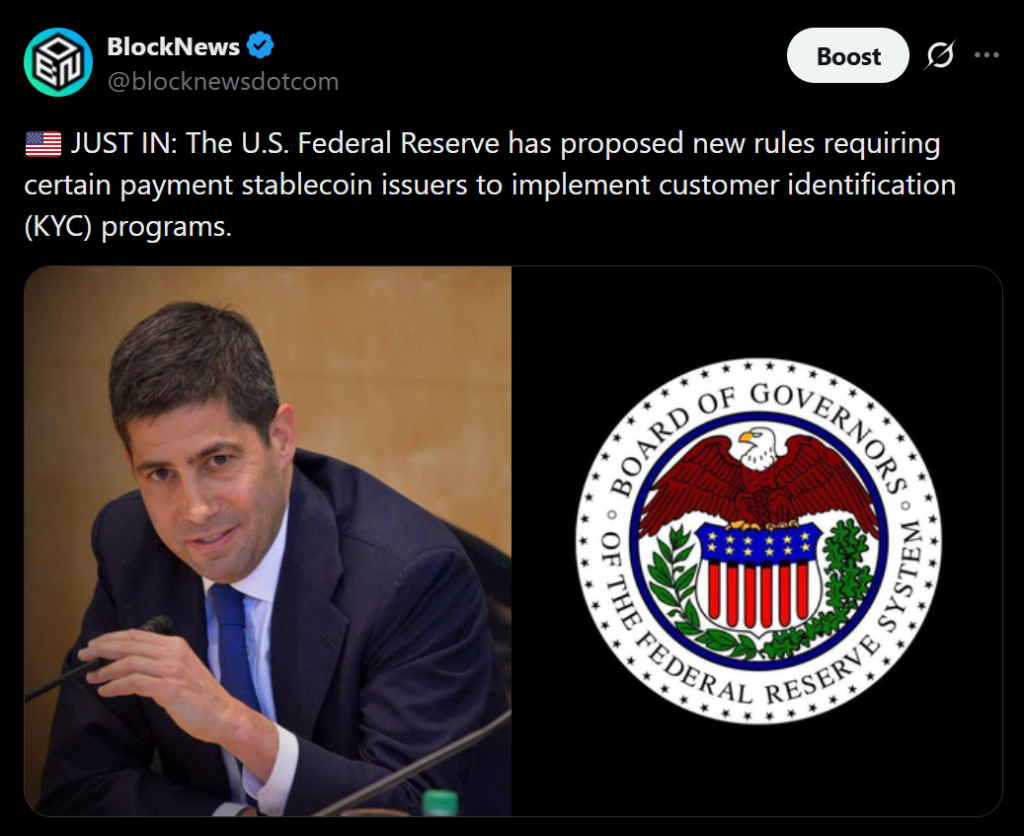
The proposal is one of the first major regulatory initiatives tied to the GENIUS Act, the landmark legislation that established a federal framework for stablecoin regulation. If approved, the new rules could significantly change how some stablecoin issuers onboard and verify customers in the United States.
Stablecoin Issuers Could Face Bank-Like Compliance Rules
Under the proposal, a specific category of stablecoin companies known as Permitted Payment Stablecoin Issuers (PPSIs) would be treated as financial institutions under the Bank Secrecy Act.
That designation would require affected issuers to establish customer identification programs designed to verify the identity of account holders and help prevent money laundering, fraud, and other illicit financial activities.
The Federal Reserve said the requirements would be comparable to those already imposed on banks and credit unions, bringing stablecoin providers closer to traditional financial institutions from a compliance perspective.
Multiple Regulators Join the Effort
The proposal was introduced jointly by several major U.S. regulatory agencies, including the Federal Reserve, the Financial Crimes Enforcement Network (FinCEN), the Office of the Comptroller of the Currency (OCC), the Federal Deposit Insurance Corporation (FDIC), and the National Credit Union Administration.
The coordinated approach highlights how seriously regulators are treating stablecoins as they become increasingly integrated into the broader financial system.
Regulators argue that stronger identity verification measures are necessary as stablecoins continue growing in popularity for payments, remittances, trading, and digital asset settlement.
GENIUS Act Begins Reshaping the Stablecoin Industry
The proposal marks another milestone in the rollout of the GENIUS Act. The legislation established a regulatory framework aimed at providing greater clarity for stablecoin issuers while introducing stricter compliance standards.

Supporters of the law argue that clearer rules could encourage broader institutional adoption of stablecoins by creating stronger consumer protections and regulatory certainty. Critics, however, worry that additional compliance burdens could increase operational costs and make it harder for smaller issuers to compete.
The proposal will remain open for public comment for 60 days after it is officially published in the Federal Register, giving industry participants an opportunity to provide feedback before any final rules are adopted.
Circle and Stablecoin Stocks React
The announcement also drew attention from investors. Shares of Circle Internet Group, the issuer behind the USDC stablecoin, declined roughly 2.2% during Thursday morning trading following the news.
While the proposal does not specifically target Circle or USDC, investors are closely watching how the new regulatory framework could affect stablecoin issuers across the industry. Companies that already maintain strong compliance programs may be better positioned to adapt, while others could face additional operational requirements.
What It Means for Crypto
For the crypto industry, the proposal signals that U.S. regulators are moving beyond broad policy discussions and into the implementation phase of stablecoin regulation. Rather than banning or restricting stablecoins, regulators appear focused on integrating them into the existing financial compliance framework.
If adopted, the rules could further legitimize stablecoins as part of the U.S. financial system while increasing oversight of issuers operating within the market. As stablecoins continue to play a growing role in crypto trading, payments, and tokenized finance, regulatory developments like these are likely to become increasingly important for the entire digital asset ecosystem.
Disclaimer: BlockNews provides independent reporting on crypto, blockchain, and digital finance. All content is for informational purposes only and does not constitute financial advice. Readers should do their own research before making investment decisions. Some articles may use AI tools to assist in drafting, but every piece is reviewed and edited by our editorial team of experienced crypto writers and analysts before publication.







 English (US) ·