
 3 months ago
85
3 months ago
85
- Nvidia CEO Jensen Huang called fears that AI is destroying jobs “complete nonsense.”
- Huang believes artificial intelligence will create new industries, boost productivity, and generate entirely new categories of work.
- The comments come as concerns grow over whether AI will replace workers or become a tool that enhances human productivity.
Artificial intelligence has quickly become one of the most debated technologies in the world. Depending on who you ask, AI is either about to unlock a new era of innovation or trigger widespread job losses across multiple industries. Nvidia CEO Jensen Huang has made it clear which side of that debate he stands on.
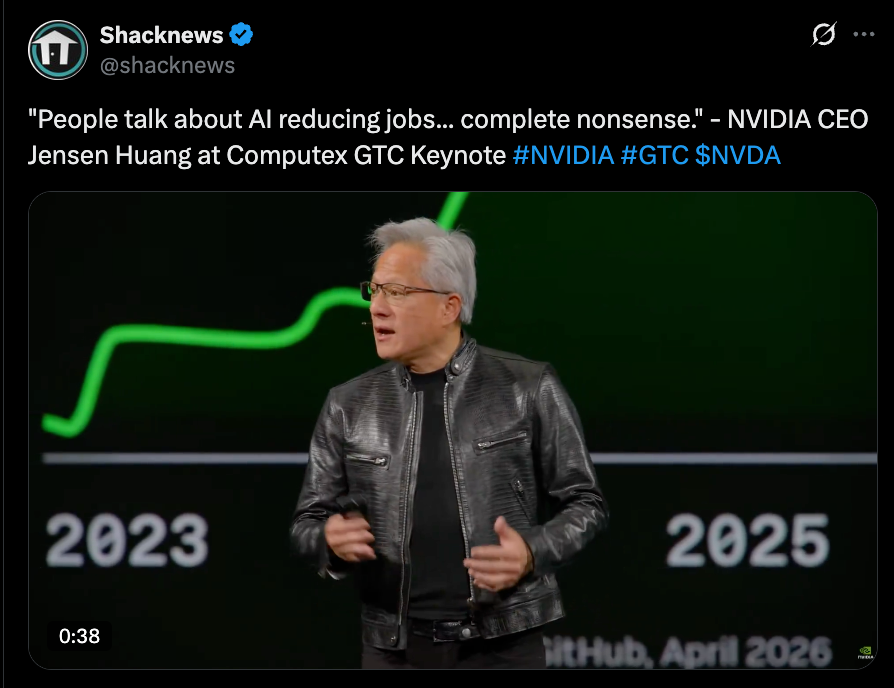
Speaking recently about growing concerns surrounding AI-driven layoffs, Huang dismissed the idea that artificial intelligence is simply replacing workers. He described the narrative as “complete nonsense,” arguing that AI is far more likely to create opportunities than eliminate them. His comments arrive at a time when headlines are increasingly focused on automation, workforce disruption, and predictions that AI could eventually replace millions of jobs.
A Different View of the AI Revolution
Much of the public conversation around artificial intelligence has centered on what jobs might disappear. Customer support, software development, administrative work, and even some creative professions are frequently mentioned as potential targets for automation.
Huang sees the situation differently. Rather than viewing AI as a replacement for human workers, he believes it will function similarly to past technological breakthroughs that improved productivity and created entirely new industries. From his perspective, AI will help people accomplish more, opening the door to jobs and business opportunities that do not currently exist.
History offers some support for that argument. Previous innovations such as personal computers, the internet, and smartphones transformed labor markets in significant ways. While certain roles declined, entirely new industries emerged around technologies that were once viewed as disruptive threats.
Critics Continue to Raise Concerns
Not everyone shares Huang’s optimism. Some researchers, economists, and technology executives have warned that increasingly capable AI systems could dramatically reshape white-collar employment. As AI becomes better at handling tasks traditionally performed by humans, critics argue that demand for certain positions may decline.

The concern is not limited to repetitive jobs. Advanced language models and AI agents are now capable of performing work that was once considered highly specialized, fueling debate about how quickly businesses may adopt automation. While few disagree that AI will create opportunities, the question remains whether those opportunities will arrive quickly enough to offset potential disruptions.
Why Investors Are Watching Closely
For Nvidia, the discussion carries enormous significance. The company sits at the center of the artificial intelligence boom, producing the chips that power everything from large language models to enterprise AI systems and advanced research projects.
If Huang’s outlook proves correct, AI adoption could drive years of business investment, productivity gains, and economic expansion. That would create additional demand for computing infrastructure, benefiting not only Nvidia but the broader technology sector. Investors have been closely watching AI developments because the technology’s long-term impact could reshape entire industries and generate substantial new markets.
The Future May Be More About Adaptation Than Replacement
The debate over artificial intelligence and employment is unlikely to disappear anytime soon. As AI tools become more powerful, businesses will continue exploring ways to integrate them into everyday operations. Some roles will undoubtedly change, and certain tasks may become automated.
Huang’s argument is that this process should not automatically be viewed as a negative outcome. Technology has historically altered how people work rather than eliminating the need for human contribution altogether. While transitions can be challenging, new technologies often create opportunities that were difficult to imagine beforehand.
Whether AI ultimately transforms jobs, replaces some of them, or creates entirely new industries remains one of the defining economic questions of this decade. Jensen Huang has made his position clear: betting against human adaptability has rarely worked in the past, and he does not expect artificial intelligence to be the exception.
Disclaimer: BlockNews provides independent reporting on crypto, blockchain, and digital finance. All content is for informational purposes only and does not constitute financial advice. Readers should do their own research before making investment decisions. Some articles may use AI tools to assist in drafting, but every piece is reviewed and edited by our editorial team of experienced crypto writers and analysts before publication.








 English (US) ·