
 3 hours ago
20
3 hours ago
20
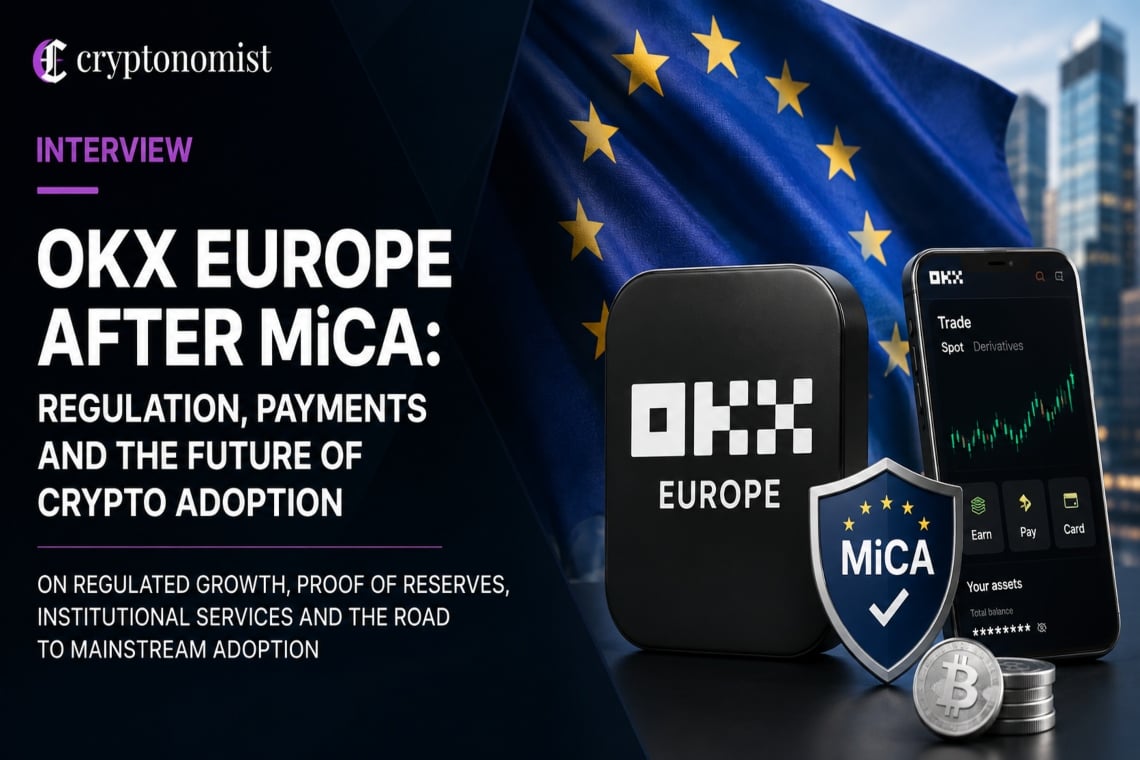
A new interview by The Cryptonomist explores OKX Europe’s post-MiCA strategy, the evolution of the European regulatory landscape, and the next phase of crypto adoption. The discussion also covers Proof of Reserves, payments, institutional services, and the growing convergence between traditional finance and crypto platforms.
- Many exchanges struggled with the transition to MiCA. What were the biggest operational challenges OKX faced in adapting its European business to the new regulatory framework?
We got our MiCA licence in January 2025, eighteen months before the July 2026 deadline. So the real challenge wasn’t a last-minute sprint, it was building the full regulated stack early: MiCA for spot and custody, MiFID II for derivatives, a Payment Institution licence for payments. Three separate authorisations, each with its own capital requirements, governance standards and years of supervisory engagement.
It also meant that when July 1 actually hit, we weren’t reacting. A lot of the industry is only just getting there.
- What is the next phase of growth for OKX Europe? Are you focusing more on retail adoption, institutional clients, payments, or new financial products?
All of it. We’ve spent years building a comprehensive regulated crypto product stack to meet almost every financial need in one app. Since launching spot we’ve built Earn, liquid staking, OKX Pay and Card for everyday spending, and X-Perps, MiFID II regulated derivatives for eligible users.
Customers don’t want five different apps to trade, get paid and earn yield. They want one regulated place to do it all. That’s where we’re putting the resource, retail and institutional both. Institutional gets a regulated derivatives venue it didn’t have from us before. Retail gets a platform that offers everything they need.
- Europe is becoming one of the most regulated crypto markets globally. How do you expect user behaviour to change as customers increasingly prioritise regulated platforms?
It’s already happening, our own transaction data shows it. Deposits into OKX Europe from unlicensed exchanges have grown enormously, not only as we approached the transition deadline in June but through July and into August.
A licence used to be nice to have. Now it’s mandatory.
- Do you believe MiCA will accelerate consolidation in the European crypto market, and does OKX see opportunities to acquire users, technology, or businesses from competitors that cannot meet the new requirements?
Consolidation is real. Before the deadline we estimated 80% of exchanges operating in Europe wouldn’t meet the bar. Now, with more than 320 CASPs authorised, you can see who cleared it and who didn’t. We have been approached by platforms operating in Europe looking for ways to exit the market and migrate their clients to a regulated exchange. But we have nothing to announce on that front for now.
- What role do you see Europe playing in OKX’s global strategy over the next five years? Could Europe become one of OKX’s most important markets?
Our EU headquarters is in Malta, our MiCA licence gives us a full EU passport across the bloc, and Europe is where we’ve built one of the most complete regulated product stacks anywhere in the world, spot, derivatives, payments, all under one roof.
Europe is where OKX proves the regulated model works.
- How will OKX’s post-MiCA Proof of Reserves evolve? Will users see more frequent reporting, additional verification methods, or greater transparency around liabilities as well as assets?
Proof of Reserves isn’t a MiCA requirement. It’s a transparency commitment we’ve made on top of what the regulation demands, and we’ve published it monthly for years.
- A common criticism of Proof of Reserves is that proving assets alone does not always show the full financial picture. How is OKX addressing questions around liabilities, risk management, and overall solvency?
Proof of assets is a valuable transparency measure, but by itself doesn’t tell you if a company is genuinely segregating customer assets or can survive a bad quarter.
Here’s where I’d point people instead: the solvency check that actually matters for a MiCA and MiFID II licensed entity isn’t PoR. It’s the prudential requirements our regulators enforce, asset segregation, capital buffers, governance, ongoing supervision. PoR is additional transparency on top of that.
- After MiCA, what is the biggest challenge for crypto exchanges in Europe: regulation, user education, competition with traditional finance, or something else?
Regulation used to be the hard part. Now, with more than 320 CASPs authorised, a licence is table stakes rather than a differentiator. The harder job is retention.
User education still matters, most people don’t know which platforms are actually authorised. But if I had to pick one thing, it’s building enough value that users have a reason to stay rather than shop around every time a competitor cuts a fee.
- What crypto use case do you believe will drive the next wave of mainstream adoption in Europe beyond trading?
Payments. Trading got crypto taken seriously. Spending it day to day, without thinking about it, is what gets it adopted by people who’ve never touched a crypto exchange before. That’s why we built OKX Card and Pay for Europe.
The moment crypto in your account works like money in your bank account, pay a bill, tap a card, send a friend some, you’ve moved past investment and into infrastructure. That’s a real use case.
- If we look ahead to 2030, how do you expect the relationship between traditional finance and crypto platforms like OKX to evolve?
Closer than most people in either camp may be comfortable admitting. We’ve been a custody and real-world-asset partner with Standard Chartered since October 2024. I think that partnership is a preview of where this goes.
By 2030 I don’t think we’ll necessarily be all the way there. But we could be seeing which regulated platforms, from either side, are holding the infrastructure everyone else builds on.






 English (US) ·