
 2 months ago
90
2 months ago
90
In 2025, OpenAI raised funding at a $300 billion valuation. That number didn’t come from a single product launch or a breakthrough sitting in a lab somewhere. It came from usage, hundreds of millions of people opening ChatGPT every day, asking it questions, writing code with it, drafting emails through it, editing documents, building entire workflows around it, for years on end. That accumulated usage is the actual asset behind the valuation. It’s what proved the product worked at scale, what justified the pricing, and what ultimately convinced investors the company was worth funding at that number.
However, none of the people who generated that usage own any part of what it built. They paid a subscription, used the product, and walked away with nothing beyond the product itself. Stargate LLM is built around a different premise: that the people generating a platform’s usage should have a way to benefit from the value that usage creates, not just the company running it.
Where the $300 Billion Actually Came From
This isn’t a criticism of OpenAI’s business model so much as a description of how it works, and how every major AI platform’s valuation works. A company’s worth is built on engagement, retention, and the size of its active user base. ChatGPT’s usage numbers are the reason a $300 billion valuation was possible at all. Anthropic followed a similar trajectory, crossing $30 billion in annualized revenue in April 2026, again driven by daily usage from people using Claude for work, research, and everyday tasks.
The structure is consistent across the industry: users generate the data, the engagement, and the subscription revenue that make these companies valuable. The equity upside from that value sits with venture capital firms and early investors. The people doing the actual using never had an ownership stake to begin with, so there’s nothing for them to be paid out from.

Why This Structure Exists
This isn’t unique to AI. It’s how venture-backed software has worked for two decades. Google’s search engine ran on free usage from billions of people while a small group of early backers and employees became billionaires. The pattern repeats because private companies aren’t required to offer public equity, and by the time an IPO happens, if it happens at all, the earliest and steepest growth has usually already occurred. The users who built the company’s value in the meantime were never in a position to hold any of it.
AI has simply made this pattern more visible, because the scale is bigger and the growth is faster. A $300 billion valuation built substantially on usage is a bigger number than most historical examples, which is part of why it’s drawing more attention now than the same dynamic did with earlier tech platforms.
What Stargate LLM Does Differently
Stargate LLM is built around a different assumption: that usage itself should generate a return for the person doing the using, not just for the company running the platform. The mechanism for this is Proof of Usage, one of the largest allocations in Stargate’s tokenomics, with 50% of the total 150 billion coin supply, 75 billion Stargate coins, set aside specifically to reward users for real platform activity: conversational AI queries, image and video generation, referrals, staking, and structured feedback that improves the models.
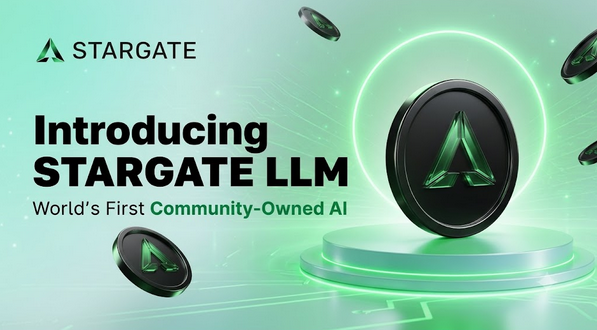
This is a structural difference, not a marketing claim. The Stargate coin is required for core platform functions, subscriptions, credits, premium model access, which means usage and coin demand are directly connected from day one. Staking in the Stargate Vault adds a second layer: locked coins earn rewards drawn from platform revenue and the usage rewards pool, with governance votes determining how a portion of that revenue gets distributed to stakers over time. It means that the people generating the platform’s usage have a mechanism to benefit from that usage that ChatGPT and Claude’s user bases simply don’t have.
Stargate’s presale is where early access to this model is currently priced. It runs across ten escalating batches, from $0.0005 up to $0.0125, building toward a $0.025 launch price target, with Batch 1 entering at a 50x ratio to that target. Of the fixed 150 billion coin supply, 96% is allocated to community, ecosystem, and presale participants, with just 1% going to the core team, a deliberate contrast to the ownership concentration typical of venture-backed AI companies.
The Bottom Line
OpenAI’s $300 billion valuation and Anthropic’s $30 billion in revenue are both real, and both were built substantially on usage from people who hold no stake in either outcome. That’s not a flaw specific to those two companies; it’s how the current AI industry is structured almost everywhere, from Google to SpaceX to every major venture-backed platform before them. Stargate LLM’s bet is that a meaningful share of AI’s next phase of growth can be built differently, with usage rewarded directly rather than only benefiting the platform running it. The mechanism for that already exists in the tokenomics: Proof of Usage rewards, Vault staking, and governance-directed revenue distributions, all tied to the same coin users are already spending on the platform. The presale is where that structure starts, open to anyone with a wallet, not just the investors who got there first.
Explore Stargate LLM:
Website: Stargate.org
Buy: own.Stargate.com
Telegram: https://t.me/StargatellmOfficial
Twitter/X: https://x.com/Stargatellm
The post OpenAI Built a $300 Billion Valuation on ChatGPT’s Usage – Stargate LLM Is Sharing That Upside With Users appeared first on Blockonomi.



 English (US) ·