
 3 months ago
47
3 months ago
47
- OpenAI misses user and revenue targets despite massive funding
- Internal concerns grow over ability to cover data center costs
- Broader AI infrastructure bets now face increased uncertainty
OpenAI is starting to miss the numbers it once set for itself, and that’s beginning to matter in a bigger way than just one company falling short. The firm didn’t hit its target of one billion weekly ChatGPT users by the end of 2025, and throughout 2026, it has also struggled to meet internal revenue expectations.
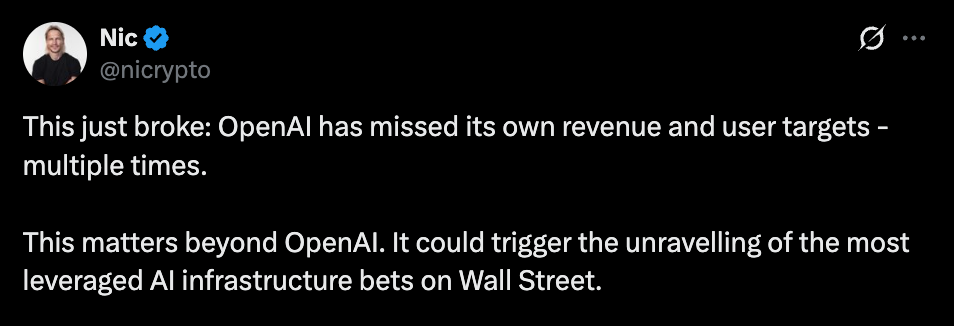
For a company sitting on massive funding and even larger infrastructure commitments, those misses feel less like minor setbacks and more like pressure building under the surface.
The Cost of Scaling Is Catching Up
The scale OpenAI is operating at isn’t small, not even close. With around $600 billion tied up in long-term data center commitments, the business model depends heavily on continued growth, both in users and revenue.
When that growth slows, even slightly, the math starts to look tighter, and what once felt like aggressive expansion can begin to resemble overextension.
Internal Concerns Are Starting to Surface
Behind the scenes, there are signs of unease. Reports suggest CFO Sarah Friar has raised concerns internally about whether the company can meet its future financial obligations if revenue doesn’t accelerate.
At the same time, leadership has pushed back publicly, dismissing those concerns, though historically, that kind of response doesn’t always settle investor nerves the way it’s intended to.
Competition Is Closing the Gap
Part of the challenge comes from rising competition. Platforms like Google’s Gemini and Anthropic are gaining ground, particularly in areas like enterprise use and coding tools, which were once seen as OpenAI’s strongest territory.

That shift is subtle, but meaningful, because it suggests the market is becoming more competitive just as OpenAI needs growth to stay strong.
The Ripple Effect Across the Industry
What makes this situation more significant is how many other players are tied to OpenAI’s trajectory. Large-scale infrastructure investments, including billions in debt-backed projects, were built on the assumption that OpenAI’s growth would continue at a rapid pace.
If that assumption weakens, it doesn’t just affect one company, it forces a reassessment across the entire AI ecosystem.
A Turning Point for the AI Boom
The AI industry has been operating on the idea that adoption would outpace spending, that demand would justify the scale of investment. OpenAI’s recent performance suggests that gap might be wider than expected.
It’s not necessarily a collapse, but it is a shift, and one that could force companies, investors, and the market as a whole to rethink how sustainable this pace of growth really is.
Disclaimer: BlockNews provides independent reporting on crypto, blockchain, and digital finance. All content is for informational purposes only and does not constitute financial advice. Readers should do their own research before making investment decisions. Some articles may use AI tools to assist in drafting, but every piece is reviewed and edited by our editorial team of experienced crypto writers and analysts before publication.







 English (US) ·