
 1 month ago
52
1 month ago
52
- Phantom and the Hyperliquid Policy Center are urging the CFTC to modernize regulations for decentralized, onchain markets.
- The groups argue that software developers and non-custodial wallet providers should not be required to register simply for building blockchain infrastructure.
- They also want regulated exchanges to be allowed to use onchain technology for trading, clearing, and settlement.
Phantom Technologies and the Hyperliquid Policy Center (HPC) have jointly called on the U.S. Commodity Futures Trading Commission (CFTC) to modernize its regulatory framework for decentralized financial markets. The proposal argues that current rules were written for traditional financial intermediaries and fail to reflect how modern blockchain-based markets operate.
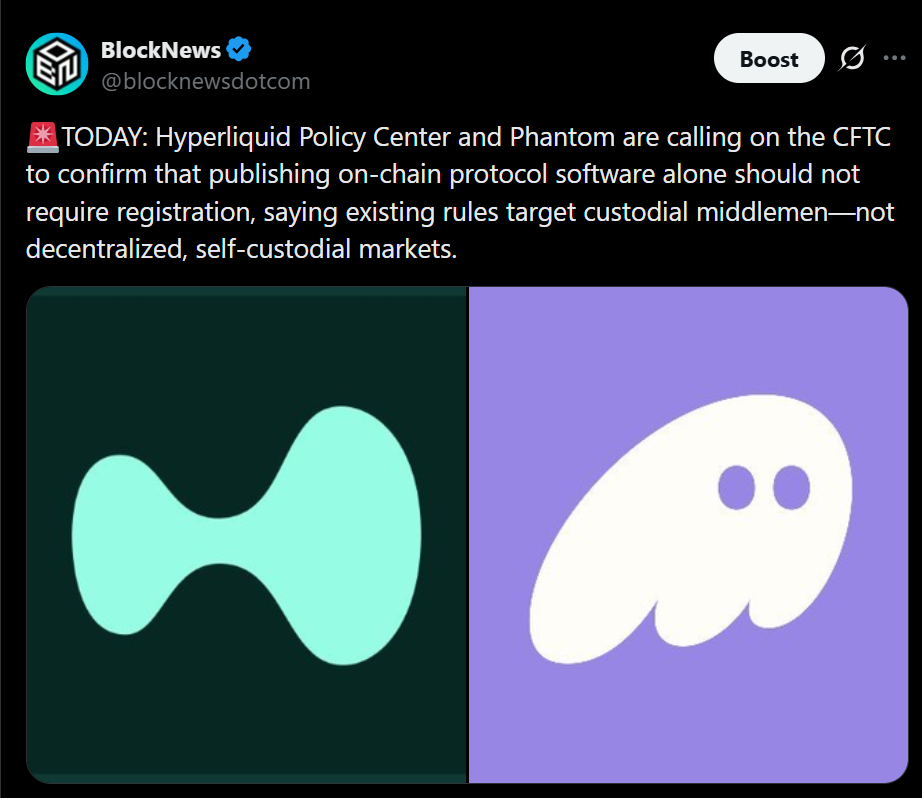
The filing responds to the CFTC’s recent request for public feedback on regulations that may prevent fintech companies from working with regulated financial institutions and market infrastructure providers.
Developers Shouldn’t Be Treated Like Financial Intermediaries
A central argument in the filing is that simply developing or contributing to onchain software should not automatically require registration with the CFTC.
According to Phantom and HPC, existing regulations largely assume a custodial model where intermediaries control customer funds and execute trades. In contrast, decentralized protocols often allow users to retain full control of their assets while interacting directly with blockchain networks.
The groups argue that registration requirements should only apply to businesses that actually custody customer funds, handle orders, or execute transactions on behalf of clients—not software developers or blockchain protocols operating independently.
Bringing Onchain Infrastructure Into Regulated Markets
The filing also proposes allowing regulated financial institutions to integrate decentralized blockchain infrastructure into their existing operations.
Under the proposal, designated contract markets could use onchain protocols for trade matching and execution, while derivatives clearing organizations could leverage blockchain technology for collateral management, settlement, clearing, and default processing.
Supporters believe these changes could improve efficiency while maintaining regulatory oversight.
Phantom Wants Regulatory Certainty
Phantom also urged the CFTC to convert its previously issued no-action letter into a formal rule.

The no-action letter provided regulatory relief for Phantom’s non-custodial wallet services because the company does not hold customer funds, manage private keys, execute trades, or act as an intermediary between users.
Phantom and HPC argue that formal rulemaking would provide greater legal certainty for other wallet providers and blockchain interfaces operating under similar non-custodial models.
Expanding Access to Onchain Markets
Although Phantom already integrates Hyperliquid through its interface, the feature is currently unavailable to users in the United States.
The organizations say they are working together to establish a regulatory framework that would eventually allow Americans to access onchain derivatives markets under CFTC oversight. If adopted, the proposed changes could represent a significant step toward integrating decentralized financial infrastructure into the regulated U.S. financial system while preserving user self-custody and encouraging innovation.
Disclaimer: BlockNews provides independent reporting on crypto, blockchain, and digital finance. All content is for informational purposes only and does not constitute financial advice. Readers should do their own research before making investment decisions. Some articles may use AI tools to assist in drafting, but every piece is reviewed and edited by our editorial team of experienced crypto writers and analysts before publication.







 English (US) ·