
 2 months ago
57
2 months ago
57
The letters examine the growing influence of artificial intelligence (AI) on today’s and future human lives and call to remain “profoundly human.” Leo XIV acknowledges that AI changes the current Social Doctrine and calls for protecting jobs and the role of work in the economy.
Key Takeaways
- Pope Leo XIV’s 1st AI encyclical warns that unregulated tech threatens labor, demanding new social rules next.
- The Catholic Church rejects using AI just for profit, next urging markets to prioritize a human-centric goal.
- Pope Leo XIV next urges global regulators to shift away from GDP toward a new metric for overall well-being.
Pope Leo XIV Issues First AI Encyclical Letter: Humanity Must Remain “Profoundly Human”
Artificial intelligence (AI) technology and recent developments affecting human labor and its significance have pushed today’s religions to examine these circumstances and adapt their dogma to these new times.
On Monday, Pope Leo XIV, the first American and Peruvian pope, published his first encyclical letter dealing with this issue, titled MAGNIFICA HUMANITAS. The document seeks to issue recommendations to magnify the human person in the age of artificial intelligence, considering that this technology should not be classified as a force antagonistic to humanity, but that it “can cause harm when not oriented toward the good.“
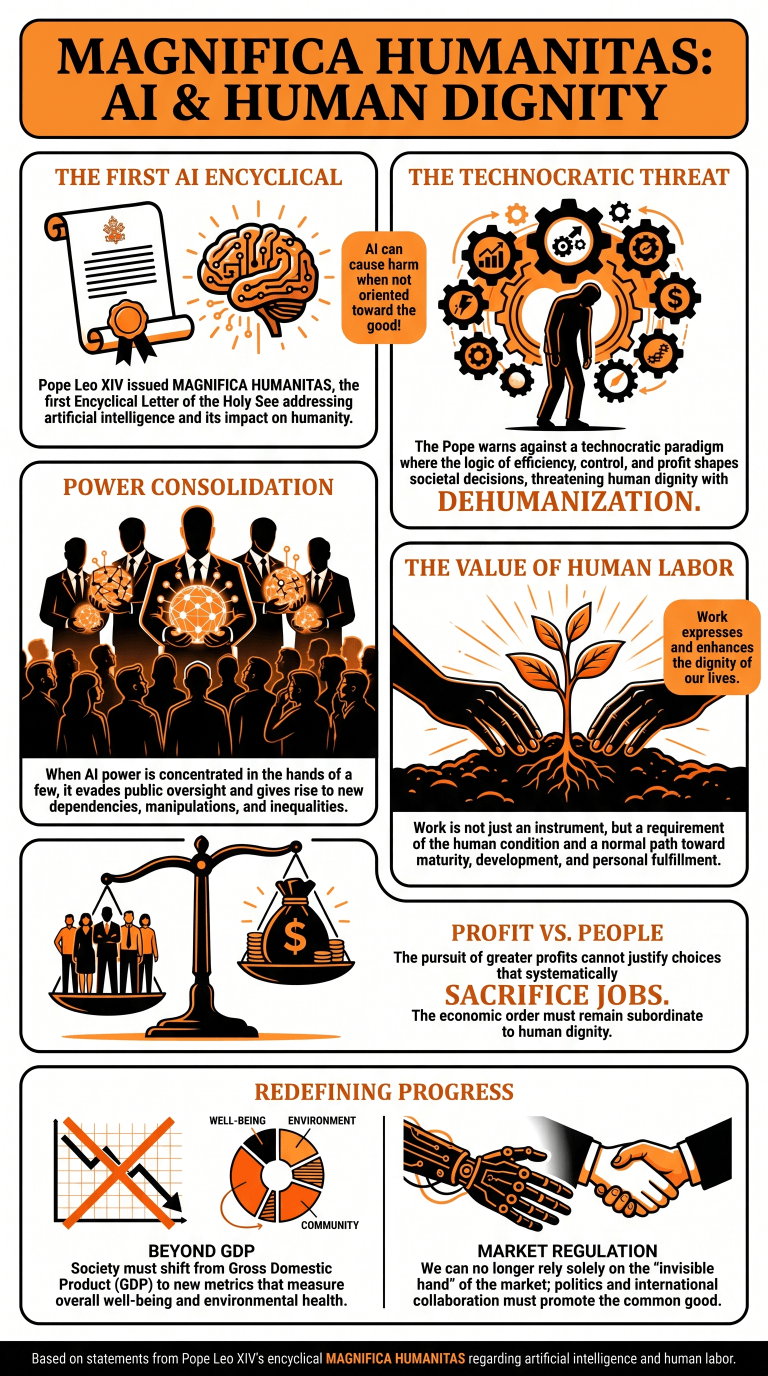
In the document, Leo XIV addresses several of the church’s concerns, acknowledging the age of transformation humanity is passing through after the surge of AI, calling to remain “profoundly human” as “human dignity is threatened by new forms of dehumanization.”
The chief of the Catholic Church warns about the rise of a technocratic paradigm, cemented in the tendency to “let the logic of efficiency, control and profit alone shape personal, social and economic decisions,” and warns about the effects of a few wielding AI. “When such power is concentrated in the hands of a few, it tends to become opaque and evade public oversight, increasing the risk of distorted forms of development that give rise to new dependencies, exclusions, manipulations, and inequalities,” he expressed.
The value of work and the new role of the human being in the work environment are also part of Leo XIV’s analysis. His Holiness claims that “work is not simply an instrument; it expresses and enhances the dignity of our lives,” labeling it as “a requirement of the human condition, a normal path toward maturity, development and personal fulfilment.”
In light of how some AI industry figureheads are claiming that AI might result in a wave of unemployment, Leo XIV claimed that, to the eyes of the church:
“The pursuit of greater profits cannot justify choices that systematically sacrifice jobs, because the human person is an end, not a means, and the economic order must remain subordinate to human dignity and the common good.”
To this end, the pope warns that we must shift from current economic metrics, including Gross Domestic Product (GDP), to new definitions that take the overall well-being of people and the environment into account.
“In the age of AI and robotics, it is no longer possible to rely solely on the ‘invisible hand’ of the market,” he concluded, claiming that politics and regulations, as well as international collaboration, must be set to promote social inclusion, the common good, and dignified work.








 English (US) ·