
 1 hour ago
11
1 hour ago
11
Ripple, Clearpool and Cicada Partners are building an institutional lending market on the XRP Ledger using RLUSD as the credit asset. The initiative aims to move DeFi yield away from trading-driven strategies and toward loans backed by real business demand.
Key Takeaways
- Clearpool and Cicada are building RLUSD lending on XRPL after $930M+ in Clearpool loans.
- Ripple’s RLUSD model targets the 98% of DeFi yield still driven by market mechanisms.
- XRPL mainnet launch depends on XLS-65 and XLS-66 winning governance approval.
Ripple, Clearpool and Cicada Shift DeFi Yield Toward Real Business Credit
Ripple is backing a new institutional credit initiative on the XRP Ledger that will let fintechs, payment companies and crypto businesses borrow RLUSD against real working-capital needs.
The project brings together Clearpool, Cicada Partners and Ripple in distinct roles. Clearpool is building the lending infrastructure, Cicada will originate and manage credit, and Ripple will invest in the fund alongside other limited partners on equal terms.
The companies argue that much of today’s DeFi yield is still generated by looping, arbitrage, basis trades and liquidity incentives rather than lending to productive businesses. They estimate that roughly 98% of DeFi yield comes from market mechanisms.
The new model is intended to provide a more traditional source of return: interest paid by operating companies.
XRPL Lending Push Targets Real-World Borrowers
Clearpool, which says it has facilitated more than $930 million in institutional loans since 2021, will use XRPL’s proposed Lending Protocol and Single Asset Vault architecture.
Cicada, which has underwritten more than $860 million, will act as fund general partner and credit pool manager. Its role includes sourcing borrowers, setting covenants, and monitoring credit quality.
Ripple will supply capital and settlement infrastructure, but it will not act as a backstop.
The loans will be denominated in RLUSD, Ripple’s regulated dollar stablecoin. Borrowers are expected to include fintech and payments companies that already use stablecoins for treasury and cross-border activity. The firms say that structure creates a direct link between onchain lending and real economic demand.
For lenders, returns would come from borrower interest rather than crypto market incentives. For borrowers, the system offers another source of institutional capital while keeping settlement onchain.
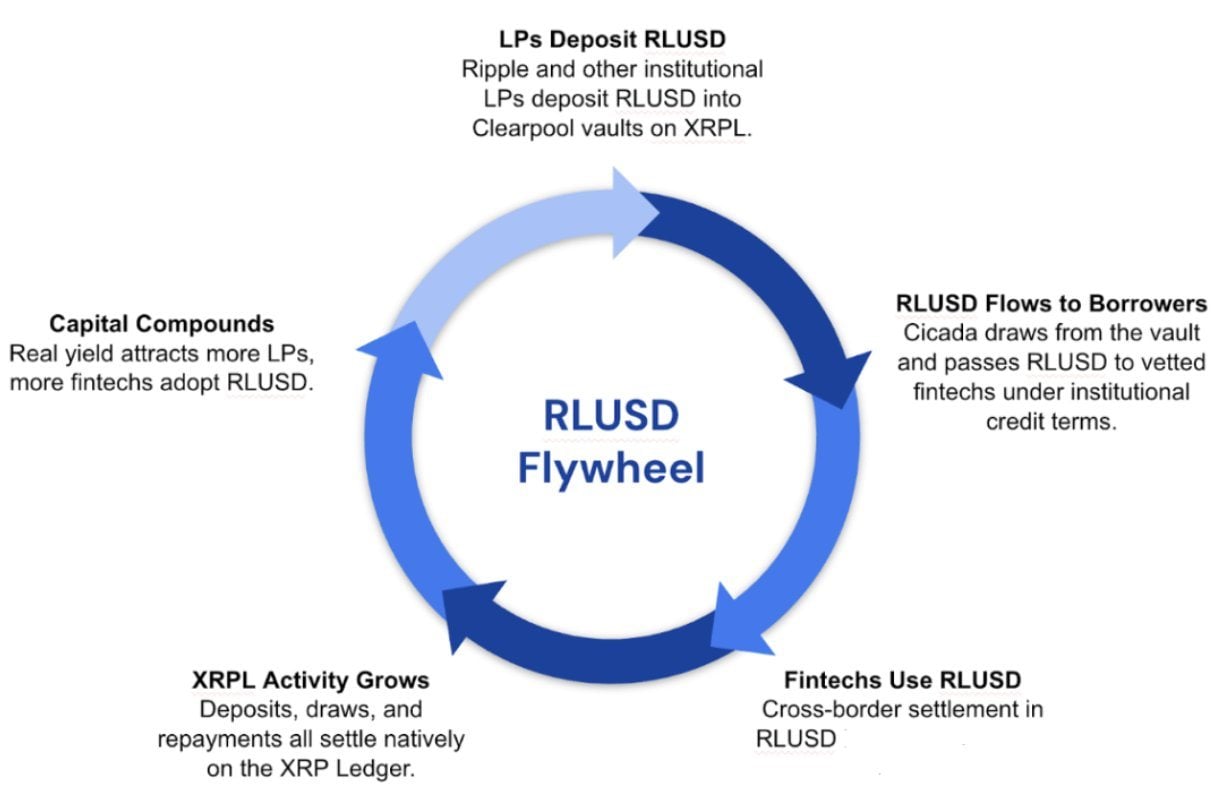 Source: @cicadacredit on X
Mainnet Launch Still Depends on XRPL Governance
The infrastructure is not yet live on XRPL mainnet.
Clearpool is currently testing the integration on Devnet. The Lending Protocol (XLS-66) and Single Asset Vaults (XLS-65) are still going through the network’s amendment voting process.
If activated, the features would allow loan issuance, repayments, and vault accounting to run natively on XRPL rather than through external smart contracts.
The system will also use XRPL features such as Permissioned Domains, Credentials, and Clawback to restrict access to verified participants and support institutional compliance requirements. XRP would continue to serve as the network’s native asset for transaction fees and reserves.
The initiative is significant because it pushes XRPL beyond its traditional payments identity. If the lending infrastructure wins approval and attracts institutional borrowers, the network could begin competing more directly in onchain private credit, one of the fastest-growing segments of tokenized finance.





 English (US) ·