
 2 months ago
47
2 months ago
47
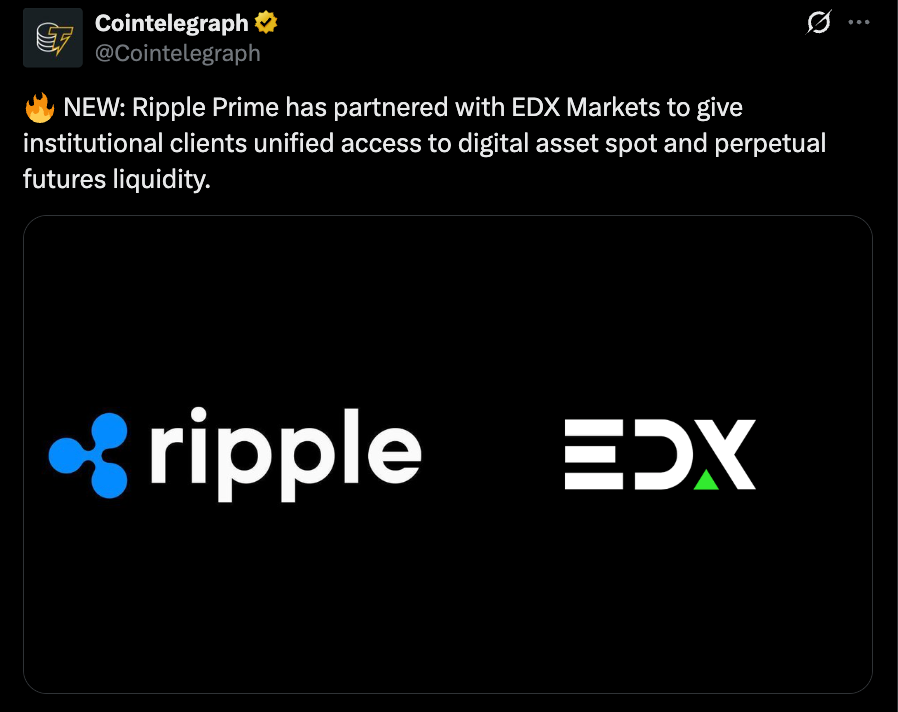
- Ripple Prime integrated with EDX Markets and EDXM International on May 19
- Institutions now gain unified access to spot and perpetual futures liquidity
- Ripple’s RLUSD stablecoin could soon become a settlement and collateral asset inside EDX
Ripple is continuing its push deeper into institutional crypto infrastructure, and this latest move feels much bigger than a standard exchange partnership announcement. Ripple Prime officially integrated with EDX Markets and EDXM International on May 19, giving institutional clients streamlined access to both spot and perpetual futures liquidity through a single prime brokerage framework.
For traditional finance firms that have spent years juggling fragmented crypto venues, multiple counterparties, and constant collateral management headaches, this is the kind of upgrade that actually matters operationally. Instead of spreading exposure across multiple exchanges and relationships, institutions can now consolidate activity under one integrated structure.
Ripple Is Quietly Building An Institutional Trading Stack
The broader strategy behind this integration has been unfolding for a while now. Ripple’s acquisition of Hidden Road for roughly $1.25 billion last year gave the company ownership of a global multi-asset prime brokerage platform, positioning Ripple far beyond its original image as simply the company behind XRP.
That acquisition changed the conversation around Ripple almost immediately. Prime brokerage infrastructure sits at the center of institutional trading operations because it helps large firms manage execution, financing, collateral, and counterparty exposure across markets.
Now, by integrating Ripple Prime directly with EDX Markets and EDXM International, Ripple is layering institutional-grade liquidity access on top of that existing infrastructure. This isn’t really about retail users anymore. It’s increasingly about becoming one of the few crypto-native firms capable of servicing large financial institutions at scale.
Institutions Want Fewer Counterparties And Less Friction
One of the biggest pain points for institutional crypto trading has always been fragmentation. Large firms often need to pre-fund positions across several exchanges simultaneously, locking up capital inefficiently while increasing operational and counterparty risk.
Ripple Prime’s unified structure attempts to solve that problem directly. Through a single relationship, hedge funds and asset managers can access both spot and perpetual futures liquidity without maintaining separate balances across multiple disconnected venues.
That kind of capital efficiency becomes extremely attractive once trading volumes scale higher. Traditional finance firms care deeply about operational simplicity, collateral optimization, and reducing exposure to exchange-related risks, sometimes even more than the actual trading products themselves.
And honestly, crypto infrastructure hasn’t historically been very good at delivering that experience cleanly.
RLUSD Could Become A Much Bigger Piece Of The Puzzle
The integration may also create a major future role for RLUSD, Ripple’s dollar-backed stablecoin. According to Ripple, RLUSD is being positioned as a potential settlement and collateral asset within the EDX ecosystem, opening the door for cross-margin functionality between spot and derivatives markets.
That’s where things could become especially important strategically. If institutions can use RLUSD efficiently across multiple trading environments without constantly relying on traditional banking rails, Ripple gains far more than just another stablecoin use case. It potentially gains infrastructure-level relevance inside institutional crypto markets themselves.
Stablecoins are increasingly becoming core settlement layers across digital finance, and the firms controlling those rails stand to benefit enormously if institutional adoption continues accelerating.
Ripple Is Starting To Look More Like Wall Street Infrastructure
At this stage, Ripple increasingly resembles a financial infrastructure company rather than a traditional crypto startup. Between the Hidden Road acquisition, expanding institutional integrations, and RLUSD’s growing role, the company appears focused on building an end-to-end trading and settlement ecosystem for large-scale market participants.
The EDX integration feels like another deliberate step in that direction. And if RLUSD eventually becomes embedded as a widely used collateral asset across institutional crypto trading, Ripple’s position inside the broader market could evolve substantially beyond XRP alone.
For now, though, the message is becoming pretty clear. Ripple isn’t just trying to participate in institutional crypto adoption anymore, it’s trying to become part of the infrastructure institutions rely on once they fully arrive.
Disclaimer: BlockNews provides independent reporting on crypto, blockchain, and digital finance. All content is for informational purposes only and does not constitute financial advice. Readers should do their own research before making investment decisions. Some articles may use AI tools to assist in drafting, but every piece is reviewed and edited by our editorial team of experienced crypto writers and analysts before publication.







 English (US) ·