
 1 month ago
46
1 month ago
46
- Ripple’s RLUSD stablecoin has received regulatory approval for use in Japan.
- The approval allows both retail and institutional users to access RLUSD through SBI VC Trade.
- Japan’s strict regulatory framework strengthens RLUSD’s credibility as Ripple expands its global stablecoin strategy.
Ripple has secured a significant regulatory victory after its U.S. dollar-backed stablecoin, RLUSD, received approval for use in Japan. The authorization opens the door for Ripple to enter one of Asia’s most tightly regulated cryptocurrency markets and marks another step in the company’s effort to expand its stablecoin business worldwide.
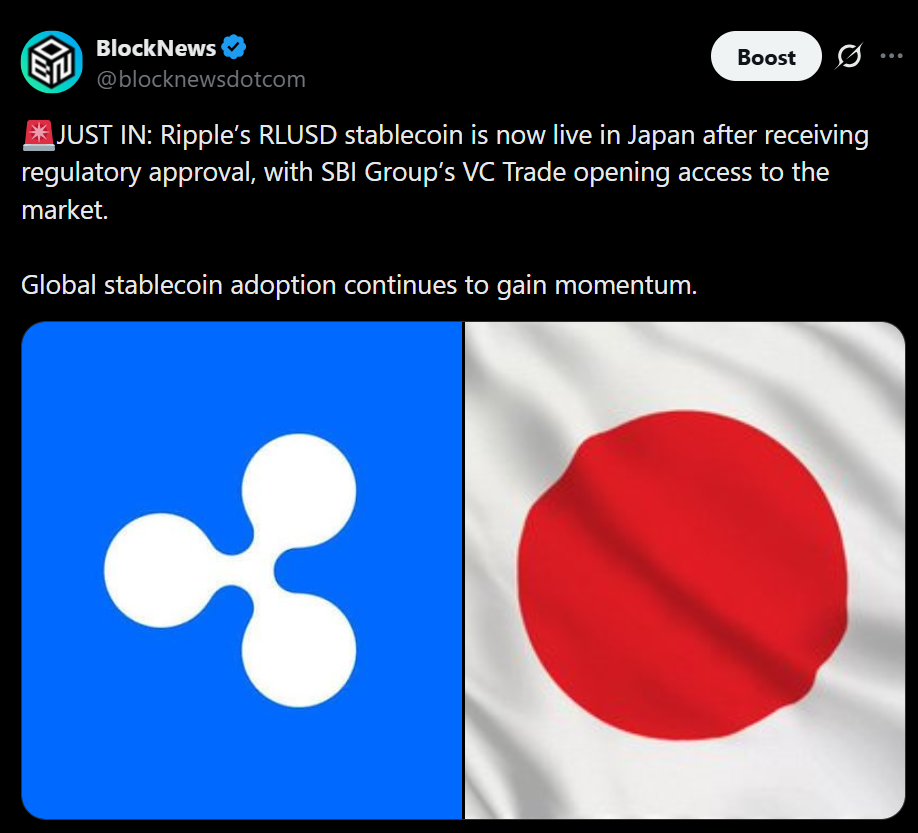
The approval was granted by Japan’s Financial Services Agency (FSA), which classified RLUSD as an electronic payment instrument under the country’s Payment Services Act. The designation allows the stablecoin to be offered through SBI VC Trade, the digital asset platform operated by Japanese financial giant SBI Group, making RLUSD available to both institutional and retail users.
Japan’s Approval Carries Significant Weight
Japan is widely recognized for having one of the strictest regulatory frameworks for stablecoins. Unlike many other jurisdictions, foreign-issued stablecoins must satisfy rigorous legal and compliance requirements before being approved for public use.
Receiving approval from Japanese regulators provides Ripple with a valuable level of credibility as governments around the world continue introducing clearer rules for digital assets. For financial institutions seeking regulated blockchain payment solutions, the approval could make RLUSD a more attractive option for cross-border transactions and digital settlements.
The launch also fulfills a memorandum of understanding signed by Ripple and SBI in August 2025, while building upon a partnership that dates back to 2016. Over the past decade, the two companies have collaborated extensively on blockchain infrastructure and cross-border payment solutions throughout Asia.
RLUSD Expands Ripple’s Stablecoin Strategy
Ripple launched RLUSD in late 2024 as part of its broader strategy to compete in the rapidly growing stablecoin market. Unlike XRP, which serves as Ripple’s native digital asset, RLUSD is a U.S. dollar-backed stablecoin designed specifically for enterprise payments, tokenization, and collateral management.
According to Ripple, RLUSD currently has a market capitalization of approximately $1.7 billion. While impressive for a relatively new stablecoin, it remains significantly smaller than industry leaders. Tether’s USDT commands roughly $186 billion in market value, while Circle’s USDC holds approximately $74 billion.
Ripple believes RLUSD can play a key role in connecting businesses with global dollar liquidity while supporting tokenized real-world assets and institutional settlement services. Company executives have positioned the stablecoin as an enterprise-focused product rather than a direct replacement for XRP.

Competition in the Stablecoin Market Is Intensifying
The Japanese expansion comes as stablecoins receive increasing regulatory attention across major global markets, including the United States, Europe, and Asia. Rather than competing solely on liquidity, issuers are now racing to secure regulatory approvals that could unlock institutional adoption.
While Japan’s approval gives RLUSD an important competitive advantage, Ripple still faces a significant challenge in catching the dominant market leaders. USDT and USDC continue to benefit from substantially larger user bases, deeper liquidity, and broader integration across exchanges, decentralized finance platforms, and payment networks.
Still, gaining access to Japan’s regulated financial market represents a meaningful step forward. If Ripple can convert regulatory approval into increased transaction volume and institutional adoption, RLUSD could steadily strengthen its position within the global stablecoin ecosystem.
Disclaimer: BlockNews provides independent reporting on crypto, blockchain, and digital finance. All content is for informational purposes only and does not constitute financial advice. Readers should do their own research before making investment decisions. Some articles may use AI tools to assist in drafting, but every piece is reviewed and edited by our editorial team of experienced crypto writers and analysts before publication.






 English (US) ·