
 7 months ago
90
7 months ago
90
Quick Facts:
 Robinhood CEO Vlad Tenev predicts prediction markets will become a major financial asset class, driven by retail demand for hedging real-world events.
- Current blockchain infrastructure struggles to balance the speed required for prediction markets with the security of deep liquidity networks like Bitcoin.
- Bitcoin Hyper integrates the Solana Virtual Machine (SVM) on Bitcoin, offering a solution that combines sub-second latency with Bitcoin’s settlement security.
- Institutional interest is evident, with over $31.2M raised in presale and significant whale accumulation recorded on-chain.
Robinhood CEO Vlad Tenev just staked his reputation on a bold prediction: event-contract trading, better known as prediction markets, is about to become a dominant asset class.
Speaking recently on the surge of retail interest in political forecasting, Tenev suggested that platforms allowing users to hedge on real-world outcomes are rapidly moving from niche novelty to essential financial infrastructure.
He’s not wrong. The billions wagered on the 2024 U.S. elections via platforms like Polymarket prove the market is hungry for ‘truth futures’, instruments that price reality better than pundits can. But there’s a catch.
Current prediction markets face a bottleneck: they rely on networks that force a choice between speed and decentralization. You can’t usually have both.
This infrastructure gap is triggering a race for faster execution layers. While Solana has historically captured this speed-hungry traffic, the real liquidity is trapped elsewhere: Bitcoin.
That $2T capital base is largely idle. Investors are noticing this disconnect, and the massive opportunity it creates.
Capital is pivoting toward solutions that bridge this gap, driving inflows into Bitcoin Hyper ($HYPER), a project bringing high-speed programmability to the original blockchain.
Bitcoin L2 With SVM Integration Solves Latency Issues For High-Speed dApps
Let’s be honest: Bitcoin’s 10-minute block times make it useless for the real-time trading Tenev forecasts.
You can’t run a high-frequency prediction market on a network that takes that long to settle. Bitcoin Hyper ($HYPER) fixes this by integrating the Solana Virtual Machine (SVM) directly as a Layer 2 on Bitcoin. It’s not just a minor upgrade; it’s a fundamental architectural shift allowing developers to write high-performance apps in Rust while anchoring security to the Bitcoin network.
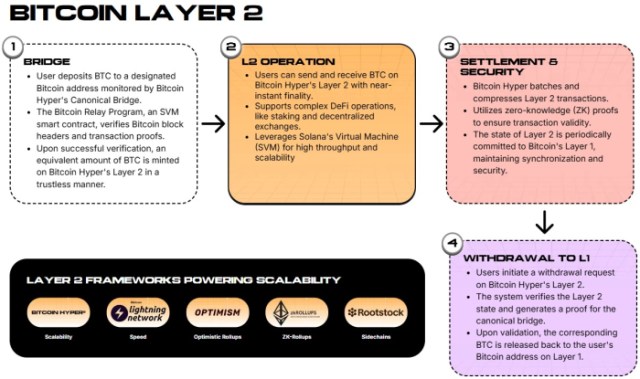
By using a decentralized canonical bridge, the project lets users move $BTC into an execution environment with sub-second finality. It mirrors the performance that made Solana famous, negligible gas fees and instant speed, minus the security trade-offs.
For developers building the next generation of prediction markets or gaming dApps, the choice between Bitcoin’s liquidity and Solana’s speed just disappeared.
The implications are huge. If prediction markets soar as Tenev suggests, the underlying rails must handle thousands of transactions per second. Bitcoin Hyper’s modular approach, separating settlement from execution, positions it as the backbone for this new asset class.
It effectively unlocks Bitcoin’s market cap for DeFi applications like swaps and lending that were previously impossible on the main chain.
Whales Accumulate $HYPER as Presale Crosses $31.2M Milestone
Smart money is already positioning for the shift. Traders are betting on a rotation of capital from idle Bitcoin into active Layer 2 yield generation.
The numbers back this up: Bitcoin Hyper has raised over $31.2M and the presale is still going.
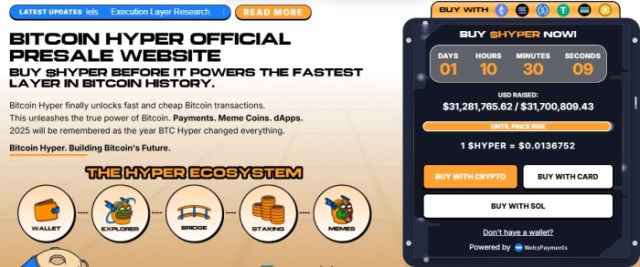
That figure highlights the massive pent-up demand for Bitcoin-native utility. With tokens currently priced at $0.0136752, the project is attracting a mix of retail participants and larger entities eyeing the SVM-on-Bitcoin narrative.
On-chain metrics reveal sophisticated actors are making moves. Etherscan records show 3 whale wallets have accumulated over $1M. The largest single transaction ($500K) is leading the herd straight into FOMO territory.
This activity suggests high-net-worth players are looking past the immediate hype cycle to the long-term infrastructure play. The vesting structure reinforces this view, a 7-day lock for presale stakers ensures capital stays committed during the initial price discovery phase.
Beyond the raw stats, staking incentives are driving this accumulation. Investors get immediate staking access after the Token Generation Event (TGE), earning rewards for governance participation. In a market where Bitcoin dominance is high but yield is scarce, the promise of APY on a Bitcoin-denominated Layer 2 acts as a powerful magnet.
Disclaimer: This article is for informational purposes only and doesn’t constitute financial advice. Cryptocurrency investments, especially presales, carry high risks including volatility and potential loss of principal. Always conduct your own due diligence before investing.








 English (US) ·