
 3 months ago
64
3 months ago
64
- Russia moves forward with sweeping crypto regulation framework
- Legal access allowed via licensed intermediaries starting July 2026
- Strict controls limit withdrawals, payments, and retail participation
Russia just took a major step toward formalizing its crypto market, but not in the way many in the industry might expect. The State Duma has passed the first reading of a new bill that would overhaul how digital currencies are handled, with overwhelming support from lawmakers.
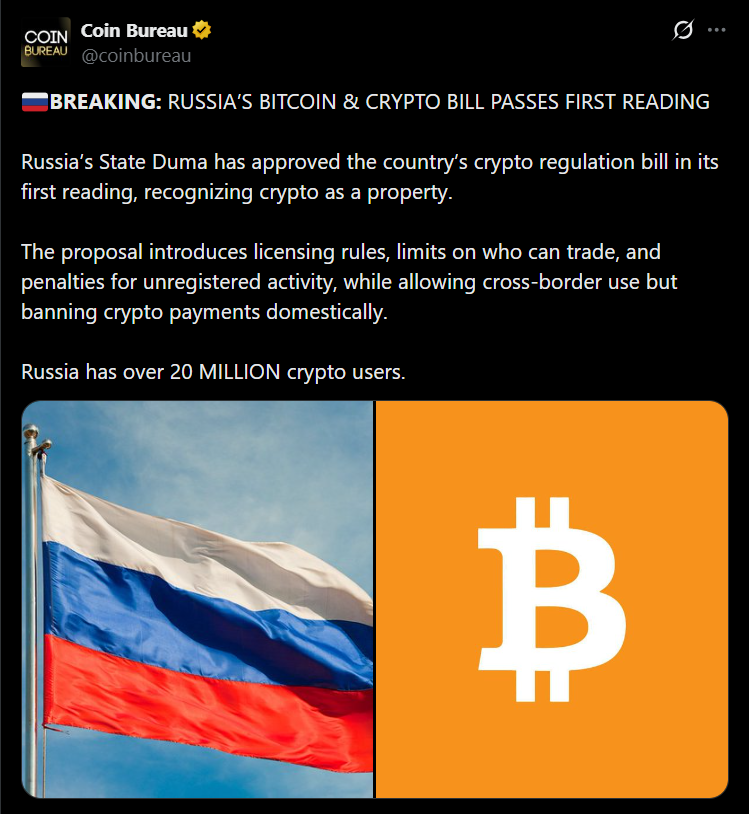
On paper, it looks like legalization. In practice, it’s more like controlled access, tightly structured, heavily monitored, and designed to keep most activity within regulated channels.
A Framework Built Around Control
The proposal introduces five types of regulated entities, including exchanges, brokers, and depositories, essentially building a full-stack system where every interaction with crypto flows through approved intermediaries.
Starting July 1, 2026, individuals and businesses will be able to buy crypto legally, but only through these licensed platforms. That’s a big shift from the current grey-zone environment, though it comes with clear limitations.
Not All Crypto Makes the Cut
Another key detail is eligibility. Only cryptocurrencies that meet high standards for market cap, liquidity, and operational history will be allowed on regulated exchanges.
That likely narrows the field significantly, favoring major assets like Bitcoin and Ethereum while leaving smaller or newer tokens outside the formal system. It’s less about innovation here, more about stability and oversight.
Payments Still Off the Table
Despite opening access, Russia is still drawing a firm line on usage. Crypto will remain banned for domestic payments, which means it won’t function as everyday money within the country.
However, it will be allowed for international trade settlements, which hints at a different strategic goal. This isn’t about retail adoption, it’s about using crypto as a tool for cross-border transactions.
The Custody Restrictions Raise Questions
One of the more controversial elements is how crypto can be stored and moved. The proposal introduces a centralized digital depository system, where withdrawals are restricted to licensed foreign institutions, not personal wallets.
That effectively removes self-custody for users within the regulated framework, which runs counter to one of crypto’s core principles. It’s a trade-off between security and control, and not everyone will be comfortable with it.
Retail Investors Face Barriers
The bill also creates a tiered system for investors. Non-qualified participants will need to pass testing requirements and may face limits on how much crypto they can buy annually.

More experienced or “qualified” investors get greater flexibility, but even then, activity remains within the boundaries of licensed infrastructure. It’s access, but with guardrails, and quite a few of them.
What Happens Next
This was only the first reading, meaning the framework is approved, but details can still change. Amendments will be proposed in the second reading, followed by a final vote before moving to the Federation Council and the president.
If everything proceeds as planned, the law could take effect by July 2026. And if it does, Russia’s crypto market will shift from loosely regulated to tightly controlled almost overnight.
A Different Kind of Adoption
What Russia is building isn’t a free crypto market, it’s a regulated system designed to fit within its broader financial structure. That might limit innovation, but it also brings clarity and legal certainty.
Whether that balance works depends on perspective. For some, it’s progress. For others, it’s crypto with the edges sanded off. Either way, it’s a model that other countries will probably be watching closely.
Disclaimer: BlockNews provides independent reporting on crypto, blockchain, and digital finance. All content is for informational purposes only and does not constitute financial advice. Readers should do their own research before making investment decisions. Some articles may use AI tools to assist in drafting, but every piece is reviewed and edited by our editorial team of experienced crypto writers and analysts before publication.








 English (US) ·