
 3 months ago
94
3 months ago
94
Key Highlights
- Samsung delivered the world’s first 12-layer HBM4E memory chip samples, featuring over 20% faster performance and 30%+ additional capacity versus prior HBM4 technology.
- Shares of Samsung climbed 5.8% during South Korean market hours; Micron (MU) advanced 2% in premarket trading.
- BNP Paribas forecasts the HBM memory sector will reach $76 billion in revenue this year, expanding to $156 billion by 2027.
- SK Hynix commands 57% of worldwide HBM revenue share; Samsung captures 22%, with Micron holding 21%.
- The HBM4E chips leverage Samsung’s 1c DRAM manufacturing process combined with a 4-nanometer foundry logic die.
Samsung Electronics announced Friday that it has delivered initial samples of its 12-layer HBM4E memory chips to clients — marking an industry milestone. The news propelled Samsung shares up 5.8% in Seoul trading, while Micron gained approximately 2% before U.S. markets opened.
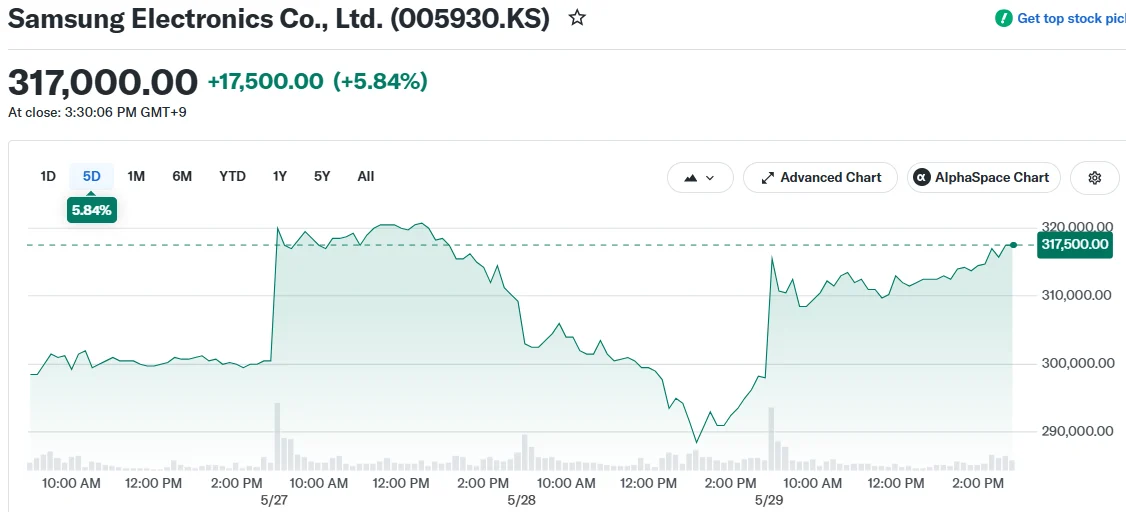 Samsung Electronics Co., Ltd. (005930.KS)
The advanced memory solution provides greater than 20% faster data throughput and over 30% increased storage capacity when benchmarked against the preceding HBM4 standard.
According to Samsung, the chip integrates its newest 1c DRAM process node — representing the company’s sixth-generation 10-nanometer-class DRAM architecture — combined with a 4-nanometer foundry logic base die.
This milestone arrives merely three months following Samsung’s February launch of standard HBM4 chip samples. The accelerated timeline underscores Samsung’s aggressive pursuit of leadership in the AI memory market.
“Samsung plans to begin mass production for HBM4E aligned with customer schedules, following initial sample shipments and optimization,” the company said in a statement.
Among Samsung’s client roster are Nvidia, AMD, and Google — industry giants fueling demand for cutting-edge memory solutions in artificial intelligence infrastructure.
The South Korean tech giant had previously indicated in April its intention to ship HBM4E samples during Q2. The company met that commitment.
Implications for Micron
Micron stands as the primary American rival to Samsung and SK Hynix in high-bandwidth memory production. While Samsung’s announcement appears competitive on its face, the market dynamics tell a more nuanced story.
Micron has publicly stated that its complete HBM4 production capacity is already allocated through 2026. This pre-sold inventory suggests Samsung’s latest advancement won’t immediately erode Micron’s position.
BNP Paribas projects the overall HBM market will more than double in 2025 to approximately $76 billion, before climbing to $156 billion by 2027. Such robust expansion provides sufficient opportunity for all three manufacturers to prosper.
As of late 2025, SK Hynix controlled the market with 57% of global HBM revenue share, per Counterpoint Research data. Samsung accounted for 22%, while Micron represented 21%.
Market Context
Micron has experienced substantial momentum in the semiconductor sector, and Samsung’s HBM4E debut appears unlikely to disrupt that trajectory given persistent supply constraints industrywide.
SK Hynix maintains its position as the HBM market leader, though Samsung is evidently narrowing the competitive distance — and doing so more rapidly than industry observers anticipated.
Nvidia, among the largest HBM chip consumers, traded up 0.78% Friday amid broadly positive sector sentiment.
Samsung’s HBM4E incorporates the company’s most sophisticated DRAM technology node to date, which Samsung claims positions the product strategically for upcoming AI computing platform demands.
The post Samsung Shares Surge 6% on First-Ever HBM4E Memory Chip Shipment appeared first on Blockonomi.



 English (US) ·