
 3 months ago
89
3 months ago
89
- Sei unveiled its Giga roadmap targeting over 200,000 transactions per second and sub-400 millisecond finality.
- The upgrade introduces Autobahn consensus, parallel execution, and asynchronous processing to boost performance.
- If successful, Sei could emerge as one of crypto’s fastest Layer 1 networks for trading, gaming, AI, and institutional adoption.
The blockchain industry has reached a point where nearly every Layer 1 claims to be faster, cheaper, and more scalable than the competition. Investors hear the same promises repeatedly, making it increasingly difficult to separate genuine technical breakthroughs from marketing campaigns. Sei‘s newly announced Giga roadmap is attempting to do exactly that by setting performance targets that stand out even in today’s crowded infrastructure race.

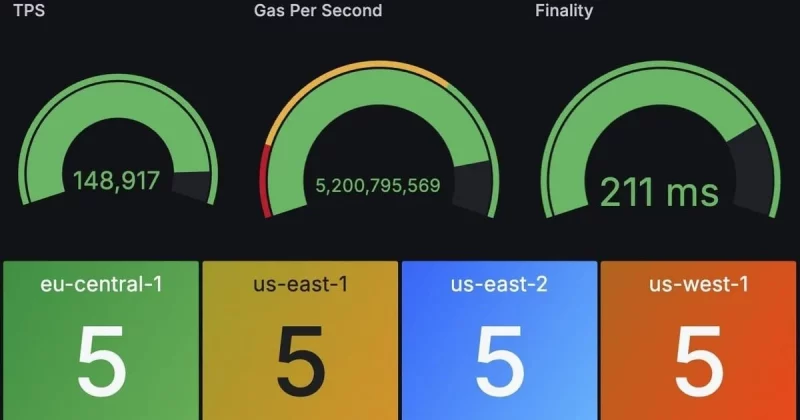
At the center of the announcement is an ambitious goal: processing more than 200,000 transactions per second while achieving transaction finality in less than 400 milliseconds. Those figures place Sei among a growing group of networks chasing ultra-high throughput, but they also raise expectations considerably. If the network can deliver on those targets, it could become a serious contender in sectors that require near-instant execution and massive transaction capacity.
Autobahn Consensus Powers the Next Phase
The foundation of the Giga roadmap is a new architecture built around Autobahn consensus, asynchronous execution, and parallel transaction processing. Rather than forcing every transaction through a single sequential workflow, the system is designed to process multiple operations simultaneously. This approach aims to reduce congestion and eliminate many of the bottlenecks that have historically limited blockchain scalability.
According to Sei’s published research and technical documentation, internal testing has already demonstrated throughput exceeding 5 gigagas per second while maintaining sub-400 millisecond finality. While real-world performance often differs from laboratory environments, the early benchmarks suggest the network is focused on pushing technical boundaries rather than making vague scalability claims. The architecture appears specifically designed for applications where speed is critical and delays are costly.
Ethereum Compatibility Remains a Priority
One advantage that may help Sei attract developers is its continued commitment to Ethereum Virtual Machine compatibility. Developers building Ethereum applications can migrate existing projects without learning an entirely new programming environment or rebuilding infrastructure from scratch. That compatibility lowers barriers to entry and could accelerate ecosystem growth if performance improvements materialize.
Developer adoption has become one of the most important battlegrounds among Layer 1 networks. Fast technology alone rarely guarantees success. Networks that combine performance with familiar tooling and strong developer support often have a much better chance of attracting long-term activity. Sei appears to be targeting both sides of that equation simultaneously.
Why High-Speed Infrastructure Matters
The next phase of blockchain adoption will likely require far more than simple peer-to-peer transfers. Artificial intelligence agents, decentralized exchanges, real-time gaming platforms, payment systems, and tokenized real-world assets all demand infrastructure capable of processing enormous volumes of transactions with minimal latency. These applications simply cannot function efficiently on slower networks.
That reality explains why investors and developers are paying attention to Sei’s roadmap. Institutional finance and high-frequency trading environments, in particular, require speed and reliability that many existing blockchains still struggle to provide. If Sei can approach its stated performance targets, it could become an attractive destination for projects seeking enterprise-grade infrastructure.
Execution Will Determine the Outcome
The Giga roadmap represents one of the most significant technical initiatives in Sei’s history. Naturally, the ambitious performance goals have generated a healthy degree of skepticism throughout the crypto industry. Blockchain development is filled with examples of networks that promised revolutionary scalability only to encounter unexpected challenges during deployment.
Still, ambitious goals are often necessary to push the industry forward. If Sei delivers even a substantial portion of what it is targeting, the network could evolve from another high-speed Layer 1 into a major infrastructure platform supporting next-generation blockchain applications. In crypto, promises attract attention, but execution earns adoption. The coming months will reveal whether Sei can transform its bold roadmap into measurable results.
Disclaimer: BlockNews provides independent reporting on crypto, blockchain, and digital finance. All content is for informational purposes only and does not constitute financial advice. Readers should do their own research before making investment decisions. Some articles may use AI tools to assist in drafting, but every piece is reviewed and edited by our editorial team of experienced crypto writers and analysts before publication.









 English (US) ·