
 1 hour ago
16
1 hour ago
16
Solana’s biggest consensus overhaul since launch has crossed a major hurdle. Alpenglow activated on testnet Sept. 24 and devnet Sept. 25, replacing TowerBFT with Votor and targeting transaction finality in just 100 to 150 milliseconds. Solana co-founder Anatoly Yakovenko declared, “You are not ready for this.” However, those speeds remain unproven under full mainnet conditions, and competing validator clients still have work to do before the transition is complete.
Key Takeaways
- Solana switched on Alpenglow on testnet Sept. 24 and devnet Sept. 25, replacing its old TowerBFT system with Votor.
- Alpenglow aims to cut Solana’s finality time from 12.8 seconds to just 100-150 milliseconds.
- Anza hasn’t set a mainnet launch date yet, and Firedancer and Frankendancer still need to add Votor support.
Solana Retires Its Old Consensus Engine on Two Public Networks
Solana just pulled off something that would have sounded like science fiction in its early days. Its Alpenglow consensus overhaul is now operating on two public test networks, with a design targeting irreversible settlement in roughly one-tenth of a second.
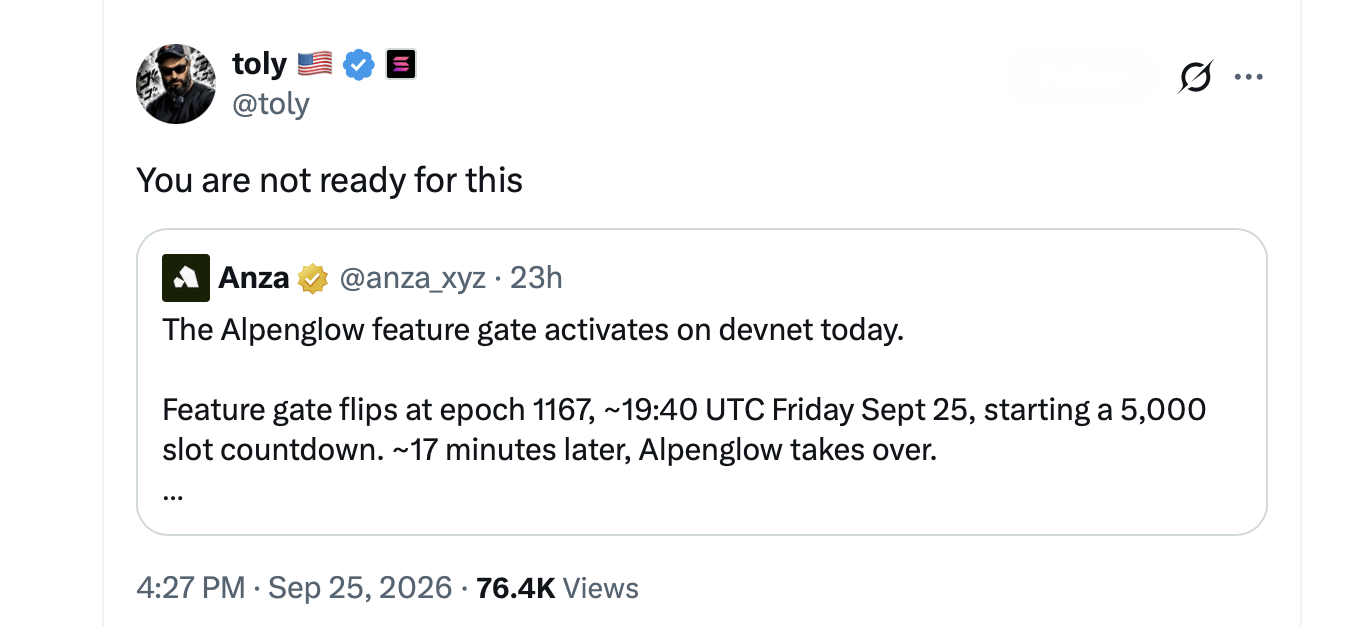 Image source: X
That’s a far cry from the approximately 12.8 seconds the network currently needs for economic finality. Co-founder Anatoly Yakovenko celebrated the devnet countdown with five words. “You are not ready for this.” Yet the real test is still ahead, and the machinery responsible for securing billions in assets hasn’t made the switch.
TowerBFT Gets the Ax After a 17-Minute Countdown
Anza, the outfit behind Solana’s Agave validator client, activated Alpenglow on public testnet Sept. 24. Following a 5,000-slot countdown lasting approximately 17 minutes, the transition finished at slot 444,625,255. The final TowerBFT block carried 82% of stake. An Alpenglow genesis block followed, retiring the previous consensus system on that cluster and handing finalization duties to Votor.
Devnet joined the party Sept. 25, completing its transition at slot 504,148,999. These weren’t entirely fresh experiments, either. A dedicated community cluster has rehearsed the change since May, including an unsuccessful early attempt that required a restart. The core protocol, SIMD-0326, received governance approval in September 2025 with 98.27% of participating votes.
From 12.8 Seconds to the Blink of an Eye
Here’s where things get interesting. Solana’s existing system requires validators to submit votes as onchain transactions and wait through a 32-slot confirmation chain. Those voting transactions reportedly account for approximately 75% of network transaction counts. Votor moves voting offchain, collecting peer-to-peer votes into compact BLS certificates instead.
Two confirmation paths operate simultaneously.
- Fast path: 80% of stake agrees in one round, targeting 100 milliseconds.
- Fallback: 60% agrees initially, followed by another round, targeting 150 milliseconds.
The trade-off is a revised security model accommodating 20% adversarial stake and another 20% offline. Rotor, the planned replacement for Turbine block propagation, comes later. The Solana Virtual Machine, transaction format, programs and fees remain unchanged. Wallet users won’t need to migrate anything.
Faster Finality Brings a Catch for Exchanges
Yakovenko’s declaration carries a practical implication. Even if the Solana protocol settles transactions in 100 milliseconds, exchanges, bridges and custodians might still process deposits using systems designed around considerably longer confirmation periods. There’s another wrinkle. Removing validator votes from blocks will make reported transaction counts drop, even when actual user activity hasn’t budged.
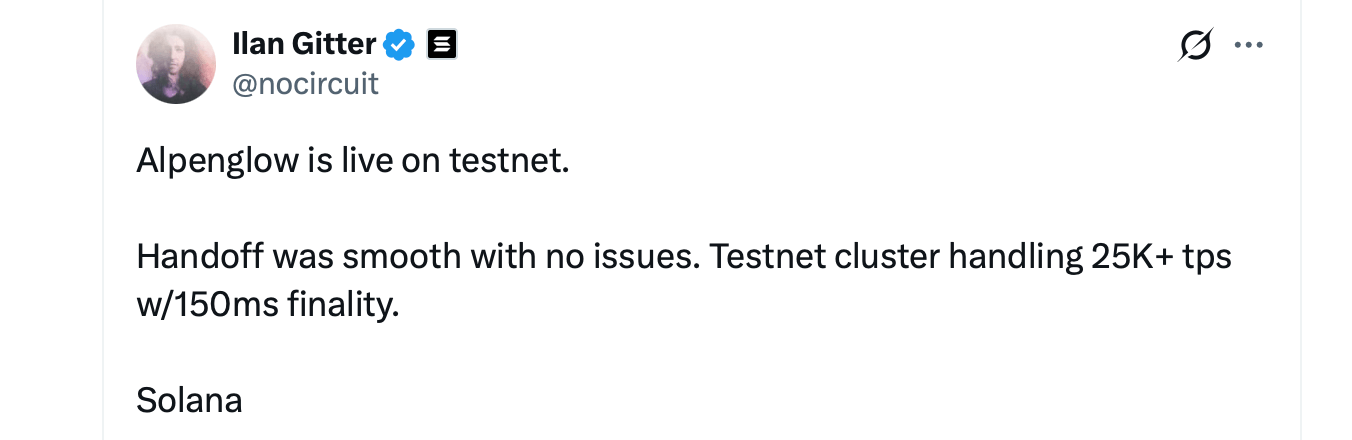 Image source: X
Anza is warning infrastructure providers to prepare. Indexers must distinguish competing candidate banks until final certification, while Geyser and gRPC consumers receive a new bank_id identifier. Solana Foundation’s Ilan Gitter cited more than 25,000 transactions per second with 150-millisecond finality on the testnet cluster following activation. A tidy figure, certainly, but one measured on a test cluster rather than mainnet.
Mainnet Still Has a Few Hurdles to Clear
The advertised 100-150 millisecond performance comes from simulations and smaller-scale testing. Sustained results across a full public validator set handling live market activity remain unproven. Client diversity presents another complication. Firedancer and Frankendancer haven’t implemented Votor, leaving the first public transitions dependent on Agave 4.3.
Anza wants developers testing integrations throughout an observation period before any mainnet-beta migration. No firm activation date has been announced. Sept. 28 appears in Agave schedules as a window for resuming feature activations, not a confirmed Alpenglow launch. For Solana, the proposition is straightforward enough. Transactions that currently require seconds to finalize might eventually settle in milliseconds. Whether the exchanges, custodians and infrastructure providers handling those transactions can keep pace is another matter entirely.





 English (US) ·