
 3 months ago
98
3 months ago
98
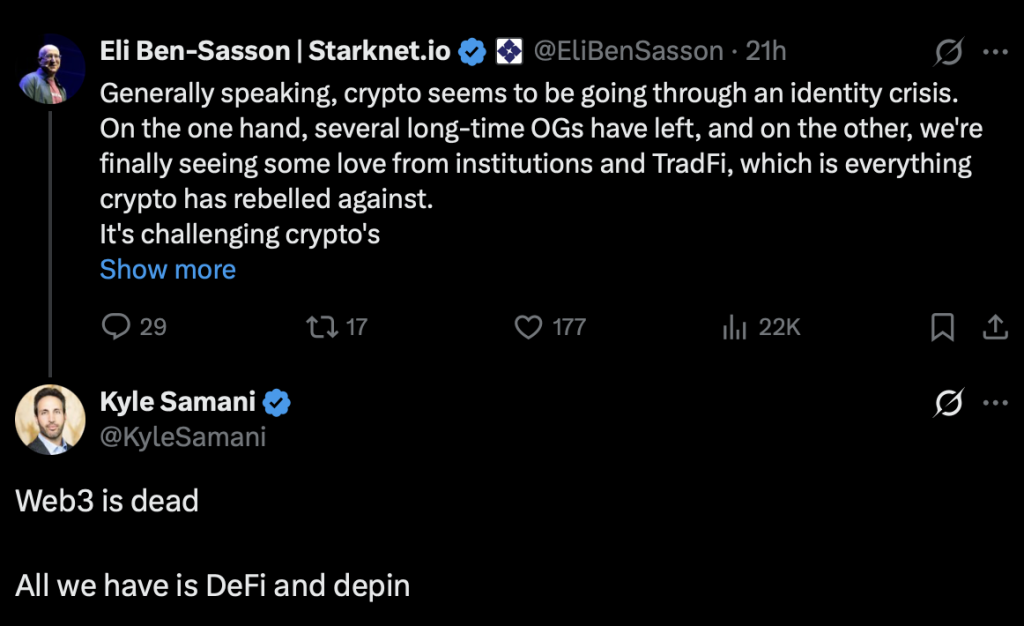
- Solana Treasury Chairman Kyle Samani sparked debate by claiming Web3 has lost relevance while DeFi and DePIN continue growing.
- Many Web3 applications have struggled to achieve mainstream adoption despite years of investment and development.
- Investors are increasingly focusing on sectors with measurable utility, including DeFi, DePIN, and tokenized real-world assets.
A bold statement from Kyle Samani, co-founder of Multicoin Capital and chairman of Solana Treasury, has reignited one of crypto’s oldest debates. In a post that quickly spread across the industry, Samani argued that “Web3 is no more,” adding that decentralized finance (DeFi) and decentralized physical infrastructure networks (DePIN) may now represent the most viable paths forward for blockchain adoption.
The comment immediately divided opinion. Some dismissed it as an oversimplification, while others quietly admitted there may be more truth behind the statement than many would like to acknowledge. After all, years of hype, billions in funding, and countless product launches have yet to produce the mainstream Web3 revolution that many predicted during the last bull cycle.
Whether people agree with Samani or not, his remarks highlight a growing shift in how investors evaluate blockchain projects today. Narratives alone are no longer enough. Markets increasingly want proof.
What Happened to the Web3 Vision?
Not long ago, Web3 was arguably the most powerful narrative in crypto.
The promise was ambitious. Blockchain technology would power decentralized social networks, gaming ecosystems, creator economies, digital ownership platforms, and entirely new versions of the internet. Venture capital firms poured billions into startups chasing this future, convinced that decentralized applications would eventually challenge the dominance of Big Tech.
For a while, enthusiasm seemed unstoppable.
Yet several years later, reality looks far more complicated. While some projects have built loyal communities, most Web3 applications have struggled to attract sustained mainstream adoption. Blockchain-based social platforms remain niche compared to traditional alternatives. Many play-to-earn gaming projects experienced explosive launches only to lose users once rewards declined. And the dream of hundreds of millions of people interacting with decentralized apps every day still feels distant.
The technology works. The adoption, however, hasn’t quite arrived at the scale many expected.
DeFi Continues to Prove Its Value
While much of Web3 has struggled to gain traction, decentralized finance has remained remarkably resilient.
Unlike speculative concepts that rely heavily on future potential, DeFi already provides clear and measurable utility. Lending platforms, decentralized exchanges, derivatives markets, and yield-generating protocols collectively handle billions of dollars in value every single day.
That practical use case matters.
Users don’t need to be convinced that DeFi might be useful someday. They’re already using it. Capital continues flowing through these systems because they solve real financial problems, offering services that operate around the clock without traditional intermediaries.
This is one reason many investors now view DeFi as one of crypto’s strongest long-term sectors. The products are live, the demand is measurable, and the revenue models are easier to evaluate compared to many consumer-focused Web3 experiments.
DePIN and Real-World Utility Gain Momentum
Another sector attracting growing attention is DePIN, short for decentralized physical infrastructure networks.
These projects connect blockchain incentives with real-world infrastructure such as wireless networks, data storage, computing power, sensors, and connectivity services. Rather than focusing solely on digital interactions, DePIN projects create economic incentives for participants to contribute physical resources.
That approach has resonated with investors.
Many see DePIN as one of the clearest examples of blockchain technology solving tangible problems outside purely financial applications. Instead of asking users to embrace decentralization as an ideology, these networks offer practical benefits that can be measured in performance, efficiency, and cost savings.
As a result, DePIN has emerged as one of the fastest-growing narratives across the broader crypto ecosystem.
Tokenized Real-World Assets Continue Attracting Institutions
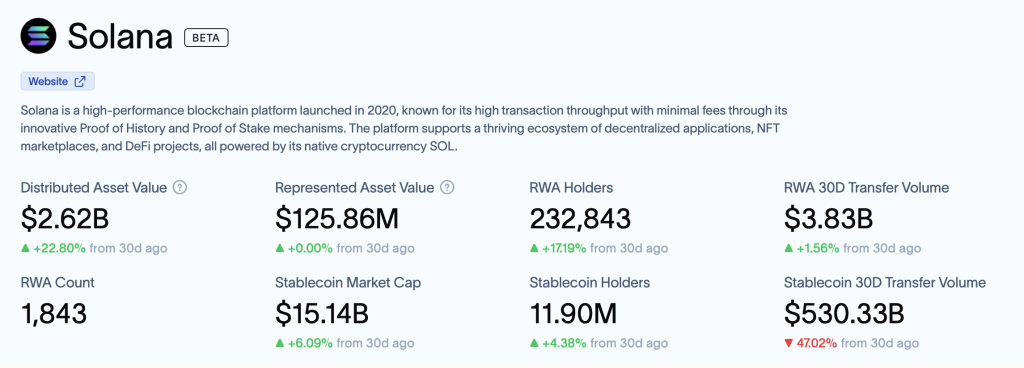
Beyond DeFi and DePIN, another area gathering momentum is the tokenization of real-world assets, often referred to as RWAs.
Banks, asset managers, and financial institutions are increasingly exploring blockchain-based systems for representing traditional assets such as government bonds, Treasury bills, real estate, and private credit products. The appeal is straightforward: faster settlement, improved transparency, lower operational costs, and increased efficiency.
Institutional interest in tokenization has expanded significantly over the past year, helping transform RWAs from a niche concept into one of the industry’s most closely watched sectors.
At the same time, projects like Hyperliquid have demonstrated that crypto-native financial platforms can still achieve substantial growth without relying on traditional Web3 narratives. Prediction markets have also experienced renewed demand, particularly during major political, economic, and sporting events.
In many ways, these sectors highlight a common theme. Utility is winning.
The Market Wants Results, Not Promises
Samani’s comments do not necessarily mean Web3 is dead.
The broader vision of decentralized internet applications remains compelling, and innovation continues across the sector. However, investor priorities appear to be evolving. Rather than funding ambitious ideas based primarily on future possibilities, capital is increasingly flowing toward projects that demonstrate real activity, measurable revenue, and sustained user engagement.
That shift may ultimately be healthy for the industry.
Crypto has matured considerably over the past few years, and markets are becoming more selective about where they place their bets. The strongest sectors today are not necessarily the ones making the biggest promises. They’re the ones generating actual usage, attracting capital, and solving problems that people genuinely care about.
For now, DeFi, DePIN, tokenized assets, and other utility-driven sectors appear to be leading that transition. Whether Web3 eventually reclaims the spotlight remains to be seen, but one thing is becoming increasingly clear: the market is demanding substance over storytelling.
Disclaimer: BlockNews provides independent reporting on crypto, blockchain, and digital finance. All content is for informational purposes only and does not constitute financial advice. Readers should do their own research before making investment decisions. Some articles may use AI tools to assist in drafting, but every piece is reviewed and edited by our editorial team of experienced crypto writers and analysts before publication.







 English (US) ·