
 20 hours ago
23
20 hours ago
23
Here’s something that would have sounded absurd two years ago: Bitcoin is now the calm one.
South Korea’s KOSPI index, the country’s benchmark equity gauge, has become more volatile than Bitcoin over the past several weeks. The index’s annualized realized volatility hit 57%, comfortably above Bitcoin’s 47%.
The numbers tell a striking story
Since early June 2026, daily average price swings on the KOSPI have been running at 3.8%. Bitcoin’s daily moves? Just 1.7%.
KOSPI options-based implied volatility surged to 81% annualized. Bitcoin’s equivalent figure sits around 38%.
The KOSPI triggered market-wide circuit breakers seven times through mid-July 2026. In all of 2025, that number was zero.
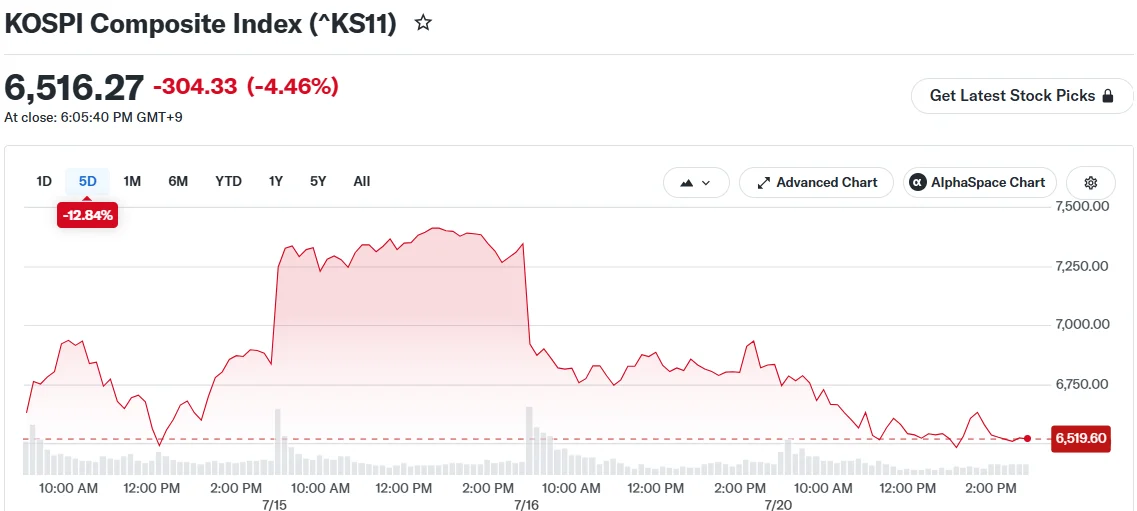
As of July 20, the KOSPI closed around 6,516, dropping roughly 4.5% in a single session. That came after the index peaked near 9,386 in June, meaning it shed more than 30% of its value from peak to recent close.
How did we get here
Two companies, Samsung Electronics and SK Hynix, account for approximately 50% of the KOSPI’s total market value. Those individual stocks have been posting annualized volatilities between 78% and 90%.
The run-up was fueled by AI enthusiasm. South Korea’s semiconductor giants are central to the global AI supply chain, and investors piled in aggressively. The KOSPI more than doubled from its starting point earlier in the year, with gains exceeding 100% at peak levels.
Then two things happened almost simultaneously. Excitement around AI started to cool, and the Bank of Korea hiked interest rates.
South Korean retail investors are heavily leveraged through margin trading. When circuit breakers started firing, forced liquidations likely compounded the selling pressure.
What this means for crypto investors
For institutional allocators who have historically underweighted Bitcoin due to volatility concerns, the KOSPI situation challenges a core assumption. If a major equity benchmark can exhibit realized volatility that’s 10 percentage points higher than Bitcoin, and implied volatility more than double, the “crypto is uniquely risky” argument loses some structural integrity.
The KOSPI’s problems stem partly from having two stocks dominate half its value. The structural issues driving KOSPI volatility — heavy retail participation, margin leverage, and concentrated positions in momentum-driven sectors — aren’t unique to South Korea.
Disclosure: This article was edited by Editorial Team. For more information on how we create and review content, see our Editorial Policy.



 English (US) ·