
 3 months ago
86
3 months ago
86
Key Takeaways
- Trading under ticker SPCX, SpaceX shares jumped approximately 30% above the $135 IPO price on debut day
- With $75 billion raised, the offering shattered Saudi Aramco’s previous IPO record from 2019
- The public listing propelled Elon Musk’s net worth past $1 trillion, a historic first
- Optimistic analysts view the company as an integrated AI and aerospace powerhouse; skeptics highlight the $4.94 billion 2025 loss
- Corporate structure gives Musk 80–85% voting control, raising concerns among institutional investors
Space Exploration Technologies Corporation made its Nasdaq debut Friday trading under SPCX, with shares jumping roughly 30% from the initial public offering price of $135. Early indications placed the opening price near $175, catapulting the company’s market capitalization to roughly $2.29 trillion.
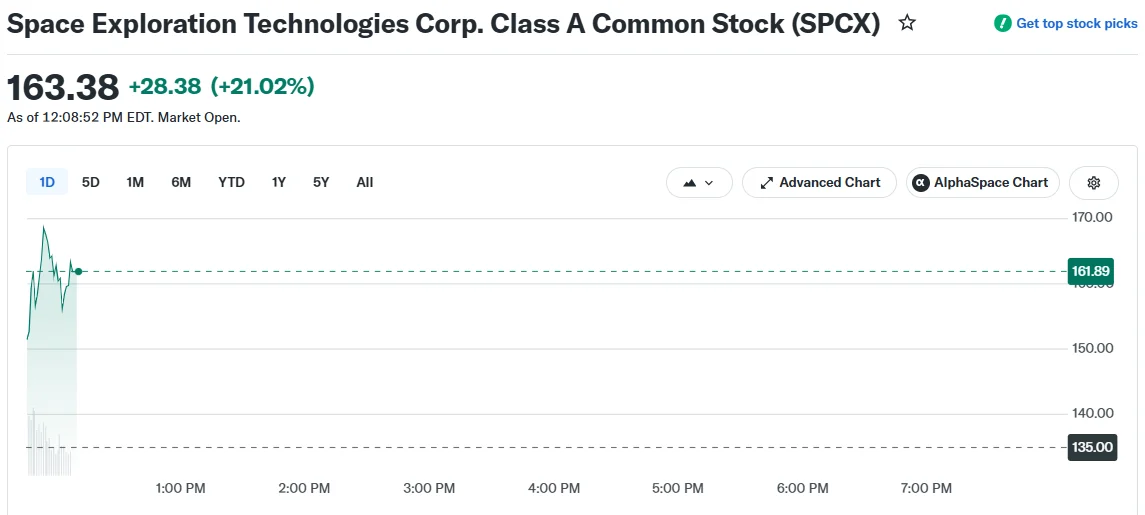 Space Exploration Technologies Corp. Class A Common Stock (SPCX)
The public offering generated $75 billion in capital, establishing a new benchmark as the biggest IPO ever executed. This figure dwarfs the previous record holder, Saudi Aramco, which raised $26 billion five years ago.
From his location at Starbase in South Texas, Elon Musk participated in a ceremonial bell-ringing to commemorate the trading launch. According to Forbes calculations, the listing pushed Musk’s personal wealth beyond the $1 trillion threshold, establishing him as humanity’s first trillionaire.
SpaceX set the share price at $135 and issued 555.56 million shares to the public. Reports suggest retail investor demand exceeded $100 billion, while BlackRock submitted a single institutional purchase order worth $5 billion.
Breaking from convention, the aerospace company reserved 30% of available shares for individual retail investors, a rare allocation in offerings of this magnitude. Management also bypassed the standard roadshow presentations investment banks normally conduct to assess market appetite.
Core Business Operations
Established in 2002, the company’s stated objective centers on establishing human presence across multiple planets. The Starlink broadband internet system now provides connectivity to subscribers in 164 nations and generates approximately 60% of the firm’s $18.67 billion in 2025 revenues.
According to company disclosures, SpaceX launches have represented over 80% of total orbital payload mass during the preceding three years. The Starlink network currently maintains service for around 10.3 million customers through a constellation comprising 9,600 active satellites.
Early in 2026, SpaceX finalized a combination with Elon Musk’s artificial intelligence venture xAI. Oppenheimer emerged as the first prominent financial institution to publish coverage, assigning an outperform recommendation with a $190 price objective. New Street Research established a 12-month valuation target at $165.
Goldman Sachs forecasts envision AI-related revenues potentially expanding 100-fold to reach $322 billion by 2030, though analysts acknowledge substantial uncertainty surrounding these projections.
Skeptical Perspectives
Critical voices question whether current valuations reflect fundamental economics. Morningstar assigned SpaceX an intrinsic value of merely $63 per share, characterizing the public offering as “significantly overvalued.” Finance professor Aswath Damodaran calculated enterprise value at $1.22 trillion, substantially below the IPO-implied valuation.
Prominent short seller Jim Chanos declared the company doesn’t merit a $1.75 trillion valuation “based on any reasonable assumptions.” He observed SpaceX currently trades at approximately 90 times sales, contrasting sharply with Tesla’s 14 times multiple.
Financial statements reveal SpaceX recorded a $4.94 billion net loss during 2025, reversing the $791 million profit generated in 2024. The deficit followed the xAI combination. Revenues climbed 33% compared to the prior year.
Elon Musk maintains an estimated 80–85% of voting authority, substantially limiting public shareholder influence. Pension administrators in California and New York submitted correspondence opposing the offering’s governance framework, highlighting super-voting share classes and compulsory arbitration replacing traditional shareholder litigation rights.
S&P Global rejected requests to expedite SpaceX entry into the S&P 500 index, suggesting passive fund inflows may materialize more gradually than certain market participants anticipated. Nasdaq modified its regulations to permit accelerated inclusion in Nasdaq-affiliated index products, with qualification potentially occurring within 15 days following the listing.
The post SpaceX (SPCX) Goes Public: Elon Musk Hits Trillion-Dollar Net Worth Milestone appeared first on Blockonomi.




 English (US) ·