
 8 months ago
114
8 months ago
114
This article is authored by Arthur Firstov, the Chief Business Officer at Mercuryo, a global leader in crypto payments infrastructure. Arthur is a recognized voice on stablecoins, digital banking, and the convergence of web3 and traditional finance – and this article is based on his insights from partnerships with more than 300 companies, including Circle, Coinbase, Mastercard, Revolut, and Polymarket.
As the digital assets market matures beyond speculation, a new phase of global finance is emerging, one defined by interoperability, compliance, and inclusion. Speaking at Token2049 Singapore 2025, Arthur Firstov outlined how the next evolution of financial systems is closing the gap between decentralized finance (DeFi) and traditional financial institutions.
The conversation focused on a simple idea with big implications: the worlds of crypto and mainstream finance are no longer parallel universes. They are converging to build accessible, efficient, and transparent global markets for both institutional and retail participants.
A Payment Layer for the Digital-Asset Era
“Stablecoins are becoming the new fintech,” says Firstov, who believes that in the next few years, every fintech company will, in effect, be a stablecoin company.
The data supports this trajectory. Recent research shows that stablecoin transfers for payments have already reached roughly $19.4 billion year-to-date in 2025 and are on pace to surpass $1 trillion annually by 2030, just for the emerging payments use cases, not speculative trading. At the same time, McKinsey now estimates that total stablecoin transaction volume across all use cases has already topped $27 trillion a year, putting it on a potential path to overtake legacy networks before the decade is out.
That growth highlights how quickly the narrative has shifted from “crypto trading” to “digital settlement rails.”
“In practice, the experience is seamless. Users can buy digital assets with a debit card or Apple Pay, convert them into stablecoins, send value globally in seconds, and cash out to a bank account,” Firstov explains.
Behind that simplicity is an expanding network of wallets, fintechs, and global payment rails working together to power instant, borderless transfers, the foundation of a new digital-asset settlement layer for the modern economy.
From Skepticism to Scale: Klarna, Tempo and the New Rails
One of the clearest signals that this shift is real comes from names that, until recently, had nothing to do with crypto.
In late 2025, Swedish digital bank Klarna, best known for its “buy now, pay later” services, announced KlarnaUSD, its first U.S.-dollar stablecoin, built on Tempo, a new payments-focused blockchain developed by Stripe and Paradigm.
KlarnaUSD is issued via Bridge’s Open Issuance platform (a Stripe company) and is currently live in test mode, with a full launch on Tempo’s mainnet planned for 2026. Klarna explicitly frames the move as a way to:
– Bypass expensive, slow cross-border payment routes
– Tap into a $120 billion annual cross-border fee pool
– Serve over 100 million existing customers on cheaper, programmable rails
For Firstov, this kind of partnership is exactly what “closing the gap” looks like in practice:
“When a digital bank like Klarna launches a stablecoin on a dedicated payments blockchain, the story is no longer ‘crypto people sending tokens to each other.’ It is mainstream payment companies quietly rewriting their settlement stack on top of stablecoin rails.”
Moves like KlarnaUSD on Tempo sit in the same category as PayPal’s PYUSD and other institution-led experiments: they are early, controlled, and compliance-heavy, but they reveal where the industry expects the real growth to come from.
Who Is Using It and Why
“The digital-assets audience usually consists of blockchain enthusiasts and developers driving innovation in the space,” Firstov says.
But he adds that the user base now extends far beyond tech insiders:
– Digital nomads managing income across borders
– People with families abroad sending remittances
– Aspiring founders and freelancers getting paid globally
– More sophisticated users exploring new digital-asset products and yield opportunities
This variety of users reflects the growing diversity in access. In Latin America and Southeast Asia, where local currencies often face severe volatility, stablecoins are increasingly used as everyday banking alternatives rather than speculative assets.
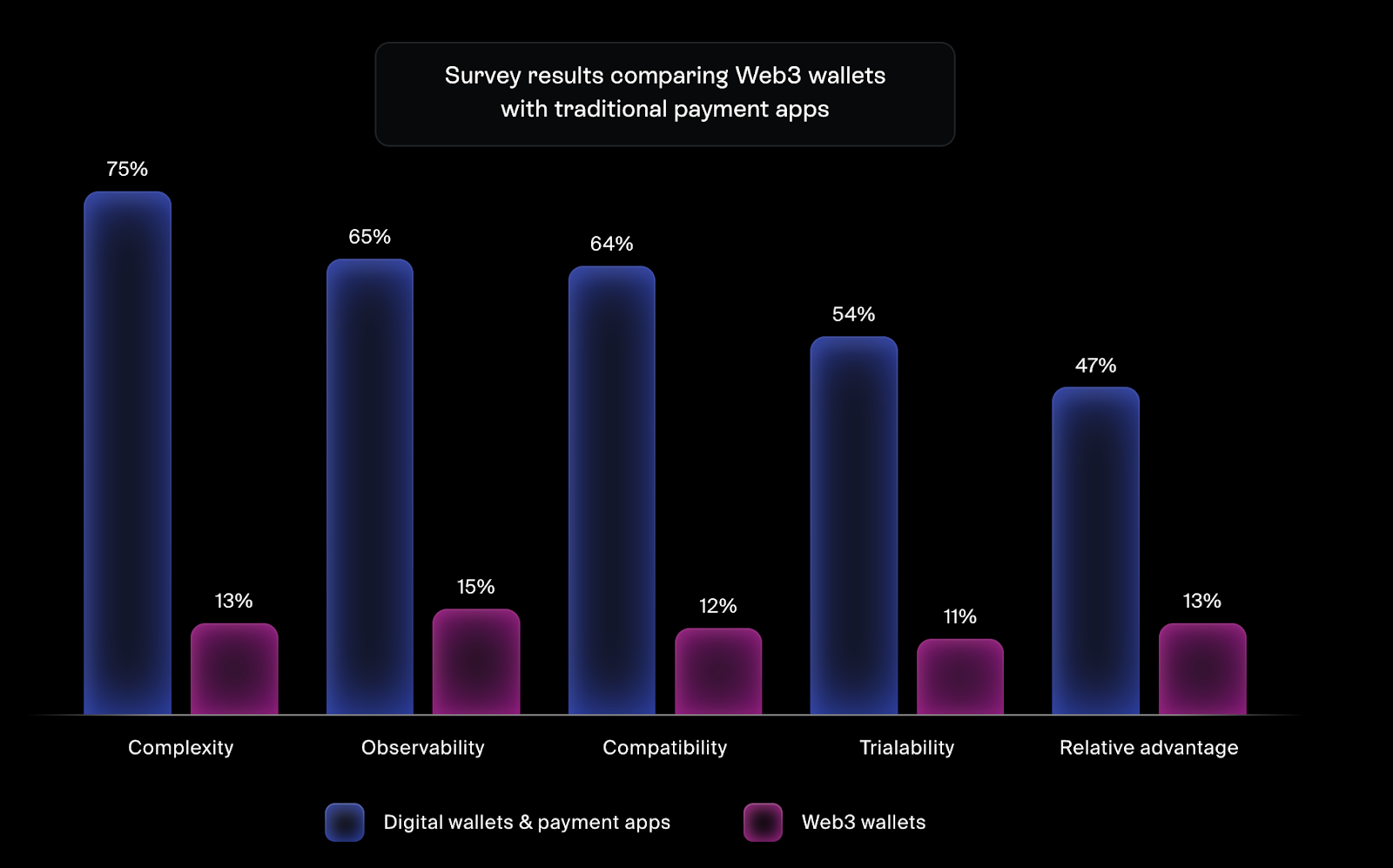 Figure: Survey results comparing web3 wallets with traditional payment apps (Protocol Theory 2025).
The macro numbers underline the shift. The global stablecoin supply has pushed past $300 billion, signaling that this is no longer a niche segment. Meanwhile, new research from Protocol Theory (in partnership with Mercuryo) shows that in the U.S. only 12 percent of adults feel web3 wallets fit their lives, compared with 64 percent for traditional digital wallets. That gap highlights both the remaining friction and the size of the opportunity to make self-custodial experiences as intuitive as the apps people already use every day.
Liquidity, Infrastructure and Market Movement
“The real battlefield today is infrastructure,” Firstov insists. “It does not matter which chain you use; what matters is that the rails work around the clock, globally.”
Recent reports back this up: payment volumes in B2B stablecoin settlements jumped from under $100 million per month in early 2023 to more than $3 billion monthly in early 2025. That kind of growth demands serious plumbing:
– Multi-chain settlement
– Real-time routing
– Robust global compliance and sanctions screening
– Institutional-grade custody and auditability
This is where examples like KlarnaUSD on Tempo are instructive. Tempo is purpose-built for payments, and Klarna is using it not as a marketing gimmick, but as a way to lower settlement costs for merchants and users at scale.
Meanwhile, institutions are waking up more broadly. Tokenized real-world assets (RWAs) could reach $2 trillion by 2028, with stablecoins acting as the underlying “plumbing” that moves value between markets and instruments. Firstov points to ETF-style flows, digital asset token (DAT) liquidity channels, and regulated rails as early previews of what is coming next.
The “Golden Era” for Users
“We are stepping into the golden era for users,” Firstov says. “The biggest financial institutions and blockchain platforms are now competing for distribution. As a result, users can access new financial products and markets, from stablecoins to tokenized assets, with fees near zero and almost no premium.”
That is a bold claim, but the numbers give it weight. Cost reductions of up to 99 percent have been reported in cross-border transfers using stablecoin rails compared to legacy correspondent banking. And as Klarna, PayPal, Stripe, Revolut and others deploy stablecoin-based rails, the playing field is shifting from early adopters to global scale.
In effect, users are getting the upside of institutional competition: cheaper transfers, faster settlement, and access to new products, while the heavy lifting happens behind the scenes in infrastructure.
Final Take
Arthur Firstov and his peers are operating at a rare inflection point. The merging of DeFi, stablecoins, and institutional finance signals a future where money moves anytime, anywhere, instantly, and cheaply.
What once looked like two separate universes, crypto on one side and banks and fintechs on the other, is rapidly becoming a single, programmable financial fabric. KlarnaUSD on Tempo is one concrete example; the next wave will bring more banks, more stablecoins, and more tokenized assets onto similar rails.
As the underlying infrastructure matures, liquidity deepens, and regulatory clarity expands, the promise of programmable money is no longer theoretical. The mission now is not just innovation but inclusion, ensuring that from retail users in Argentina to hedge funds in New York, everyone can plug into the same digital-asset economy.
The post Stablecoins in the Wild: When Fintech Discovers Programmable Money appeared first on BeInCrypto.






 English (US) ·