
 5 months ago
79
5 months ago
79
Key Takeaways
- All three major indices closed lower Friday, with the Nasdaq sliding 1% and extending its correction
- Crude oil prices jumped more than 2%, pushing Brent above $103 per barrel amid ongoing Middle East tensions
- President Trump postponed his Iran strike deadline by 10 days to April 6, but investors remained skeptical
- The S&P 500 headed toward its fifth consecutive weekly drop, the longest streak since spring 2022
- Volatility index climbed to approximately 30, indicating expectations of continued market turbulence
Wall Street extended its downturn on Friday as crude oil prices surged and market participants expressed doubt that Middle East tensions would ease anytime soon.
The Nasdaq Composite declined 1%, sinking deeper into correction territory. The Dow Jones Industrial Average shed approximately 500 points, representing a 1.1% loss. The S&P 500 dropped nearly 1%.
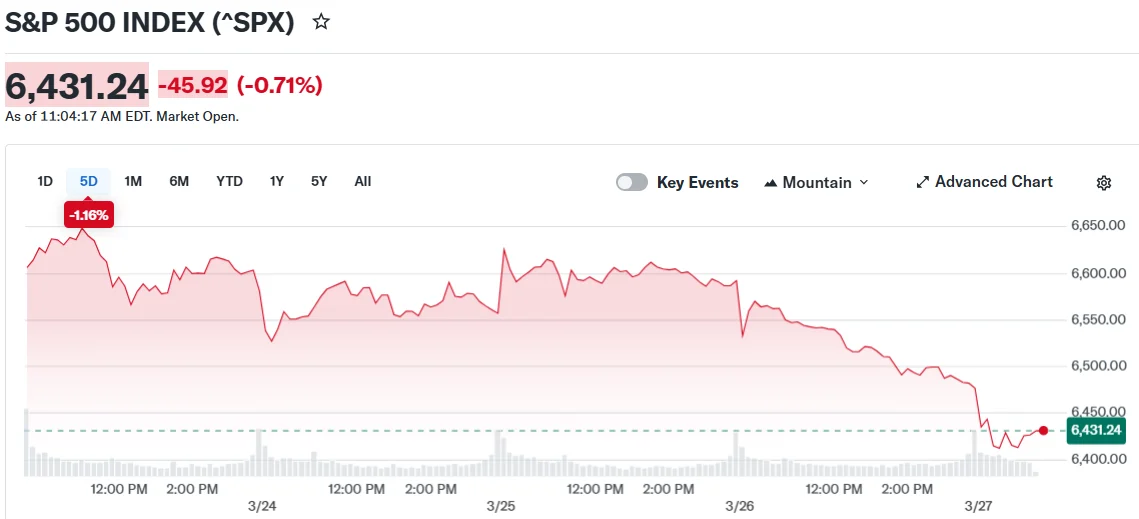 S&P 500 INDEX (^SPX)
The S&P 500 was positioned for its fifth consecutive weekly loss. This would mark the index’s longest stretch of weekly declines since the spring of 2022.
Oil prices served as a primary catalyst for the market downturn. Brent crude surged beyond $103 per barrel. West Texas Intermediate exceeded $97. Both energy benchmarks gained more than 2% during Friday’s trading session.
The energy price spike occurred even after President Trump announced an extension to his Iran ultimatum. He had initially indicated the US would target Iran’s energy facilities if negotiations failed by Friday. On Thursday evening, he moved that deadline to April 6 following an Iranian request.
Investors interpreted the deadline postponement negatively. Market participants expressed concern that the delay merely allows elevated oil prices additional time to damage the worldwide economy.
“It’s another one of those days where futures drift lower throughout the morning as traders follow the new daily routine of getting up, brushing their teeth, and clicking ‘Sell,'” said Paul Hickey, co-founder of Bespoke Investment Group.
Shipping through the Strait of Hormuz has stopped due to escalating conflict, intensifying pressure on energy markets. Iranian officials have thus far rebuffed American diplomatic overtures.
Volatility Index Climbs
The CBOE Volatility Index advanced 2.6 points to reach approximately 30, a threshold that indicates market participants anticipate challenging conditions in coming weeks.
Hickey observed that the Nasdaq is approaching its 10th weekly decline in the past 11 weeks. He emphasized that such persistent downward momentum has only occurred during a handful of periods throughout the index’s existence.
Consumer confidence figures published Friday also revealed increasing negativity among American consumers.
Treasury bond yields showed mixed movement during the session. The 10-year yield reached an eight-month peak earlier this week, with certain market observers suggesting bond market stress might compel Trump to pursue conflict resolution more aggressively.
Senate Approves Funding Measure
Senators approved legislation in the early hours of Friday to finance the TSA and additional Department of Homeland Security functions, although ICE funding was excluded. The legislative action moves closer to resolving a partial government shutdown that has caused airport disruptions and sparked economic concerns.
Gold experienced additional downward pressure from central bank reserve liquidations, based on Friday morning market intelligence.
By midday Friday, the Dow had fallen more than 500 points, the S&P 500 declined approximately 1%, and the Nasdaq dropped 1.3%.
The post Stock Market Slides for Fifth Week Running as Oil Tops $103 on March 27 appeared first on Blockonomi.




 English (US) ·