
 3 hours ago
17
3 hours ago
17
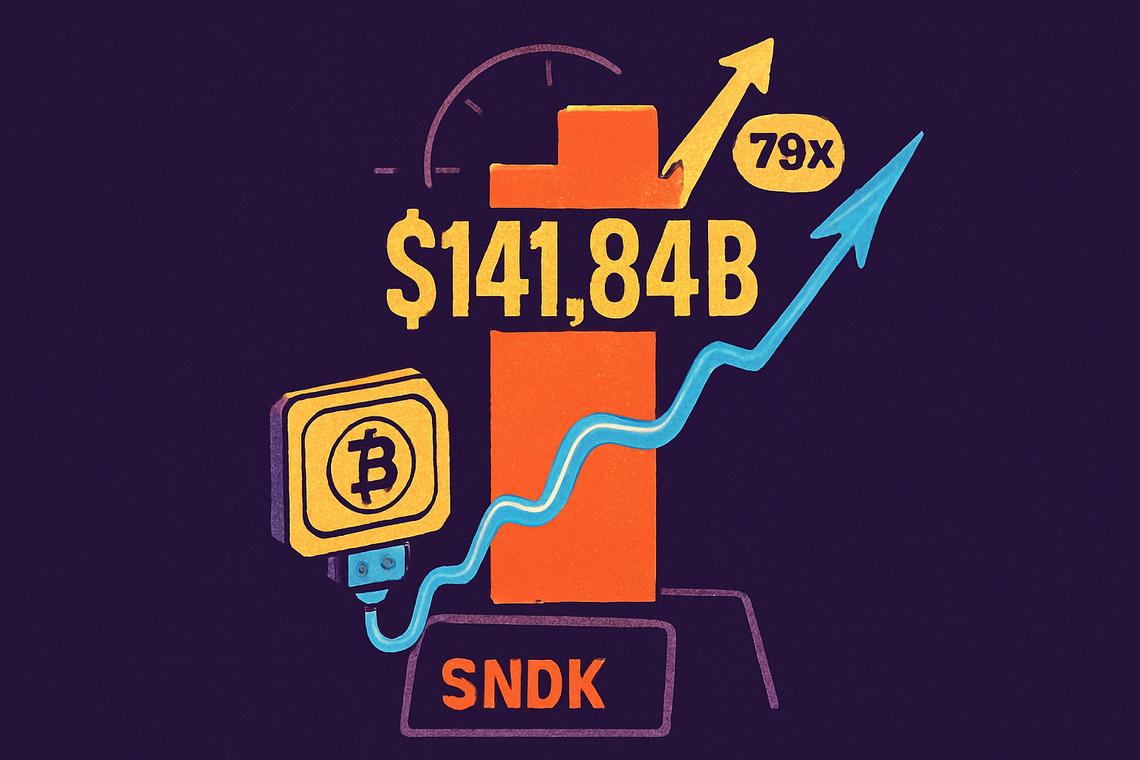
Something unusual is happening at the intersection of Wall Street and crypto exchanges, and the numbers are hard to ignore. Weekly trading volume for stock-linked perpetual contracts on centralized exchanges hit $141.84 billion as of August 16, 2026, according to data from WuBlockchain Data Center. That figure marks the latest data point in a broader stock perpetual trading surge that has reshaped how traders bet on equities without ever touching a traditional brokerage account.
Key takeaways
- Weekly volume for stock-linked perpetual contracts reached $141.84 billion on August 16, 2026 — nearly 79 times the $1.8 billion recorded at the start of the year, per WuBlockchain Data Center.
- Trading has concentrated around SNDK (SanDisk), SKHYNIX (SK Hynix) and SPCX (SpaceX)-linked contracts.
- Weekly open interest climbed from $89 million to $8.29 billion, roughly a 93-fold jump since January 2026.
- SNDK perpetual open interest alone hit $1.73 billion, making it the largest single stock-perpetual market, about 1.86 times SPCX’s $928 million, according to FinanceFeeds.
- Monthly equity-perpetual volume on centralized exchanges rose roughly 17-fold between April and July 2026, per CryptoQuant data cited by BeInCrypto.
Stock-Linked Perpetual Trading Volume Skyrockets in 2026
The scale of this shift becomes clear when you compare where trading stood at the start of the year against where it sits now. Weekly volume has multiplied nearly 79 times in roughly seven months, turning what was once a niche corner of crypto derivatives into a market processing well over a hundred billion dollars a week.
Trading Volume Growth Metrics
At the start of 2026, weekly trading volume for these equity-tied perpetual contracts sat at just $1.8 billion. By August 16, that number had ballooned to $141.84 billion, according to WuBlockchain Data Center. The pace of that expansion outstrips almost anything seen in traditional derivatives markets, and it lines up with separate figures reported by BeInCrypto, which cited CryptoQuant data showing monthly equity-perpetual volume on centralized exchanges rising roughly 17-fold between April and July alone. Different measurement windows explain the gap between the two multipliers, but both point in the same direction: demand for synthetic stock exposure through crypto derivatives has accelerated sharply this year.
Main Assets Driving Trading Activity
Three names have driven most of the action: SNDK (SanDisk), SKHYNIX (SK Hynix) and SPCX (SpaceX). SanDisk in particular has emerged as the standout. Open interest in SNDK perpetuals alone reached approximately $1.73 billion across tracked crypto venues, according to FinanceFeeds, making it the largest stock-perpetual market by outstanding positions — about 1.86 times the $928 million recorded for SpaceX-linked SPCX contracts, the next-largest market in the comparison.
SanDisk’s popularity isn’t happening in a vacuum. The company returned to public markets after separating from Western Digital in 2025 and has since ridden an AI-driven memory boom. Its latest quarter brought in $8.97 billion in revenue, up approximately 372% year over year, while SNDK shares have risen several hundred percent during 2026 on enthusiasm tied to AI infrastructure and surging NAND flash demand. That mix of volatility, retail attention and a recognizable tech story has made it a magnet for leveraged perpetual traders.
Open Interest for Perpetual Contracts Climbs Nearly 93-Fold
Open interest in stock-linked perpetual contracts has grown even faster than trading volume in relative terms, climbing from $89 million to $8.29 billion since the beginning of 2026 — an increase of roughly 93 times, according to WuBlockchain Data Center.
Magnitude and Significance of Open Interest Increase
Open interest measures the total value of positions still outstanding, rather than just how much has changed hands. A near-93-fold increase in that figure suggests traders aren’t simply flipping contracts quickly for short-term gains; they’re holding sizable leveraged positions for longer stretches. That distinction matters because open interest sitting at $8.29 billion represents real, ongoing exposure to price swings in the underlying equities, magnified through leverage rather than direct stock ownership.
This growth hasn’t happened on a single platform. Binance launched USDT-margined perpetual contracts for SanDisk and Micron on April 7, and Coinbase International followed with perpetual futures tied to SanDisk, Micron and Intel. Bybit has expanded its own 24/7 TradFi perpetual offering to cover dozens of stocks and ETFs. Decentralized venues have joined the trend too — on Hyperliquid, SanDisk trades through the Trade[XYZ] HIP-3 market, which processed roughly $113.5 billion in perpetual volume over a recent 30-day period, including about $10 billion in SNDK contracts alone, based on Loris Tools data.
Implications of the Trading Surge for Market Trends
Why does this matter beyond the headline numbers? Because it signals a structural shift in how traders access exposure to U.S. equities, not just a temporary spike in speculative appetite.
Shift Toward Synthetic Equity Exposure
Instead of buying SanDisk or SK Hynix shares directly, traders can now take synthetic price exposure through perpetual contracts that never expire and trade around the clock — including hours when Wall Street exchanges like Nasdaq are closed. That’s a meaningful change. Crypto exchanges spent years refining 24/7 leveraged trading infrastructure for Bitcoin and other digital assets, and that same architecture is now being pointed at traditional equities. The rise of SNDK to the top of the stock-perpetual rankings suggests this infrastructure has found genuine demand well beyond crypto-native assets, effectively exporting a crypto-market feature — continuous, borderless trading — into the equity world.
Risks and Unknowns of Rapid Trading Growth
The available data doesn’t specify exactly which centralized exchanges account for the largest share of this activity, nor does it break down whether the surge is being driven more by institutional desks or retail traders chasing volatility. What is clear is that perpetual contracts run on leverage, margin and funding-rate mechanics, meaning sharp price moves in the underlying stock can trigger forced liquidations far faster than in a standard, unleveraged equity portfolio. A market that has grown 79-fold in trading volume and roughly 93-fold in open interest within seven months is, by definition, a market still finding its footing — and one where sudden volatility could cut both ways for traders holding those positions.
Whether this pace of growth holds through the rest of 2026 or cools off remains to be seen, but the trend so far points to a lasting reshaping of how crypto venues and equity markets intersect, rather than a one-off spike tied to a single stock’s rally.
FAQ
What is the current weekly trading volume for stock-linked perpetual contracts on centralized exchanges?
As of August 16, 2026, weekly trading volume reached $141.84 billion, nearly 79 times higher than the $1.8 billion recorded at the start of the year, according to WuBlockchain Data Center.
Which assets dominated the trading of stock-linked perpetual contracts?
Trading was concentrated on assets including SNDK (SanDisk), SKHYNIX (SK Hynix), and SPCX (SpaceX), with SNDK emerging as the largest single market by open interest.
How has open interest changed for these perpetual contracts since early 2026?
Weekly open interest rose from $89 million at the start of 2026 to $8.29 billion in August 2026, an increase of roughly 93 times, per WuBlockchain Data Center.
What does the surge in trading volume and open interest indicate?
It points to a significant increase in trading activity on centralized exchanges and growing demand for round-the-clock synthetic price exposure to U.S. stocks through crypto perpetual futures, rather than direct equity ownership.
Article produced with the assistance of artificial intelligence and reviewed by the editorial team.





 English (US) ·