
 3 months ago
94
3 months ago
94
- Strategy’s first publicized Bitcoin sale has triggered a major resolution dispute on Polymarket.
- The company sold 32 Bitcoin between May 26 and May 31, but disclosed the transaction in a June 1 filing.
- More than $14 million is tied to the disputed May 31 prediction market alone, with traders awaiting a final ruling.
Strategy’s recent Bitcoin sale was already surprising enough. After years of relentless accumulation, the company formerly known as MicroStrategy revealed it had sold 32 Bitcoin to support corporate liquidity obligations. Now, that relatively small transaction has created an entirely different controversy, one involving prediction markets, contract wording, and millions of dollars in disputed wagers.

At the center of the debate is a Polymarket contract asking whether Strategy would sell any Bitcoin by May 31. While the sale itself is no longer in question, the timing of the disclosure has sparked a fierce battle between traders who believe the market should resolve differently depending on how the rules are interpreted.
The Sale Happened Before The Filing
According to Strategy’s June 1 filing, the company sold 32 Bitcoin between May 26 and May 31. The transaction generated approximately $2.5 million and marked the firm’s first operational Bitcoin sale since its tax-related disposal in 2022.
Under normal circumstances, the timing would seem straightforward. The sale occurred before the end of May. However, Polymarket contracts rely on specific resolution criteria, and that is where things become complicated. Although the transaction happened during the final week of May, the public filing confirming it was not released until June 1.
That gap between execution and disclosure has created two very different interpretations of the same event.
Why Traders Disagree
Supporters of the “Yes” outcome argue that the contract should resolve based on when the sale actually occurred. Their position centers on Strategy’s filing, which clearly states the Bitcoin was sold before May 31. They believe the event happened within the contract’s deadline and therefore satisfies the market conditions.
Meanwhile, “No” holders point to the fact that no public information existed before the deadline passed. From their perspective, the sale was unknown to the public until June 1, meaning traders had no way of verifying the event before the market expired.
The disagreement highlights a challenge that occasionally emerges in prediction markets. Sometimes the event itself is clear, but the exact interpretation of timing and evidence becomes far less obvious.
Millions Of Dollars Are At Stake
This is not a minor disagreement among a handful of traders. The May 31 contract alone has generated approximately $14.65 million in trading volume. Combined with related Strategy Bitcoin sale markets covering later deadlines, total volume has approached $25 million.
Before the filing became public, Polymarket traders had already been increasing the odds of a Strategy sale. Earlier in the year, the probability of a Bitcoin sale before year-end sat near 10%. That figure eventually climbed to 84% following comments from Strategy CEO Phong Le about using Bitcoin sales as a potential capital management tool.
Now, the market is no longer debating whether Strategy would ever sell Bitcoin. Instead, it is debating exactly when that sale officially counts.
UMA Will Make The Final Decision
Like many contentious prediction market outcomes, the final ruling will likely come from UMA’s optimistic oracle system, which Polymarket uses to resolve disputed markets. When ambiguity exists, the oracle enters a review process where evidence is examined before a final determination is reached.
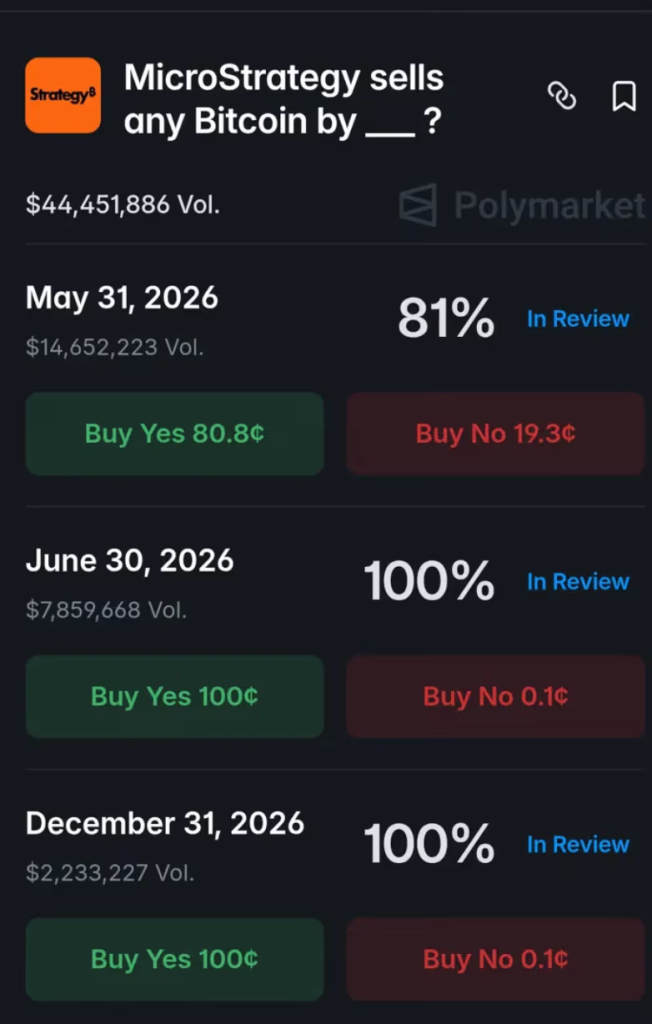
These reviews typically take several days and are designed specifically for situations where contract wording and real-world events do not align perfectly. For traders holding positions in the disputed market, that means waiting while the resolution process plays out.
A Reminder That Rules Matter
The controversy surrounding Strategy’s Bitcoin sale illustrates something prediction market participants often learn the hard way: the details matter. Sometimes more than the event itself.
Everyone now agrees that Strategy sold Bitcoin before the end of May. The question is whether the market should resolve based on when the sale happened or when the public learned about it. That distinction may end up determining the outcome of millions of dollars worth of wagers.
As prediction markets continue growing in popularity, disputes like this are likely to become more common. After all, markets are easy when everyone agrees on the facts. The real challenge begins when everyone agrees on the facts but disagrees on what they mean.
Disclaimer: BlockNews provides independent reporting on crypto, blockchain, and digital finance. All content is for informational purposes only and does not constitute financial advice. Readers should do their own research before making investment decisions. Some articles may use AI tools to assist in drafting, but every piece is reviewed and edited by our editorial team of experienced crypto writers and analysts before publication.








 English (US) ·