
 1 month ago
29
1 month ago
29
A fresh round of XRP speculation is building around an old question: what happens if SWIFT’s modernization push ends up intersecting with infrastructure built for blockchain-based settlement? In a post on X on March 10, DropCoin developer Bird argued that the market may be underestimating how ISO 20022, tokenization, and shared-ledger infrastructure could eventually strengthen the case for the XRP Ledger in institutional finance.
Bird’s core point is not that SWIFT is about to replace its own network with XRP or the XRP Ledger. It is that the direction of travel across global payments increasingly points toward a split between messaging and settlement, with SWIFT preserving its role as the coordination layer while value moves across newer rails.
“My thoughts on SWIFT potentially utilising the XRP Ledger don’t come from random speculation,” Bird wrote. “They come from watching how the infrastructure around global payments has been evolving over the last several years. First, SWIFT themselves have repeatedly demonstrated and showcased blockchain partners involved in their experiments around cross border payments, tokenisation and interoperability.”
Could SWIFT’s Strategy Be Bullish For XRP Price?
That framing matters because Bird is not building the argument around a single rumor or one-off partnership. Instead, he points to overlap between firms appearing in SWIFT-related blockchain experiments and companies that already have ties to Ripple or infrastructure connected to the XRP Ledger. In his view, that overlap is not proof of future integration, but it is enough to keep the possibility on the table.
The second pillar of the argument is SWIFT’s ISO 20022 transition, which Bird describes as the largest upgrade in the network’s history. His reading is that modernized messaging standards are arriving just as finance moves toward tokenized assets, instant settlement, and interoperable liquidity networks. In that environment, the market may be too focused on whether SWIFT will “use XRP” directly, and not focused enough on the possibility that blockchain-based settlement layers could sit alongside SWIFT’s messaging stack.
Bird put it more bluntly in a longer passage: “SWIFT could continue acting as the secure messaging layer, while financial institutions settle value using tokenised assets on networks such as the XRP Ledger. In that model, XRP can function as a neutral bridge asset for liquidity and settlement, while SWIFT continues orchestrating the communication between banks through ISO 20022 messaging. In other words, messaging and settlement don’t have to live in the same system.”
That hybrid model is the heart of the thesis. Rather than a winner-takes-all contest between legacy finance and crypto rails, Bird sees a more incremental institutional architecture taking shape, one in which large incumbents adapt to avoid disintermediation. He argues that SWIFT has a strong incentive to do exactly that, since its historical dominance came from controlling the messaging layer while the economics of settlement are now being challenged by faster and more flexible systems.
He also points to what he views as the clearest signal in the debate: SWIFT’s recent confirmation that it is adding a blockchain-based shared ledger to its infrastructure stack to support the onchain movement of regulated tokenized value across its network of more than 11,500 financial institutions. For Bird, that does not confirm XRP’s role, but it does confirm the broader direction.
“SWIFT is clearly preparing for a world where tokenised assets move across blockchain infrastructure, while they continue operating as the global coordination and messaging layer,” he wrote. “In that kind of architecture, messaging and settlement become two separate layers of the financial system. Which means settlement could occur on specialised blockchain networks designed for liquidity and asset movement, while SWIFT continues coordinating communication between institutions.”
Bird is careful to stress that he has no insider knowledge and no visibility into the final architecture. That caveat is doing real work here. His post is not evidence of an imminent SWIFT-XRP integration. It is an argument that the industry’s incentives, the technical direction of payment infrastructure, and SWIFT’s own public moves all make the idea less far-fetched than the market may assume, in his opinion.
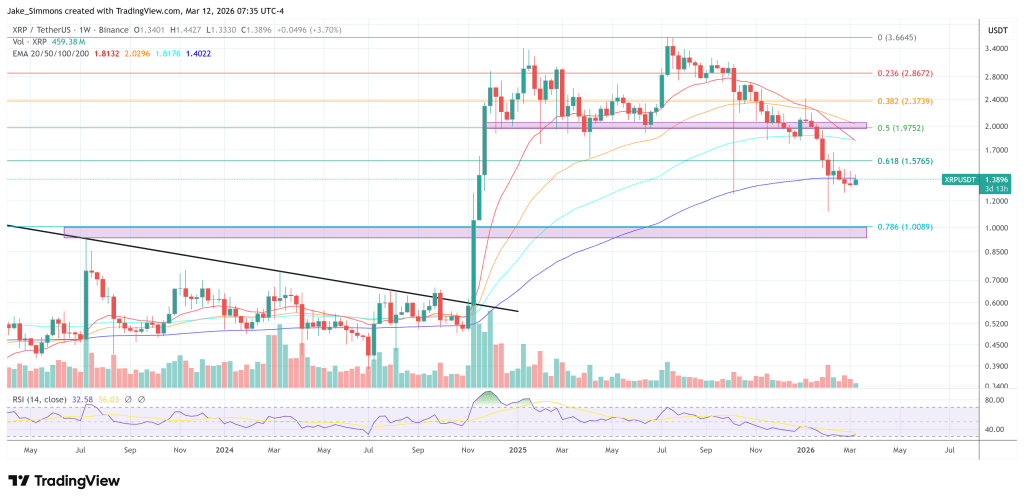
At press time, XRP traded at $1.3896.





 English (US) ·