
 2 months ago
58
2 months ago
58
- Tether is discontinuing Alloy by Tether and its gold-backed dollar stablecoin, aUSDT.
- Users have until September 17, 2026, to redeem aUSDT and recover their underlying XAUT collateral.
- The company says it is shifting resources toward products with stronger adoption and liquidity.
Tether, the issuer of the world’s largest stablecoin USDT, has announced plans to wind down Alloy by Tether and discontinue support for aUSDT, a unique dollar-pegged stablecoin backed by Tether Gold (XAUT). The decision marks another strategic shift as the company focuses on products that have gained broader adoption across the crypto market.
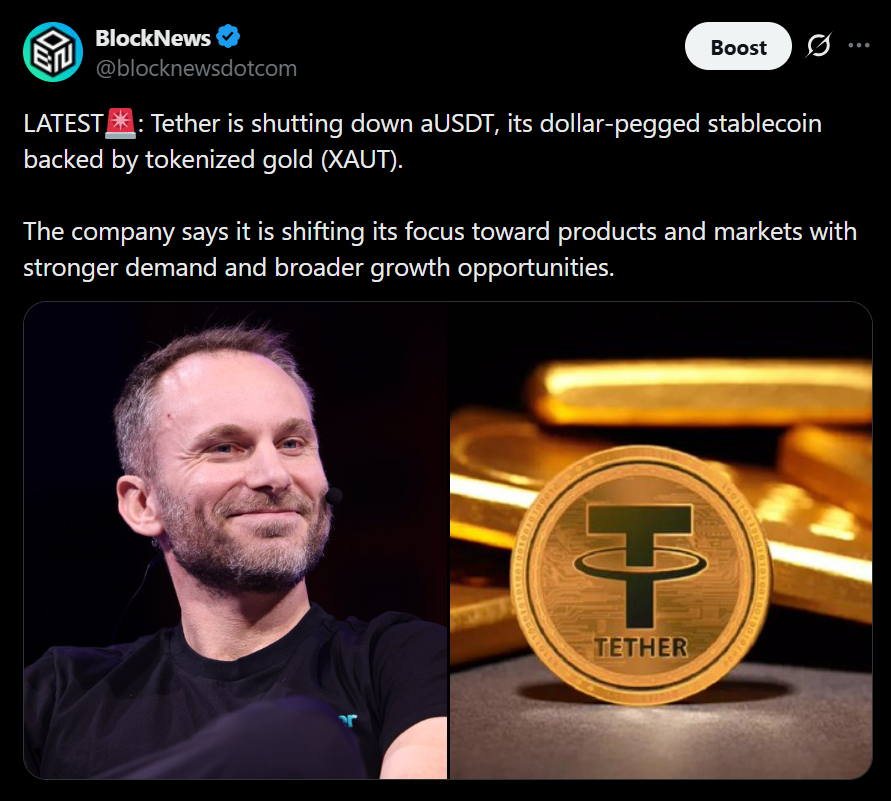
According to Tether, the move follows an internal review of user activity, market demand, and long-term business priorities. While Alloy provided valuable insights into tokenized assets and gold-backed digital products, the company ultimately determined that its resources would be better allocated elsewhere.
Tether Stops New aUSDT Minting Immediately
As part of the wind-down process, Tether has already disabled the creation of new aUSDT tokens and the opening of new positions through the Alloy platform. Existing users, however, will still have an opportunity to close their positions and reclaim their underlying collateral.
The company confirmed that holders can return their aUSDT and withdraw the corresponding XAUT over the next three months. This transition period is intended to give users sufficient time to exit the platform in an orderly manner.
Tether also issued a firm deadline. Any users who fail to redeem their aUSDT by September 17, 2026, will lose the ability to recover their XAUT through the Alloy platform, making timely action essential for current participants.
Why Tether Is Closing Alloy
Although Alloy by Tether represented an innovative experiment in tokenized real-world assets, adoption appears to have fallen short of expectations. Tether said the platform helped the company better understand how users interact with gold-backed financial products and alternative forms of collateralized stablecoins.
Despite those lessons, management concluded that stronger opportunities exist elsewhere in the ecosystem. The decision aligns with Tether’s broader strategy of concentrating resources on products with deeper liquidity and wider market demand.
The move also mirrors a previous decision involving EURT, Tether’s euro-pegged stablecoin. The company phased out support for EURT in 2025 as part of a broader effort to streamline its product portfolio and focus on areas with greater growth potential.
What Exactly Was aUSDT?
Launched in 2024, Alloy by Tether was designed as an open platform for creating digital assets backed by XAUT, Tether’s tokenized gold product. Its flagship asset, aUSDT, offered a different approach to stablecoins by maintaining a U.S. dollar peg while being backed by physical gold exposure.
Unlike traditional stablecoins backed directly by cash or cash equivalents, aUSDT was over-collateralized with XAUT. That means the value of the gold securing the stablecoin exceeded the amount of aUSDT issued, providing an additional layer of stability for holders.
The model attracted interest from users looking for alternative forms of collateralized digital dollars, though it never achieved the scale of Tether’s flagship USDT stablecoin.
Tether Continues Expanding Elsewhere
While Alloy is being retired, Tether remains active in expanding its broader ecosystem. Earlier this year, the company announced plans to launch GELT, a stablecoin tied to the Georgian lari, with support from the Georgian government.
The company also continues to grow its gold-backed token XAUT, which remains one of the largest tokenized gold products in the crypto market. By focusing on offerings with stronger demand and liquidity, Tether appears to be prioritizing scalability over experimentation as competition within the stablecoin sector continues to intensify.
Disclaimer: BlockNews provides independent reporting on crypto, blockchain, and digital finance. All content is for informational purposes only and does not constitute financial advice. Readers should do their own research before making investment decisions. Some articles may use AI tools to assist in drafting, but every piece is reviewed and edited by our editorial team of experienced crypto writers and analysts before publication.


 English (US) ·